[0007]An object of the present invention is to provide a lane marker recognizing apparatus, a vehicle, and a lane marker recognizing program which could improve recognition accuracy of the stud-type lane markers discretely provided on a road.
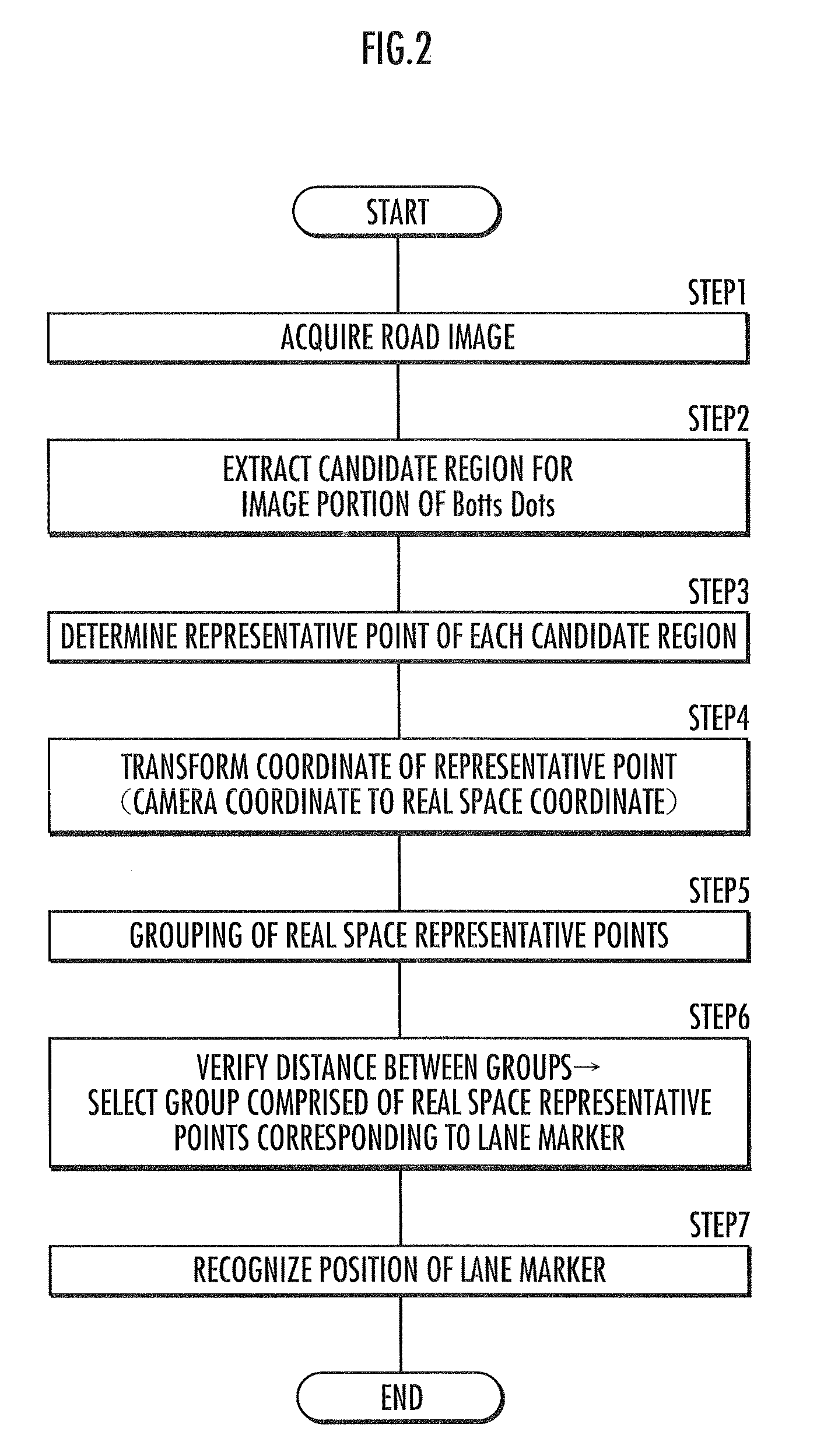
[0011]On the other hand, those real space representative points not included in the group has high possibility of being the position of objects or the like other than the lane marker. Thus, by recognizing the position of the lane marker with the lane marker position recognizing means on the basis of the real space representative points formed into one group by the grouping means, the position of the lane marker can be recognized with good accuracy, while preventing position of objects other than lane marker from being erroneously identified as the position of the lane marker.
[0013]According to this invention, the representative points are grouped by the grouping means on condition that three or more representative points aligned in the same direction exists, therefore the case where the lane marker position is recognized on the basis of the real space representative point which has no consistency in its directionality and has low possibility of being the position of the lane marker may be prevented.
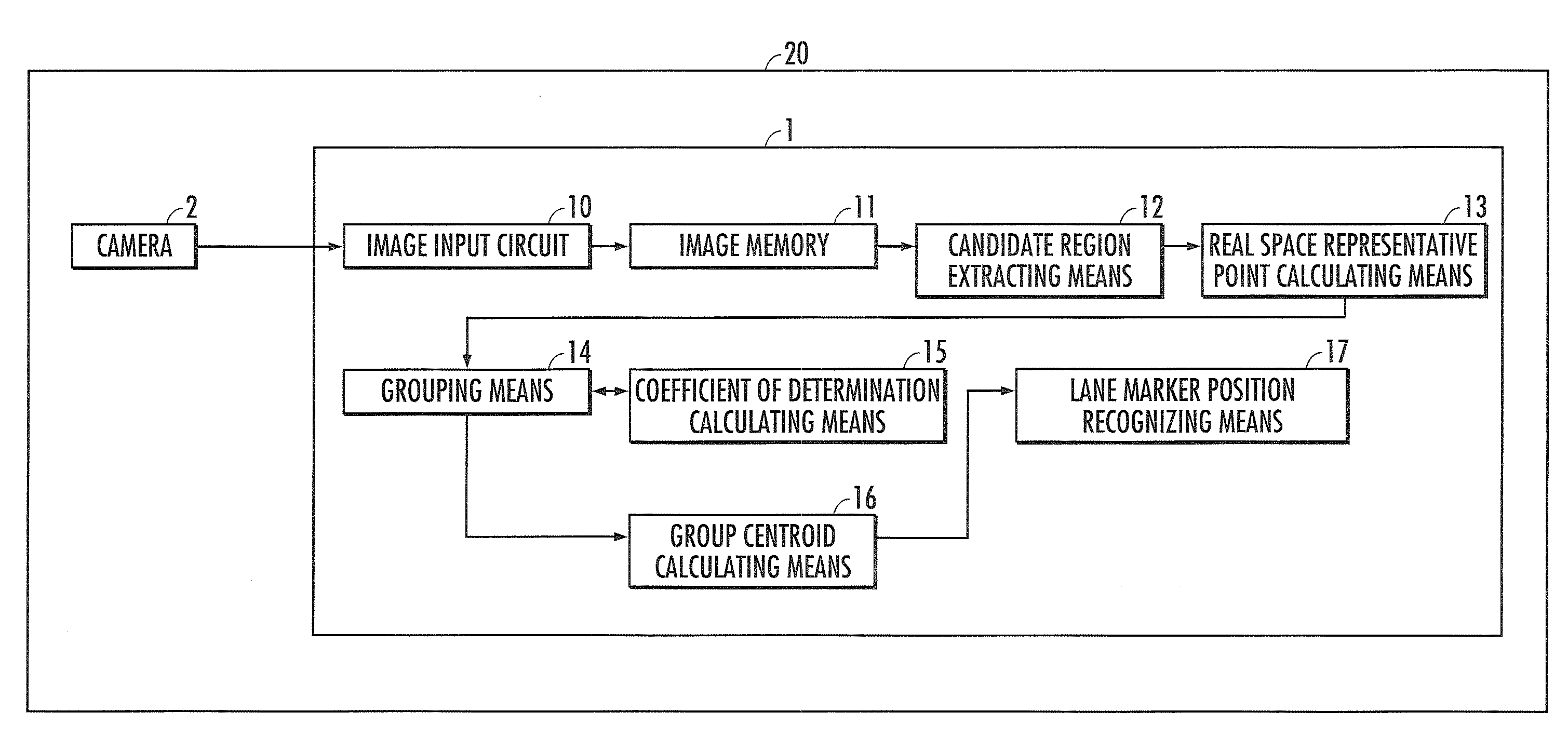
[0015]According to this invention, because the lane markers are provided in a linear fashion or in a curved fashion, it is assumed that the real space representative points calculated on the basis of the image portion of the lane marker are scattered in a linear fashion or in a curved fashion. Therefore, by obtaining the polynomial equation of a predetermined order which approximates a dot sequence of the real space representative points formed into one group by the grouping means to a straight line or a curved line, and calculating the
coefficient of determination which is the coefficient indicating the degree of approximation of the dot sequence of the representative points by the polynomial equation with the
coefficient of determination calculating means, the lane marker position recognizing means recognizes the position of the lane marker on the basis of a plurality of the real space reference points constituting the group having the
coefficient of determination equal to or greater than a predetermined value, so that the recognition accuracy of the position of the lane marker may be improved by excluding the groups comprised of real space representative points having low
linearity or curvilinearity.
[0017]According to this invention, the stud-type lane markers discretely provided are generally defined so that groups comprised of a predetermined number of lane markers provided at a predetermined interval are arranged at a predetermined interval. Therefore, in the case where there exists a plurality of groups having the same number of the real space representative points constituting the group and the distance between the
centroid of the groups is equal to or greater than the first threshold and is less than the second threshold, the lane marker position recognizing means recognizes the position of the lane markers on the basis of the real space representative points constituting such plurality of the groups. By doing so, the position of the lane marker may be determined more accurately by excluding the real space representative point on the basis of the image portion other than the lane marker.
[0024]According to the present invention, as with the lane marker recognizing apparatus according to the present invention explained above, by recognizing the position of the lane marker with the lane marker position recognizing means on the basis of the real space representative points formed into one group by the grouping means, the position of the lane marker can be recognized with good accuracy, while preventing position of objects other than lane marker from being erroneously identified as the position of the lane marker.



 Login to View More
  Login to View More