Check patentability & draft patents in minutes with Patsnap Eureka AI!

Video segmentation using statistical pixel modeling

a statistical pixel modeling and video segmentation technology, applied in closed-circuit television systems, instruments, image analysis, etc., can solve the problems of difficult utilization and inaccurate for small foreground objects, not easy to identify and automatically distinguish, and require excessive processing power and memory

Inactive Publication Date: 2009-12-03
AVIGILON FORTRESS
View PDF102 Cites 138 Cited by
  • Summary
  • Abstract
  • Description
  • Claims
  • Application Information

AI Technical Summary

Benefits of technology

[0022]A “video camera” may refer to an apparatus for visual recording. Examples of a video camera may include one or more of the following: a video camera; a digital video camera; a color camera; a monochrome camera; a camera; a camcorder; a PC camera; a webcam;

Problems solved by technology

It is not an easy thing to identify and automatically distinguish between video objects that are moving foreground and stationary background, particularly in the presence of observer motion, as discussed above.
Known techniques have proven, however, to be difficult to utilize and inaccurate for small foreground objects and have required excessive processing power and memory.

Method used

the structure of the environmentally friendly knitted fabric provided by the present invention; figure 2 Flow chart of the yarn wrapping machine for environmentally friendly knitted fabrics and storage devices; image 3 Is the parameter map of the yarn covering machine
View more

Image

Smart Image Click on the blue labels to locate them in the text.
Viewing Examples
Smart Image
  • Video segmentation using statistical pixel modeling
  • Video segmentation using statistical pixel modeling
  • Video segmentation using statistical pixel modeling

Examples

Experimental program
Comparison scheme
Effect test

first embodiment

1. First Embodiment

Two-Pass Segmentation

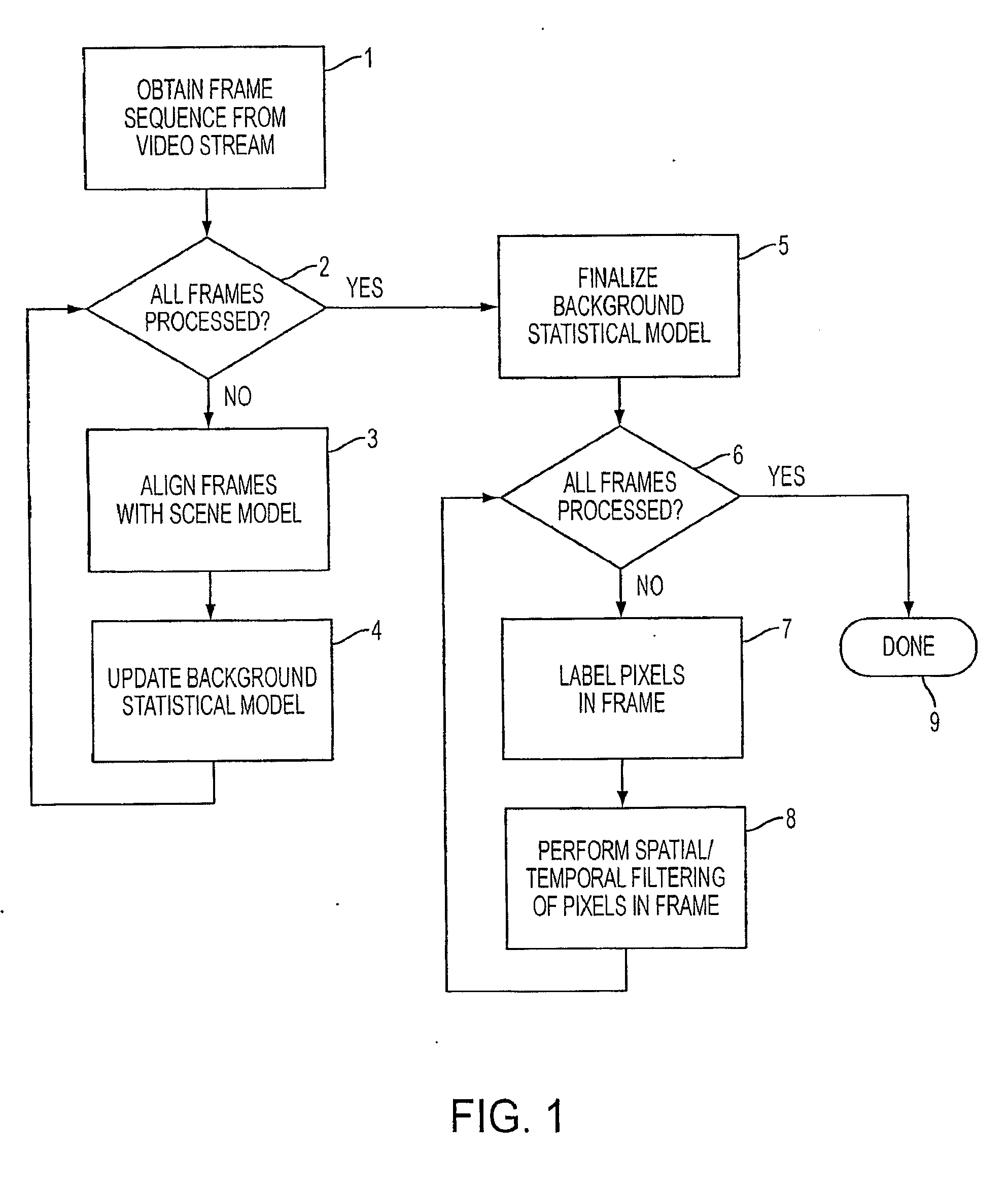
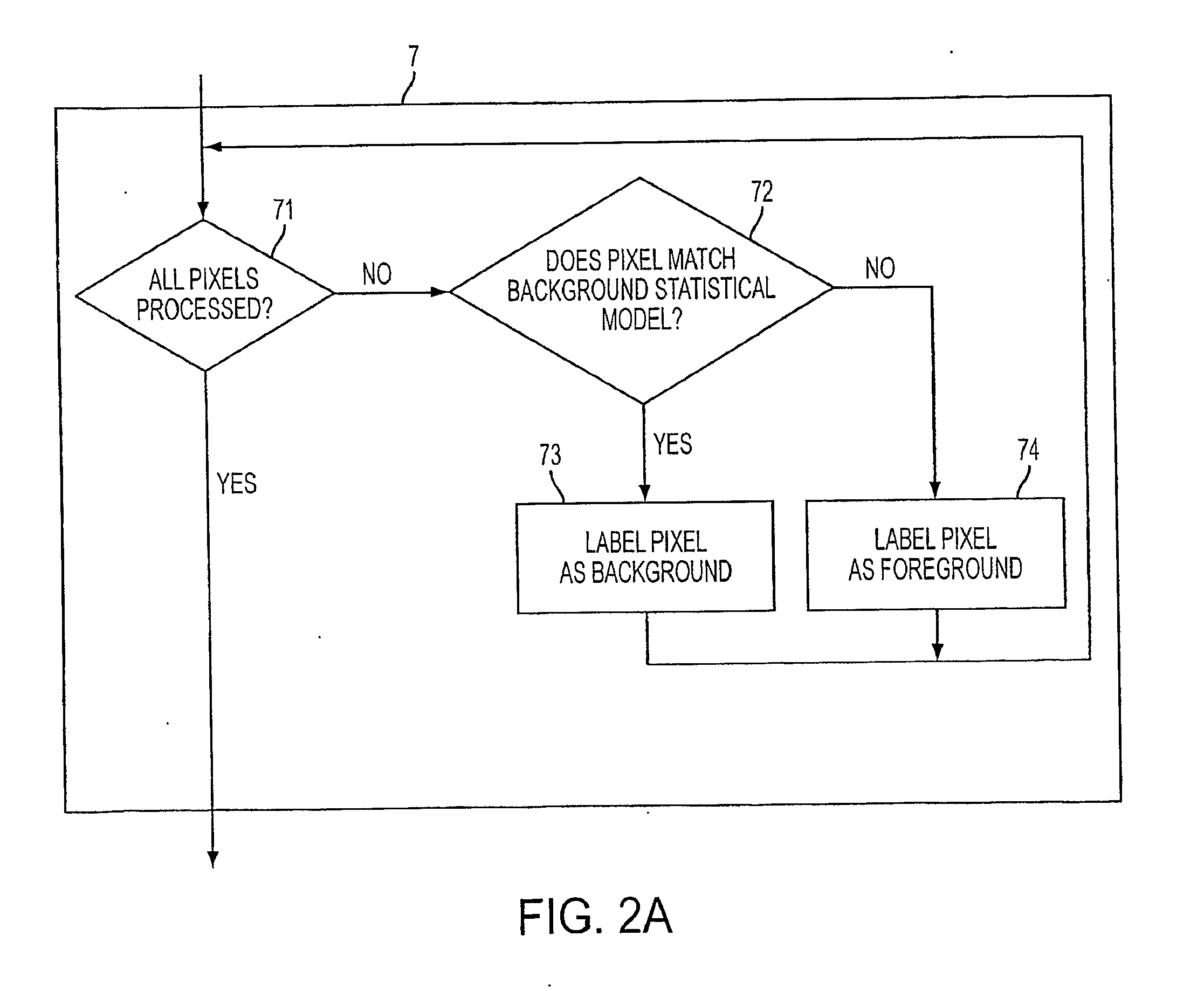
[0042]The first embodiment of the invention is depicted in FIG. 1 and corresponds to a two-pass method of segmentation. As shown in FIG. 1, the method begins by obtaining a frame (or video) sequence from a video stream (Step 1). The frame sequence preferably includes two or more frames of the video stream. The frame sequence can be, for example, a portion of the video stream or the entire video stream. As a portion of the video stream, the frame sequence can be, for example, one continuous sequence of frames of the video stream or two or more discontinuous sequences of frames of the video stream. As part of the alignment step, the scene model is also built and updated.

[0043]After Step 1, in Step 2, it is determined whether or not all frames have yet been processed. If not, the next frame is taken and aligned with the underlying scene model of the video stream (Step 3); such alignment is discussed above as well as in numerous other references.

[...

second embodiment

2. Second Embodiment

One-Pass Segmentation

[0067]FIG. 4 depicts a flowchart of a one-pass segmentation process, according to a second embodiment of the invention. Comparing FIG. 4 with FIG. 1 (the first embodiment), the second embodiment differs in that there is only a single pass of processing for each frame sequence. This single pass, as shown in Steps 2, 3, 31, 32, 8 in FIG. 4, incorporates the processes of the second pass (Steps 5-8 in FIG. 1) with the first pass (Steps 2-4 in FIG. 1), albeit in a modified form, as will be discussed below.

[0068]As in the case of the first embodiment, the second embodiment (one-pass process), shown in FIG. 4, begins by obtaining a frame sequence (Step 1). As in the first embodiment, the process then performs a test to determine whether or not all of the frames have yet been processed (Step 2). Also as in the first embodiment, if the answer is no, then the next frame to be processed is aligned with the scene model (Step 3). As discussed above, the s...

third embodiment

3. Third Embodiment

Modified One-Pass Segmentation

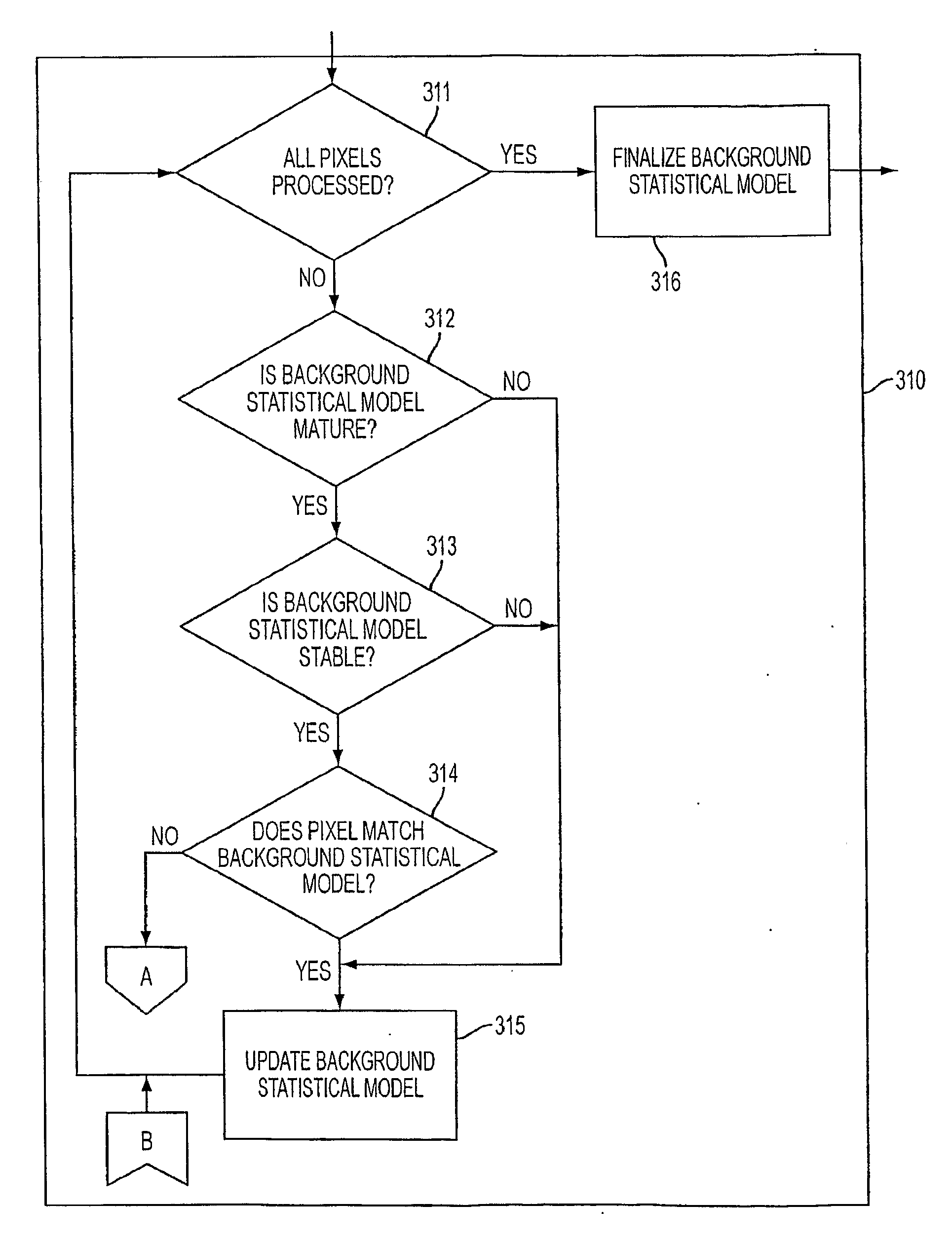
[0092]While the one-pass approach described above has a lower latency than the two-pass approach, it does have a disadvantage in regard to the background statistical model. In particular, the cumulative statistical modeling approach used in the one-pass embodiment of the invention may stabilize on a non-representative statistical model for an element (i.e., pixel, region, etc.; that is, whatever size element is under consideration). If the values (e.g., chromatic values) of frame elements corresponding to a particular element of the video scene fundamentally change (i.e., something happens to change the video, for example, a parked car driving away, a moving car parking, the lighting changes, etc.), then the scene model element will no longer accurately represent the true scene. This can be addressed by utilizing a mechanism for dynamically updating the background statistical model so that at any given time it accurately represents th...

the structure of the environmentally friendly knitted fabric provided by the present invention; figure 2 Flow chart of the yarn wrapping machine for environmentally friendly knitted fabrics and storage devices; image 3 Is the parameter map of the yarn covering machine
Login to View More

PUM

No PUM Login to View More

Abstract

A method for segmenting video data into foreground and background (324) portions utilizes statistical modeling of the pixels Λ statistical model of the background is built for each pixel, and each pixel in an incoming video frame is compared (326) with the background statistical model for that pixel. Pixels are determined to be foreground or background based on the comparisons. The method for segmenting video data may be further incorporated into a method for implementing an intelligent video surveillance system The method for segmenting video data may be implemented in hardware.

Description

FIELD OF THE INVENTION[0001]The present invention relates to processing of video frames for use in video processing systems, for example, intelligent video surveillance (IVS) systems that are used as a part of or in conjunction with Closed Circuit Television Systems (CCTV) that are utilized in security, surveillance and related homeland security and anti-terrorism systems, IVS systems that process surveillance video in retail establishments for the purposes of establishing in-store human behavior trends for market research purposes, IVS systems that monitor vehicular traffic to detect wrong-way traffic, broken-down vehicles, accidents and road blockages, and video compression systems. IVS systems are systems that further process video after video segmentation steps to perform object classification in which foreground objects may be classified as a general class such as animal, vehicle, or other moving but-unclassified object, or may be classified in more specific classes as human, s...

Claims

the structure of the environmentally friendly knitted fabric provided by the present invention; figure 2 Flow chart of the yarn wrapping machine for environmentally friendly knitted fabrics and storage devices; image 3 Is the parameter map of the yarn covering machine
Login to View More

Application Information

Patent Timeline
no application Login to View More
IPC IPC(8): G06K9/34G06V10/28
CPCG06K9/38G06K9/00771G06V20/52G06V10/28G06T7/40H04N7/18G06V10/26
Inventor LIPTON, ALAN J.HAERING, NIELSRASHEED, ZEESHANJAVED, OMARZHANG, ZHONGYIN, WEI HONGVENETIANER, PETER L.MYERS, GARY W.
Owner AVIGILON FORTRESS
Features
  • R&D
  • Intellectual Property
  • Life Sciences
  • Materials
  • Tech Scout
Why Patsnap Eureka
  • Unparalleled Data Quality
  • Higher Quality Content
  • 60% Fewer Hallucinations
Social media
Patsnap Eureka Blog
Learn More