
Light-emitting element and organic electroluminescent display device
a technology of light-emitting elements and display devices, which is applied in the direction of organic semiconductor devices, electroluminescent light sources, electric lighting sources, etc., can solve the problems that the above-mentioned problems cannot be solved
- Summary
- Abstract
- Description
- Claims
- Application Information
AI Technical Summary
Benefits of technology
Problems solved by technology
Method used
Image

Examples
first embodiment
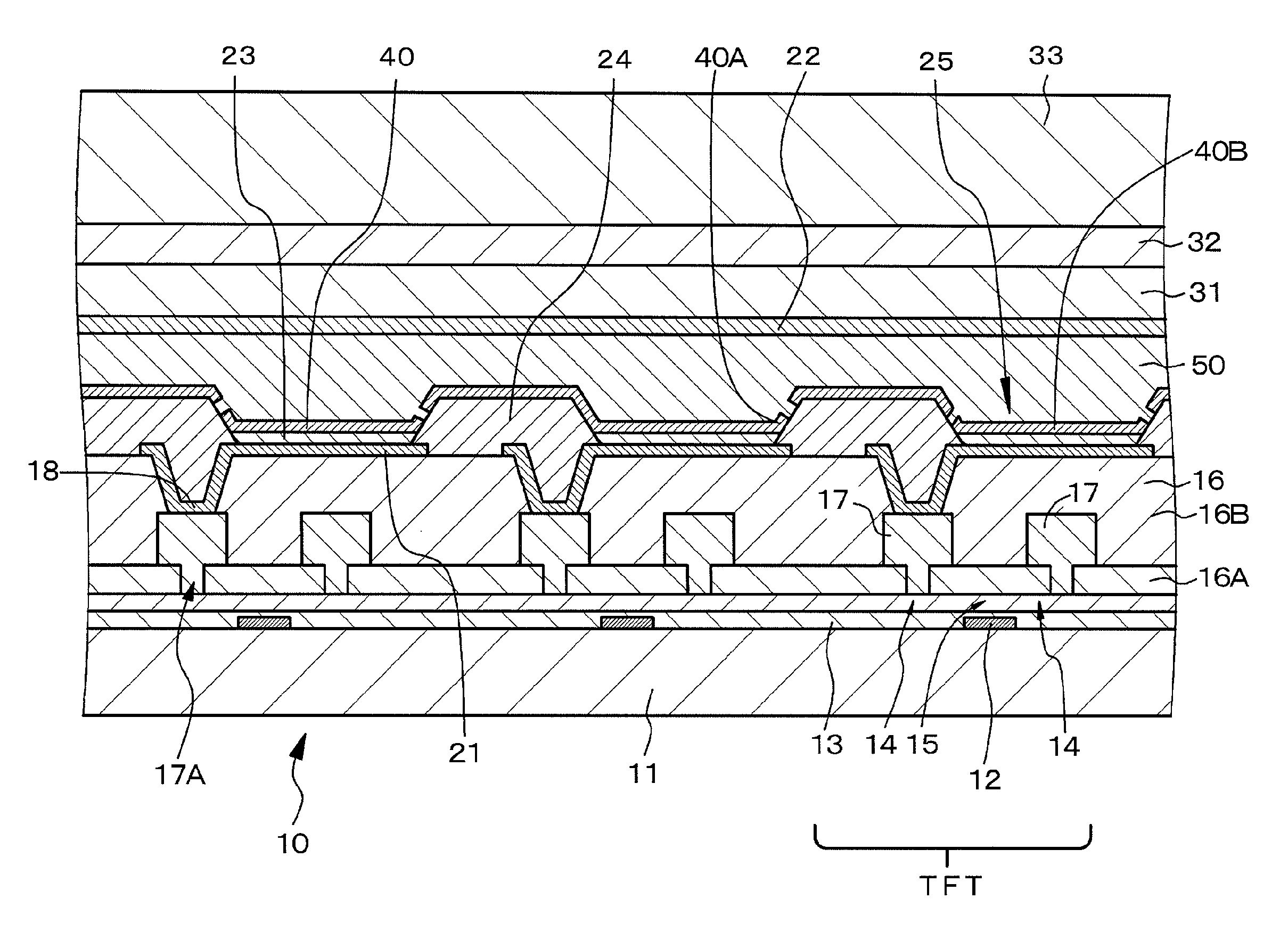
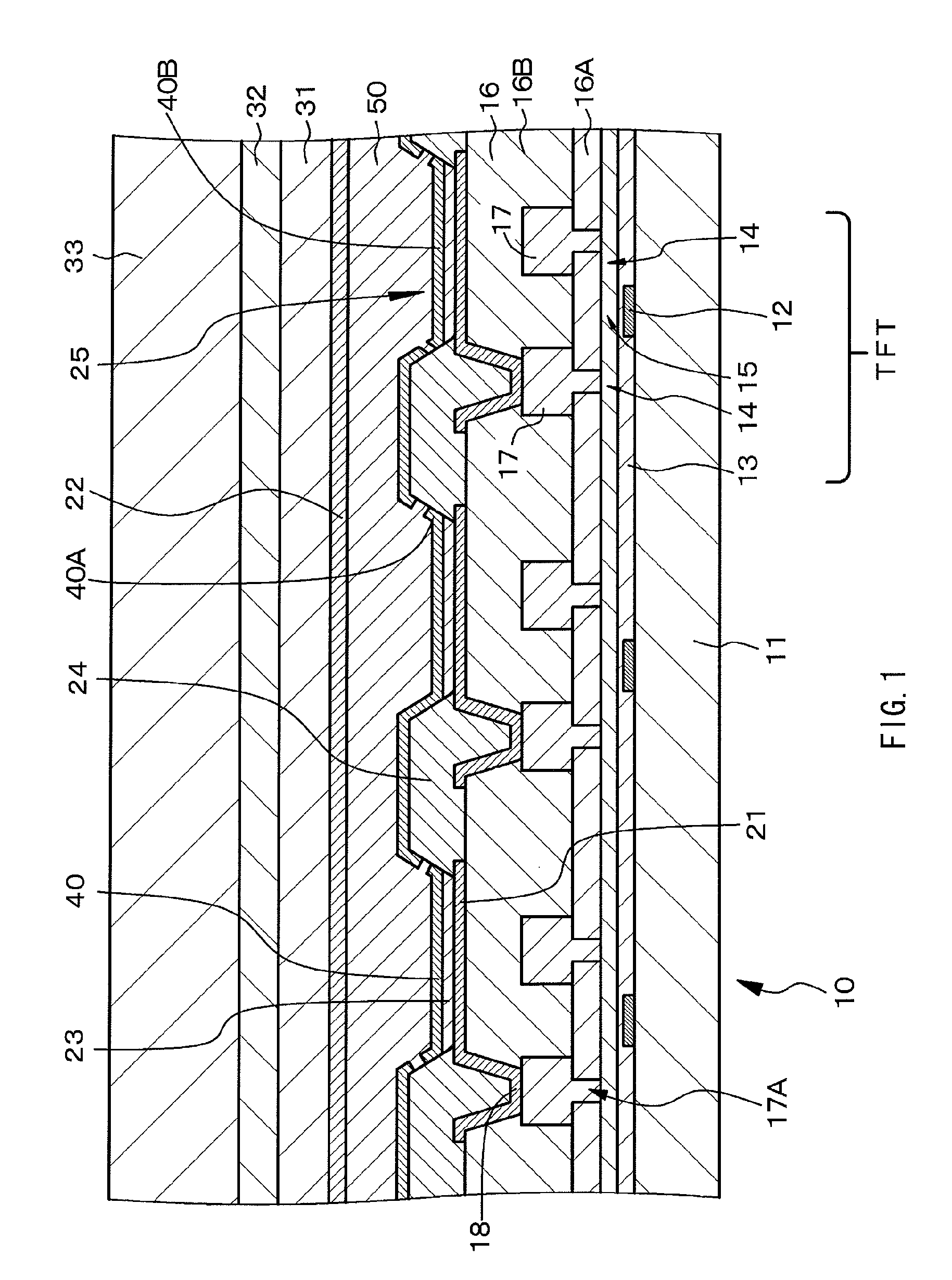
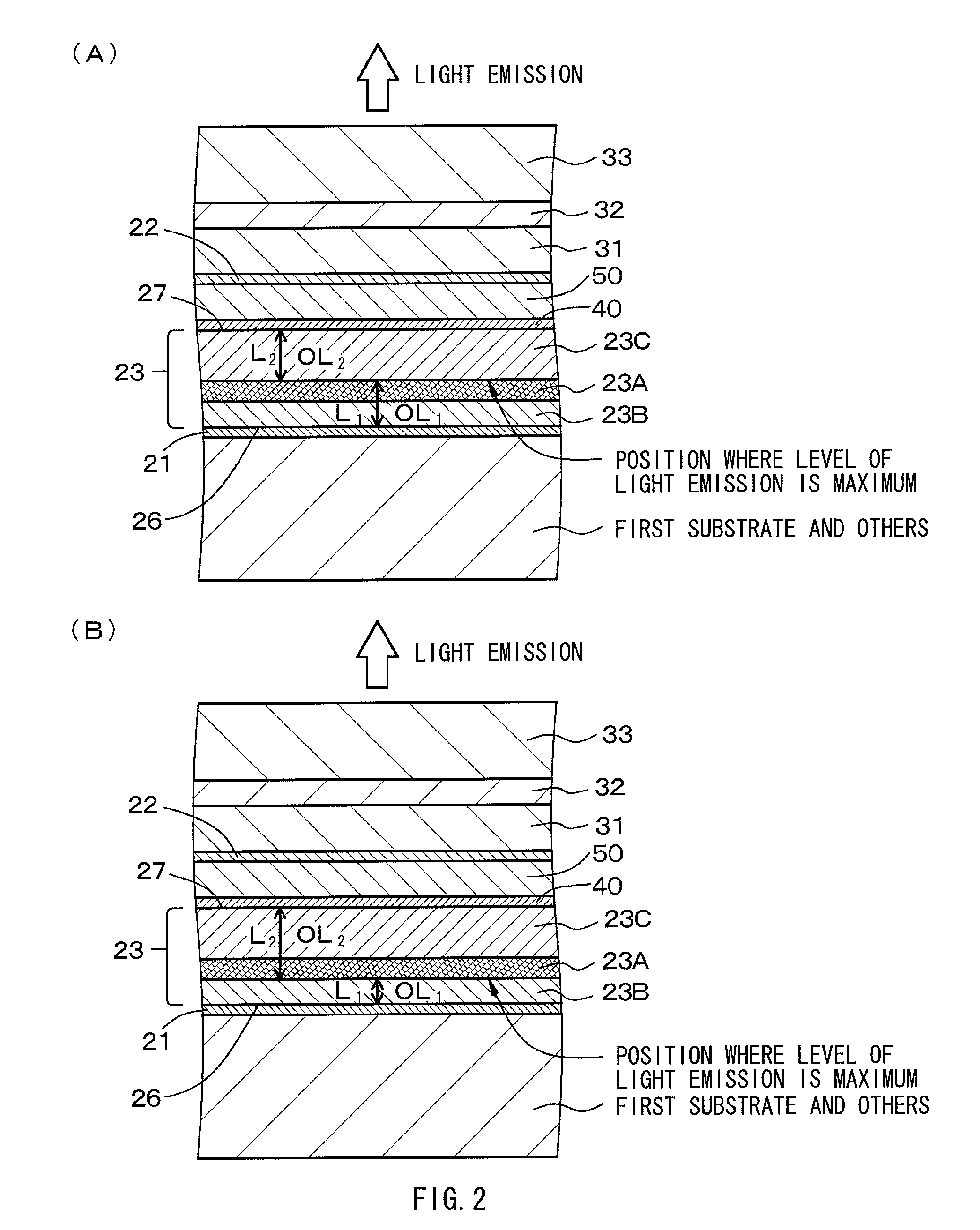
[0071]A first embodiment is related to light-emitting elements in first to sixth aspects of the invention, and to an organic EL display device of the invention. FIG. 1 shows a schematic partial cross sectional view of the organic EL display device of the first embodiment, and FIGS. 2(A) and (B) each show a schematic view of an organic layer or others. The organic EL display device of the first embodiment is an active-matrix organic EL display device for color display, and is of a top emission type. In other words, through a second electrode, and also through a second substrate, a light is emitted.
[0072]The organic EL display device of the first embodiment includes a plurality of (e.g., N×M=2880×540) light-emitting elements (to be specific, organic EL elements) 10. Note that one light-emitting element (organic EL element) 10 configures one sub pixel. Accordingly, the organic EL display device includes (N×M) / 3 pixels. Herein, one pixel is configured by three types of sub pixels, inclu...
second embodiment
[0138]A second embodiment is a modification of the first embodiment, and therein, a resistance layer is in the lamination configuration including first and second resistance layers from the side of an organic layer, and the second resistance layer has the electrical resistivity higher than that of the first resistance layer. In this second embodiment, the first and second resistance layers are both made of Nb2O5, and by changing the partial pressure of oxygen during the film formation by sputtering using Nb2O5, the first and second resistance layers respectively have the values of electrical resistivity R1 and R2 as below.
[0139]Electrical resistivity R1 of First resistance layer: 1×10⁶Ω·m (1×10⁴ Ω·cm)
[0140]Electrical resistivity R2 of Second resistance layer: 1×10⁸ Ω·m (1×10⁶ Ω·cm)
[0141]When the resistance layer is measured for a voltage drop therein, in comparison with the measurement result of voltage drop in a resistance layer configured by a single layer (electrical resistivity:...
third embodiment
[0143]A third embodiment is also a modification of the first embodiment. In the first embodiment, the part of the resistance layer positioned above the red light-emitting sub pixel may have the electrical resistance value (electrical resistance value per unit area of the resistance layer. The same is applicable to below) RR, which is the same as the electrical resistance value RG of the part of the resistance layer positioned above the green light-emitting sub pixel, and as the electrical resistance value RB of the part of the resistance layer positioned above the blue light-emitting sub pixel. In other words, the entire surface is covered uniformly by the resistance layer. Herein, generally, the blue light-emitting sub pixel with a short wavelength of light emission has the optical distance LB shorter than optical distances LG and LR respectively for the green light-emitting sub pixel and the red light-emitting sub pixel each with a longer wavelength of light emission. Therefore, t...
PUM
 Login to View More
 Abstract
Description
Claims
Application Information
 Login to View More