Method for manufacturing a waterproof and vapor-permeable shoe
Active Publication Date: 2012-02-09
GEOX SPA
View PDF9 Cites 15 Cited by
Summary
Abstract
Description
Claims
Application Information
AI Technical Summary
This helps you quickly interpret patents by identifying the three key elements:
Problems solved by technology
Method used
Benefits of technology
Benefits of technology
[0035]The aim of the present invention is to provide a method for manufacturing a waterproof and vapor-permeable shoe that allows to achieve effective sealing of the lasting margins to the assembly insole in a simpler and more effective manner than in currently known methods for manufacturing shoes that are vapor-permeable through a perforated sole.
[0036]Within this aim, an object of the invention is to propose a method that allows to provide upper assemblies, and soles associated therewith, that are structurally simpler and easier to provide with respect to those of currently known shoes that are vapor-permeable through the perforated sole.
[0037]Another object of the invention is to provide a method that allows to provide waterproof and vapor-permeable upper assemblies already during lasting, which therefore do not require the provision of a sole with a waterproof and vapor-permeable membrane that seals in a waterproof and vapor-permeable manner the regions thereof that are perforated or open for vapor permeation.
[0038]Another object of the invention is to propose a method for providing waterproof and vapor-permeable shoes that is simple to perform with relatively low costs.
Problems solved by technology
Currently it is known that even when the upper shoe assembly has a waterproof and vapor-permeable membrane, between the outer layer of the upper and the inner lining without additional refinements, then there is a substantially total lack of waterproofness.
It is in fact particularly difficult to seal the sole to said membrane, since in so-called “AGO lasting” construction the bottom of the shoe is not smooth and flat, as occurs for example in the case of “Strobel” construction, in which the edges of the insole are sewn to the edges of the upper or of the lining laminated with the membrane, but the lasting margins of the upper are superimposed on the assembly insole, creating irregularities along its perimeter.
However, it is not possible to remove these protrusions by means of the common operation of roughing the upper with steel brushes, since this operation might damage the waterproof and vapor-permeable membrane between the upper and the lining.
This production method is not free from aspects that can be improved, since the water absorbed by the outer layer of the upper and wicked inside it can stagnate below the waterproof insole.
Moreover, this construction has an additional drawback if a sole provided with openings is used, since water might enter through said openings and wet the lasting margins of the upper, impregnating it and thus rising toward the foot insertion region.
Moreover, the use of a waterproof and vapor-permeable membrane that covers the entire surface of the insole, if the vapor-permeable surface of the sole does not extend over its entire longitudinal direction, is useless and very expensive.
Since the gasket is made of waterproof and non-vapor-permeable material, this construction is unsuitable with a rubber sole rendered impermeable to water in the liquid state and permeable to water vapor by means of regions that are open or perforated and are covered and sealed with a waterproof and vapor-permeable membrane.
It is well-known that this production method is very complicated and delicate.
Moreover, precise shaping of the sock closed by means of seams and not by lasting on a last is difficult to achieve, both due to difficulty in preparing the several components that must be cut and sewn with accurate precision and due to difficulty in achieving correct tension, without creases, between the upper and the lining.
Method used
the structure of the environmentally friendly knitted fabric provided by the present invention; figure 2 Flow chart of the yarn wrapping machine for environmentally friendly knitted fabrics and storage devices; image 3 Is the parameter map of the yarn covering machine
View more
Image
Smart Image Click on the blue labels to locate them in the text.
Viewing Examples
Smart Image
Click on the blue label to locate the original text in one second.
Reading with bidirectional positioning of images and text.
Smart Image
Examples
Experimental program
Comparison scheme
Effect test
first embodiment
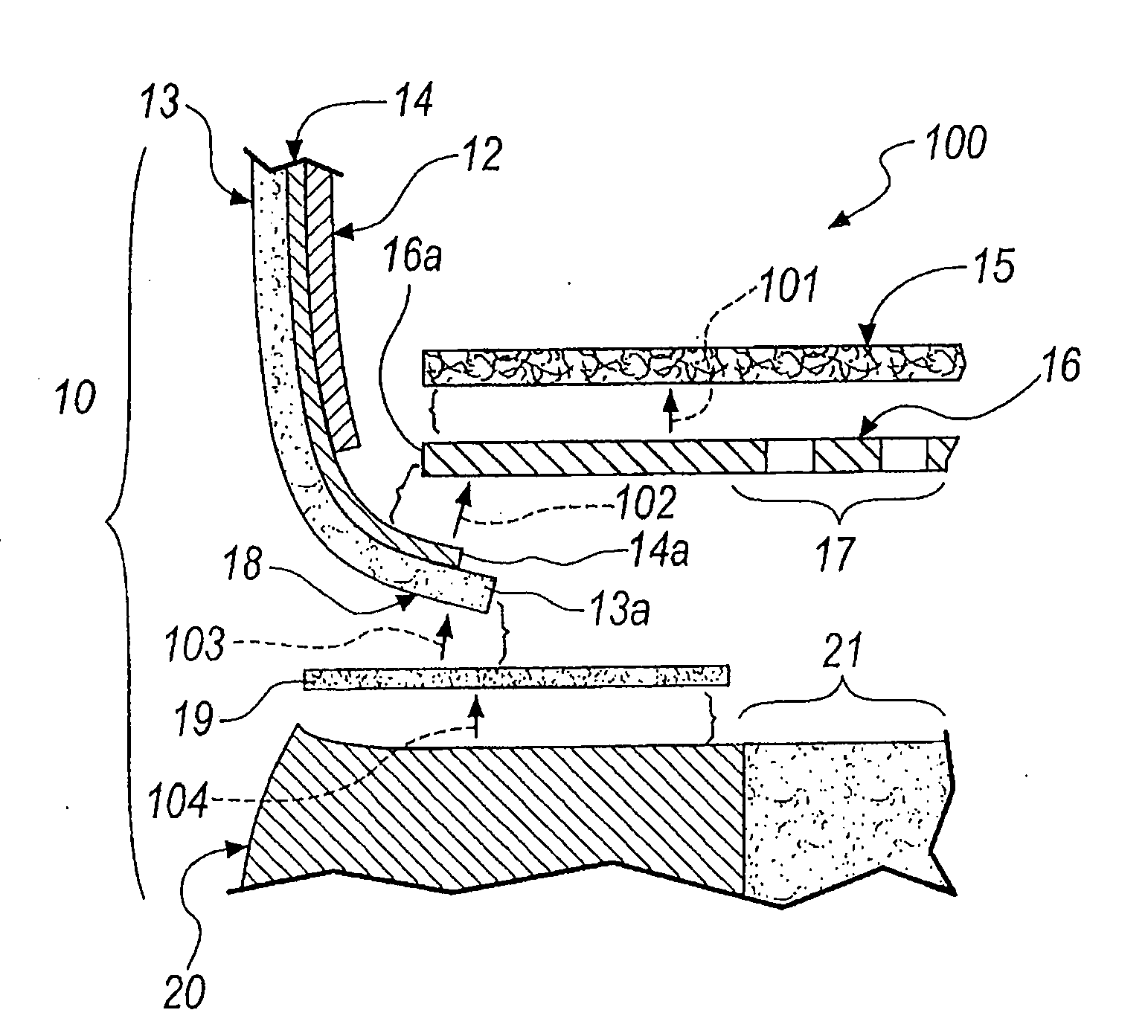
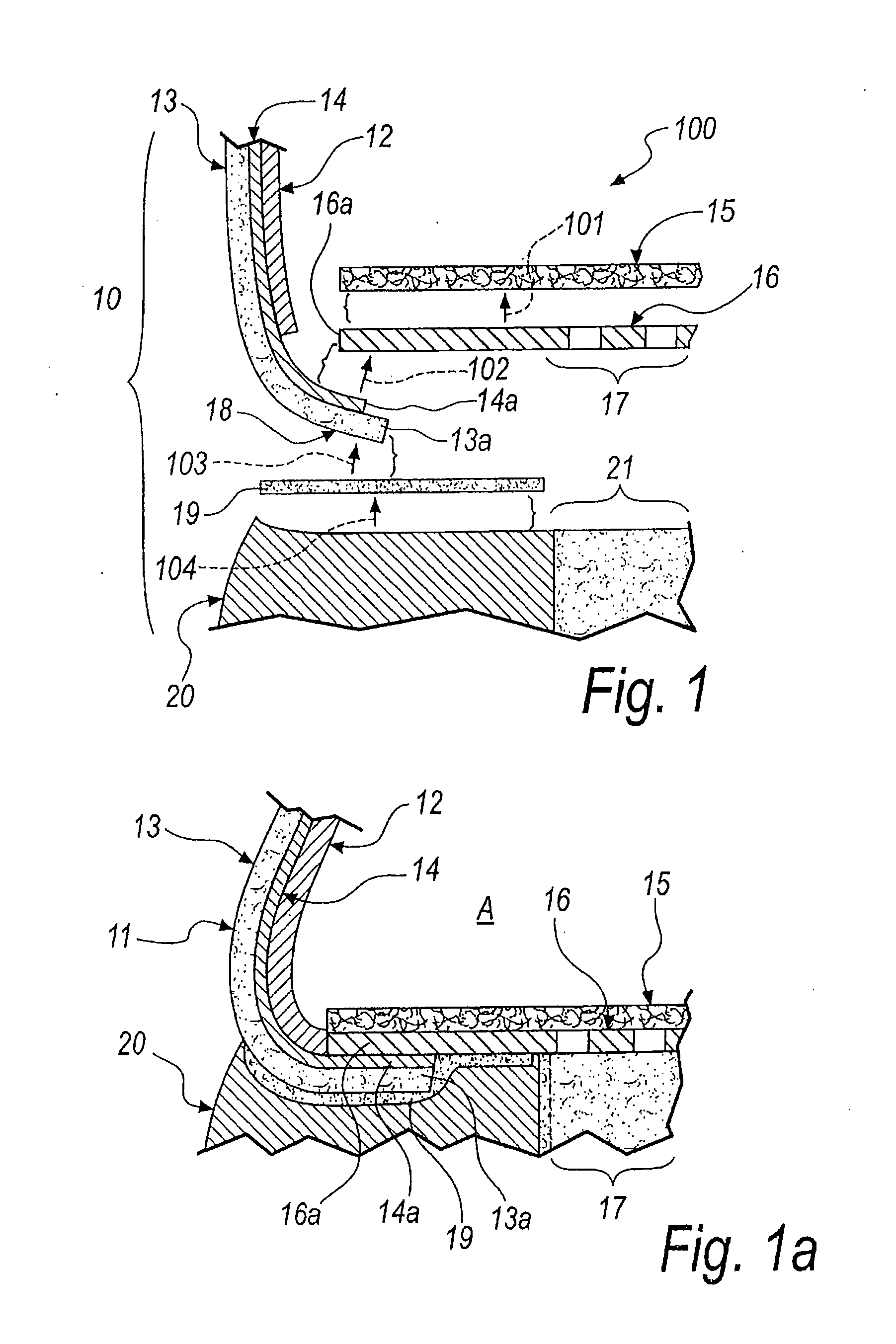
[0062]in a first embodiment, the association of the upper membrane 14 with the upper 13, so as to not compromise their vapor permeability, for example by spot gluing, or as an alternative
second embodiment
[0063]in a second embodiment, the association of the upper membrane 14 with the lining 12, so as to not compromise its vapor permeability, for example by spot gluing or lamination.
[0064]The upper membrane 14 is of the type of commonly commercially available vapor-permeable and waterproof membranes, made for example of expanded polytetrafluoroethylene, also known as e-PTFE, polyurethane, also known as PU, or the like, and a mesh that reinforces it is conveniently associated therewith.
[0065]In order to further strengthen the lower rim 14a of the upper membrane 14, it can be advantageous to apply, directly on the lower rim 14a, a waterproof reinforcement element, not shown in the figures, for example a thermo-adhesive tape, which is preferably elastic and is made of synthetic material, such as for example polyurethane. A tape that is particularly suitable for providing said waterproof reinforcement element is proposed commercially by the company TecnoGI with a weight of 120-250 g / m2.
[0...
third embodiment
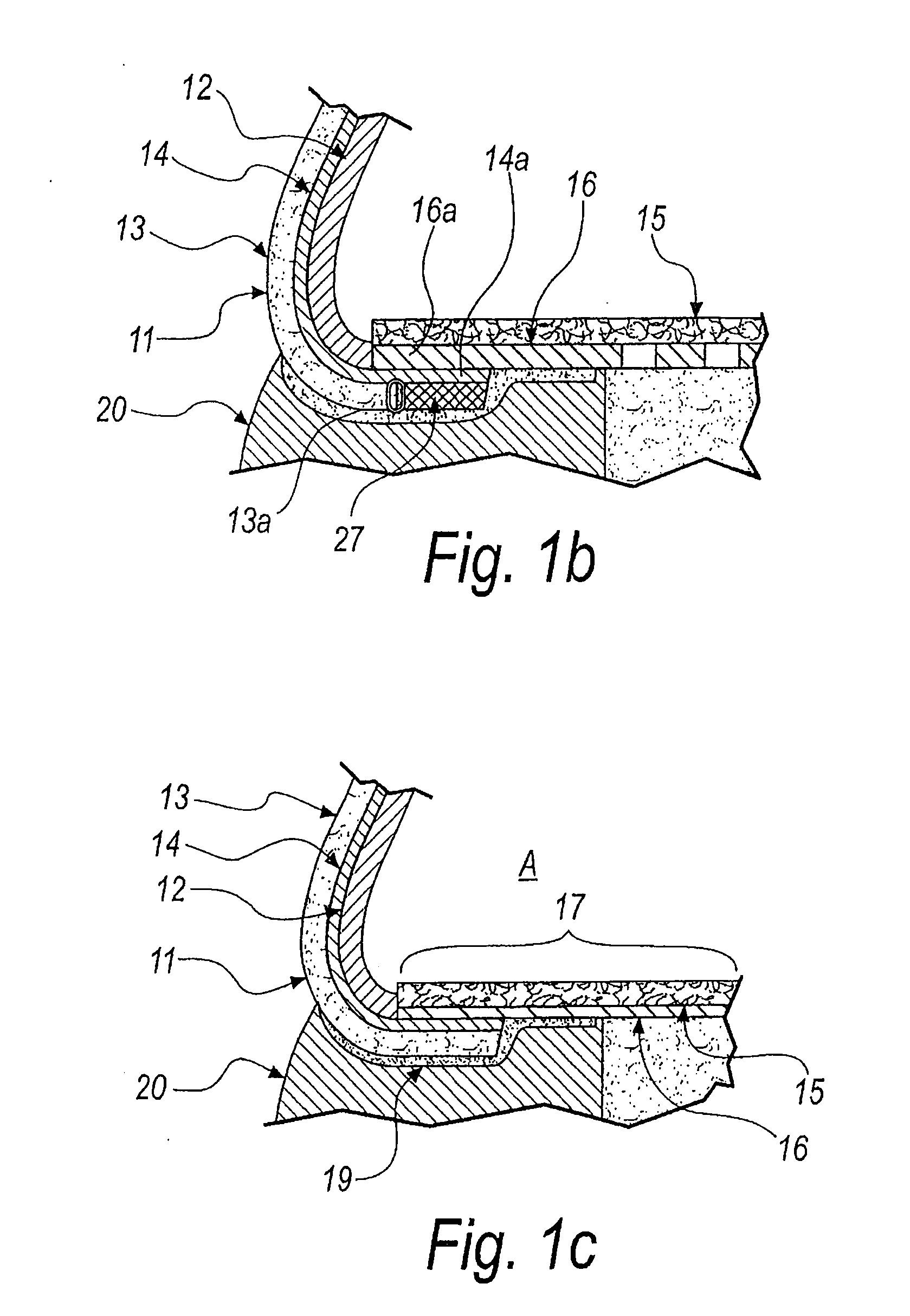
[0078]With reference to FIG. 1c, in a third embodiment, which is alternative to the previously described constructive solutions, the vapor-permeable or perforated portion 17 of the first gasket 16 is provided by means of a waterproof and vapor-permeable membrane, made of a material advantageously selected among expanded polytetrafluoroethylene, polyurethane and the like.
[0079]In particular, conveniently the vapor-permeable or perforated portion 17 affects the entire first gasket 16, which therefore is substantially entirely made of waterproof and vapor-permeable material, reinforcement layers being optionally provided which adhere thereto in order to give it greater structural strength.
[0080]Preferably, in said second and third embodiments, a sole 20 is associated with the upper assembly 11 in the subsequent assembling step 104, said sole having the vapor permeation region 21 affected by diffuse holes or broad openings which are clear.
[0081]It should be noted that these second and t...
the structure of the environmentally friendly knitted fabric provided by the present invention; figure 2 Flow chart of the yarn wrapping machine for environmentally friendly knitted fabrics and storage devices; image 3 Is the parameter map of the yarn covering machine
Login to View More
PUM
Property
Measurement
Unit
Adhesion strength
aaaaa
aaaaa
Permeability
aaaaa
aaaaa
Perimeter
aaaaa
aaaaa
Login to View More
Abstract
A method for providing a waterproof and vapor-permeable shoe, including: constructing an upper shoe assembly, including at least one vapor-permeable lining, a vapor-permeable upper, and a waterproof and vapor-permeable upper membrane that is between them; fixing to a vapor-permeable assembly insole a first gasket made of waterproof material, which has at least one vapor-permeable or perforated portion; lasting, to obtain an upper assembly of the shoe; sealing the lasting margins to the first gasket by a second gasket, including adhesion of the second gasket; and assembling, including connection of a sole to the upper assembly at least by the adhesion of material that composes the sole to the second gasket.
Description
TECHNICAL FIELD [0001]The present invention relates to a method for manufacturing a waterproof and vapor-permeable shoe, predominantly provided by means of the working method known as “AGO lasting”.BACKGROUND ART [0002]It is known that the comfort of a shoe is linked not only to its anatomically fitting properties but also to the capacity to dissipate outward the water vapor that forms inside the shoe due to sweating.[0003]For this reason, waterproof shoes with an upper coupled to a lining that is laminated with a waterproof and vapor-permeable membrane have now been known for years.[0004]The expression “waterproof and vapor-permeable” generally references the characteristic of tightness to water in the liquid state combined with permeability to water vapor.[0005]The portion of the foot that notoriously has the greatest perspiration effect is the sole, and the sweat that it generates saturates the air with moisture and mostly condenses, stagnating on the footbed.[0006]Only a margina...
Claims
the structure of the environmentally friendly knitted fabric provided by the present invention; figure 2 Flow chart of the yarn wrapping machine for environmentally friendly knitted fabrics and storage devices; image 3 Is the parameter map of the yarn covering machine
Login to View More
Application Information
Patent Timeline
Application Date:The date an application was filed.
Publication Date:The date a patent or application was officially published.
First Publication Date:The earliest publication date of a patent with the same application number.
Issue Date:Publication date of the patent grant document.
PCT Entry Date:The Entry date of PCT National Phase.
Estimated Expiry Date:The statutory expiry date of a patent right according to the Patent Law, and it is the longest term of protection that the patent right can achieve without the termination of the patent right due to other reasons(Term extension factor has been taken into account ).
Invalid Date:Actual expiry date is based on effective date or publication date of legal transaction data of invalid patent.


 Login to View More