Unlock instant, AI-driven research and patent intelligence for your innovation.

Sensor fingerprint matching in large image and video databases

a technology of image and video database and matching, applied in the field of sensor fingerprint based source device identification, can solve the problems of difficult to remove or forge unique fingerprints, inability to meet the requirements of this step, and high computational requirements, and achieve the effect of fast retrieval of media objects

Active Publication Date: 2012-08-02
POLYTECHNIC INSTITUTE OF NEW YORK UNIVERSITY
View PDF5 Cites 40 Cited by
  • Summary
  • Abstract
  • Description
  • Claims
  • Application Information

AI Technical Summary

Benefits of technology

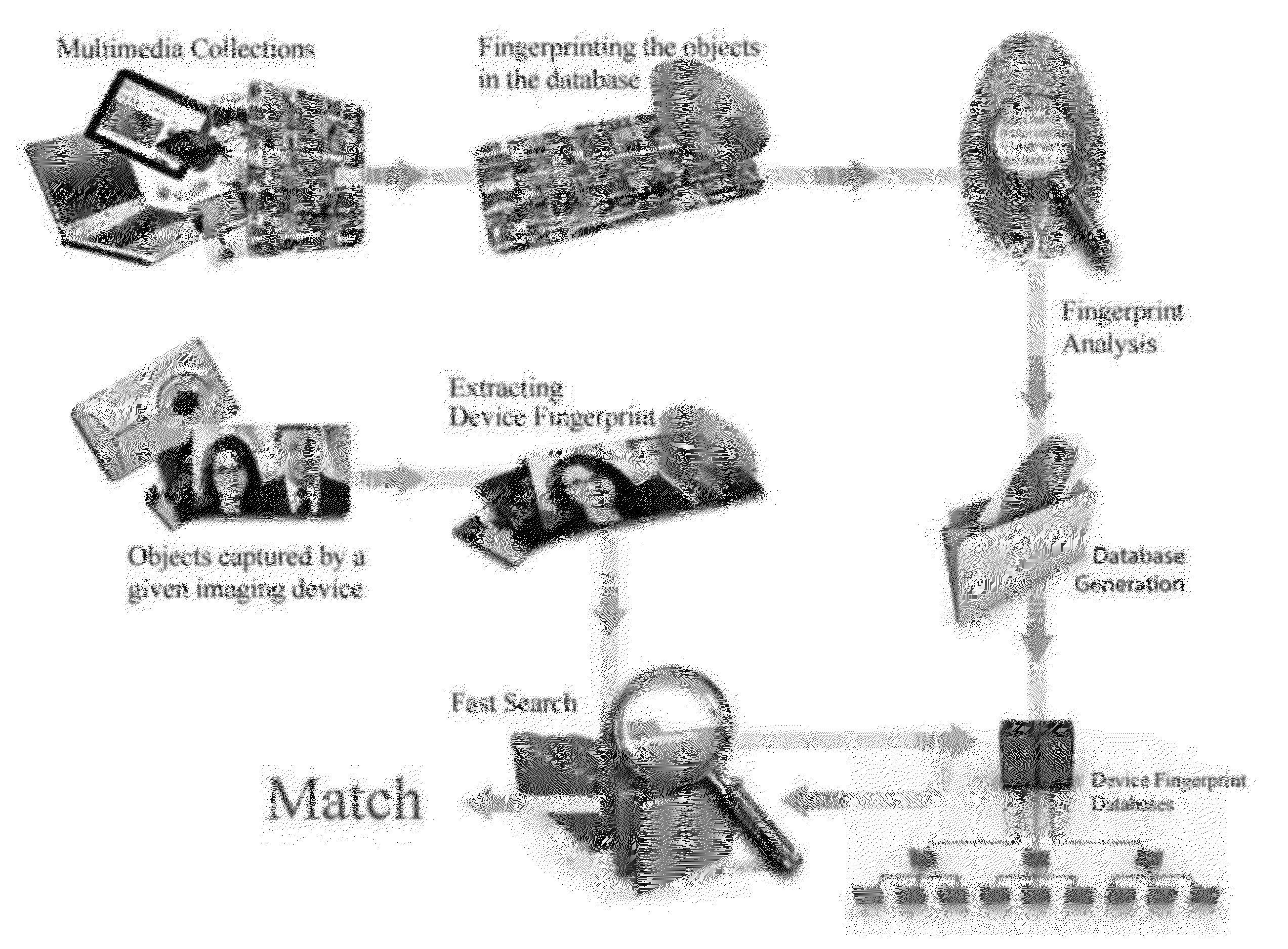
[0016]A new approach to facilitate fast retrieval of media objects exhibiting a given sensor fingerprint from a large database is described. In one exemplary embodiment consistent with the present invention, a method (and apparatus) for identifying media objects exhibiting a sensor fingerprint produced by a target source device is described. The exemplary method includes (a) receiving, by a computer system including one or more computers on network, a first set of media objects created by a plurality of source devices, each of the media objects possessing a sensor fingerprint produced by the source device which created the media object, (b) determining, by the computer system, the sensor fingerprints for each of the media objects in the received first set of media objects, (c) storing, by the computer system, the sensor fingerprints for each of the media objects in the received first set of media objects on one or more storage devices based on an

Problems solved by technology

Furthermore, this unique fingerprint is hard to remove or forge and survives a multitude of operations performed on the image such as blurring, scaling, compression, and even printing and scanning.
It should be noted that the problem in the first example above is an instance of the multimedia source “verification” problem, i.e., one is trying to match a given object to a given device.
On the other hand, in the second and third scenarios, the task turns into a multimedia source “identification” problem where one has to do a comparison with all the entities in a large database to decide which objects in the database match the query device or the query object.
For large databases, this is not feasible.
Typically, the computational requirements of this step are quite intensive; however, since it is done only once per media object, it is surmountable pending on the specifics of the decision scenario.
Therefore, computational complexity may be linear in the size of the database.
Hence for large databases, no matter how simple the matching operation is, the computational burden will be in the order of the size of database.
In this paradigm, the online step of the sensor fingerprint matching method has been a bottleneck for real-life retrieval scenarios, and has limited the benefit of the previously developed techniques.
Although the overwhelming amount of multimedia information is one of the most significant challenges faced by source-device identification techniques, computational scalability has not been a major concern for current the techniques.
As a result, even if the above conventional techniques perform quite reliably, their success will be quite limited in applications that involve large databases simply due to the sheer volume of the data and impractical due to computational limitations and time constraints.

Method used

the structure of the environmentally friendly knitted fabric provided by the present invention; figure 2 Flow chart of the yarn wrapping machine for environmentally friendly knitted fabrics and storage devices; image 3 Is the parameter map of the yarn covering machine
View more

Image

Smart Image Click on the blue labels to locate them in the text.
Viewing Examples
Smart Image
  • Sensor fingerprint matching in large image and video databases
  • Sensor fingerprint matching in large image and video databases
  • Sensor fingerprint matching in large image and video databases

Examples

Experimental program
Comparison scheme
Effect test

Embodiment Construction

[0029]The present invention may involve novel methods, apparatus, message formats, and / or data structures for fingerprint based source device identification. The following description is presented to enable one skilled in the art to make and use the invention, and is provided in the context of particular applications and their requirements. Thus, the following description of embodiments consistent with the present invention provides illustration and description, but is not intended to be exhaustive or to limit the present invention to the precise form disclosed. Various modifications to the disclosed embodiments will be apparent to those skilled in the art, and the general principles set forth below may be applied to other embodiments and applications. For example, although a series of acts may be described with reference to a flow diagram, the order of acts may differ in other implementations when the performance of one act is not dependent on the completion of another act. Further...

the structure of the environmentally friendly knitted fabric provided by the present invention; figure 2 Flow chart of the yarn wrapping machine for environmentally friendly knitted fabrics and storage devices; image 3 Is the parameter map of the yarn covering machine
Login to View More

PUM

No PUM Login to View More

Abstract

Several promising techniques have been recently proposed to bind an image or video to its source acquisition device. These techniques have been intensively studied to address performance issues, but the computational efficiency aspect has not been given due consideration. Considering very large databases, the efficiency of the sensor fingerprint based source device identification technique is described. Novel schemes that improve search complexity as compared to a conventional approach are described.

Description

§0. GOVERNMENT RIGHTS[0001]The United States Government may have certain rights in this invention pursuant to a grant awarded by the Air Force Office of Scientific Research. Specifically, the United States Government may have a paid-up license in this invention and the right in limited circumstances to require the patent owner to license others on reasonable terms as provided for by the terms of Grant Number: FA9550-09-1-0087 awarded by the Air Force Office of Scientific Research (“AFOSR”).§1. BACKGROUND OF THE INVENTION[0002]§1.1 Field of the Invention[0003]The present invention concerns sensor fingerprint based source device identification.[0004]§1.2 Background Information[0005]Promising research results have emerged in recent years in identifying the source acquisition device (e.g., camera, video camera, camera enabled smart phone, etc.) of multimedia objects. These efforts have primarily focused on the design of techniques that can identify and extract class properties (the type...

Claims

the structure of the environmentally friendly knitted fabric provided by the present invention; figure 2 Flow chart of the yarn wrapping machine for environmentally friendly knitted fabrics and storage devices; image 3 Is the parameter map of the yarn covering machine
Login to View More

Application Information

Patent Timeline
no application Login to View More
IPC IPC(8): G06K9/00G06V10/40
CPCG06F17/30799G06K2009/00583G06K9/46G06K9/00577G06F16/7847G06V20/90G06V20/80G06V10/40
Inventor BAYRAM, SEVINESENCAR, HUSREV TAHAMEMON, NASIR
Owner POLYTECHNIC INSTITUTE OF NEW YORK UNIVERSITY
Features
  • R&D
  • Intellectual Property
  • Life Sciences
  • Materials
  • Tech Scout
Why Patsnap Eureka
  • Unparalleled Data Quality
  • Higher Quality Content
  • 60% Fewer Hallucinations
Social media
Patsnap Eureka Blog
Learn More