Unlock instant, AI-driven research and patent intelligence for your innovation.

Using Mobile Device to Prevent Theft of User Credentials

a mobile device and user credentials technology, applied in the field of preventing identity theft, can solve the problems of preventing, wasting financial institutions' fees in the form of charge backs, fraud detection programs, and denying consumers fraudulent purchase refund guarantees,

Inactive Publication Date: 2013-02-21
INFERSPECT
View PDF3 Cites 61 Cited by
  • Summary
  • Abstract
  • Description
  • Claims
  • Application Information

AI Technical Summary

Benefits of technology

The invention is a way to prevent skimming (the fraudulent use of physical tokens like credit cards) at ATMs. It works by creating a unique PIN for each transaction, which is only valid for a short time. This PIN is only known by the user's mobile device and the ATM, so even if the ATM is compromised, the PIN cannot be used again. The method also includes encrypting the PIN and transmitting it to the mobile device, which ensures that the PIN is only known to the user and the ATM. This prevents the fraudsters from getting a usable PIN and alerting the financial institution to the presence of a skimming device. The invention can be easily integrated into existing ATM hardware and does not affect the speed or experience of the user. It can also be used for other types of credit or debit card transactions.

Problems solved by technology

For example, thieves may skim card numbers by installing credit card readers and / or false keyboards and cameras in an ATM machine.
The theft occurs when an unsuspecting user inserts a credit or debit card into the compromised reader, which copies the information on the card.
Skimming represents an ongoing problem that costs financial institutions fees in the form of charge backs, fraud detection programs, and fraudulent purchase refund guarantees to consumers, among others.
While some groups in Europe have installed smartcards into their plastic credit and debit cards to prevent card duplication, this does not prevent a thief who skims a PIN from stealing the physical card (perhaps, by waiting around the corner from the ATM machine).

Method used

the structure of the environmentally friendly knitted fabric provided by the present invention; figure 2 Flow chart of the yarn wrapping machine for environmentally friendly knitted fabrics and storage devices; image 3 Is the parameter map of the yarn covering machine
View more

Image

Smart Image Click on the blue labels to locate them in the text.
Viewing Examples
Smart Image
  • Using Mobile Device to Prevent Theft of User Credentials
  • Using Mobile Device to Prevent Theft of User Credentials
  • Using Mobile Device to Prevent Theft of User Credentials

Examples

Experimental program
Comparison scheme
Effect test

Embodiment Construction

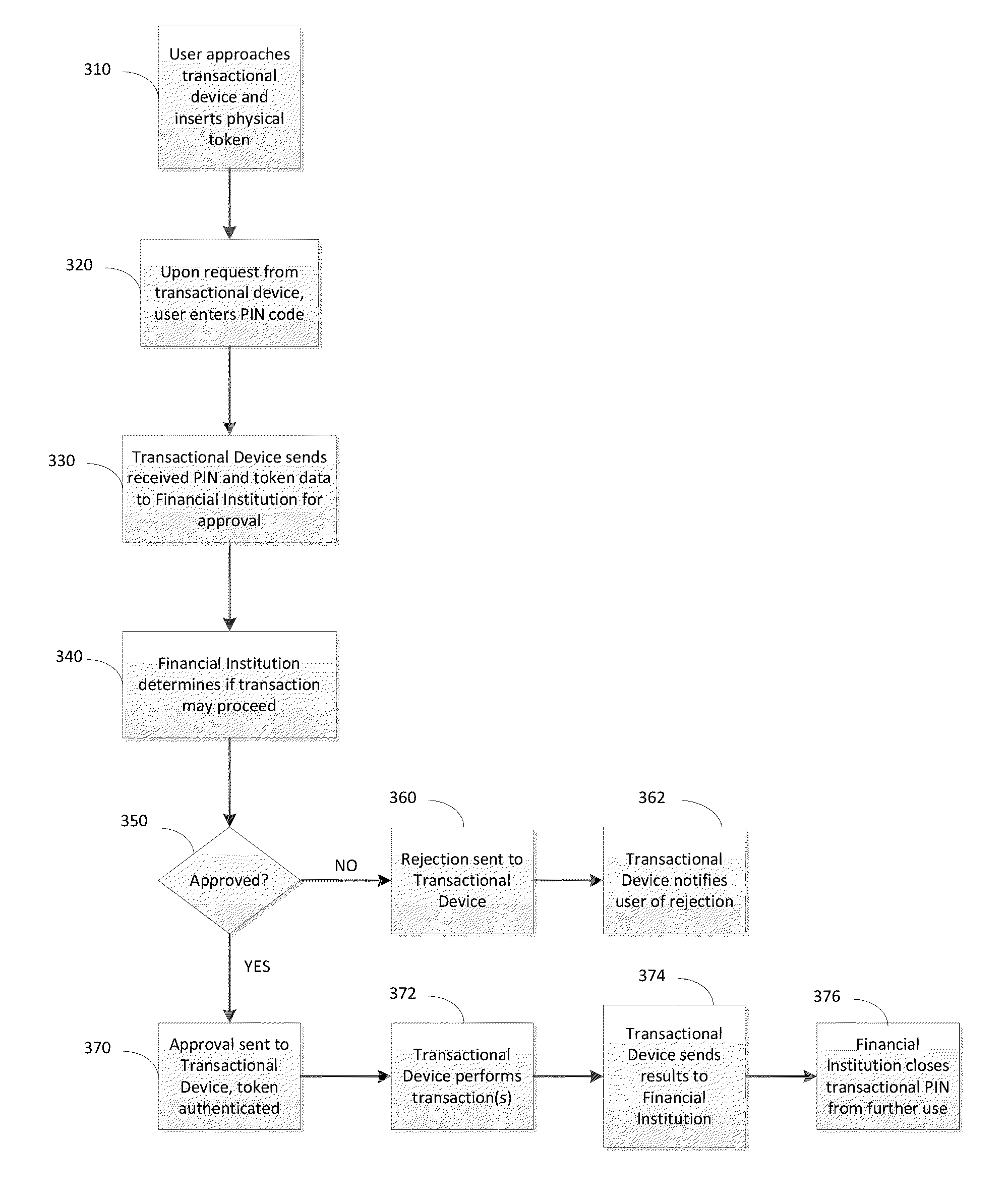
[0005]A principle problem with skimming is that the authentication factors used to complete the transaction, namely the account number and PIN, do not change. To solve this problem, various embodiments of the invention create a “transactional” PIN. The transactional PIN is useful only for a single transaction, and may also be useful for only a limited time, such as five minutes. The PIN is created in response to a request made by an application that is downloaded onto a mobile device, such as a smartphone or a tablet computer. Thus, the burden of authentication is transferred from the ATM or other transactional device to the user's mobile device. Authentication is guaranteed because the individual must first authenticate to their mobile device (and to the application thereon). The credit or debit card then becomes merely a physical token that may be combined with the authentication factors used by the individual to log in to their mobile device to provide complete authentication for...

the structure of the environmentally friendly knitted fabric provided by the present invention; figure 2 Flow chart of the yarn wrapping machine for environmentally friendly knitted fabrics and storage devices; image 3 Is the parameter map of the yarn covering machine
Login to View More

PUM

No PUM Login to View More

Abstract

Systems and methods are provided to prevent unauthorized credit and debit transactions. A system creates a transactional, or one-time-use PIN in response to a request from a mobile device, such as a smartphone or tablet computer, belonging to an authorized user. This PIN is securely transmitted to the mobile device, and used in combination with a credit or debit account number to complete the transaction. The user is determined to be authorized by the fact that they are able to access an application on the mobile device that sends the request. The application itself may be protected using a non-changing PIN.

Description

CROSS-REFERENCE TO RELATED APPLICATION[0001]This application claims the benefit of U.S. Provisional Application No. 61 / 453,911, filed Mar. 17, 2011, the contents of which are incorporated herein by reference in their entirety.TECHNICAL FIELD[0002]The present invention relates to preventing identity theft, and more particularly to the use of a mobile device and a one-time PIN to prevent harm arising from credit and debit card skimming.BACKGROUND ART[0003]Skimming is commonly defined as the theft of credit or debit card information used in an otherwise legitimate transaction. For example, thieves may skim card numbers by installing credit card readers and / or false keyboards and cameras in an ATM machine. The theft occurs when an unsuspecting user inserts a credit or debit card into the compromised reader, which copies the information on the card. The user then enters their personal identification number (PIN) on the ATM keypad. The PIN is captured by camera, or for ATMs with out touch...

Claims

the structure of the environmentally friendly knitted fabric provided by the present invention; figure 2 Flow chart of the yarn wrapping machine for environmentally friendly knitted fabrics and storage devices; image 3 Is the parameter map of the yarn covering machine
Login to View More

Application Information

Patent Timeline
no application Login to View More
IPC IPC(8): G06Q20/36G06Q20/32G06Q20/40G06Q20/20
CPCG06Q20/32G06Q20/4012G06Q20/385G06Q20/34
Inventor SCHIBUK, NORMAN
Owner INFERSPECT