
DNA Expression Construct
a gene expression and construct technology, applied in the field of minimally-designed gene expression constructs, can solve the problems of unwanted immune effects, inapplicability of plasmids to clinical protocols, and insufficient transfection efficiency
- Summary
- Abstract
- Description
- Claims
- Application Information
AI Technical Summary
Benefits of technology
Problems solved by technology
Method used
Image

Examples
examples
Manufacture of DNA Constructs
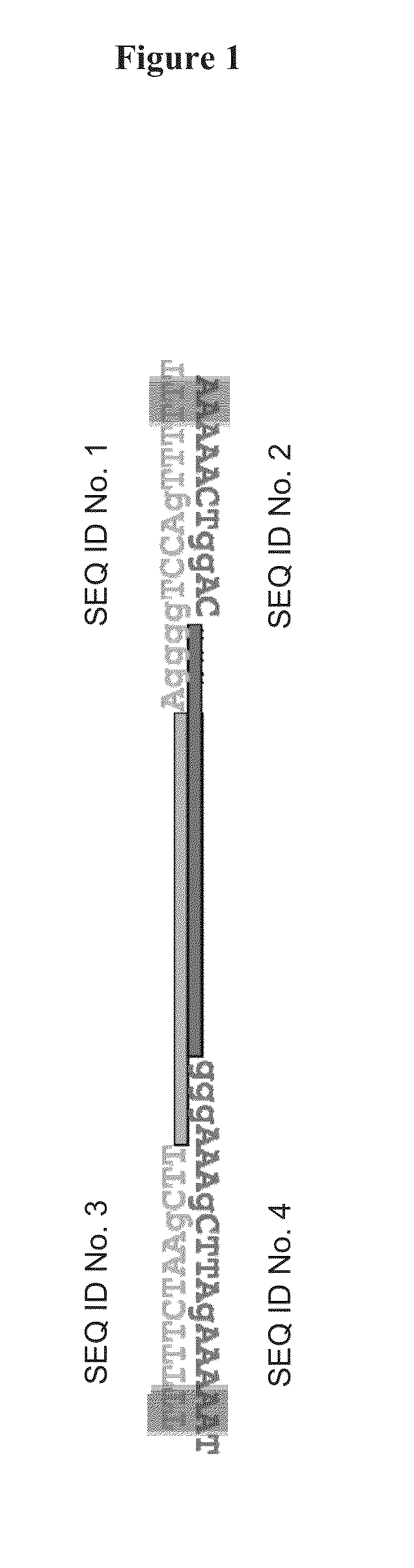
[0063]The manufacture of the DNA constructs according to the disclosure resembles that of EP 0 941 318. However, the hairpin oligonucleotides are replaced by so-called “L-adapters”, as summarized in Table 1. Both adapters were composed of the individual chimeric DNA molecules SEQ ID No. 1 and SEQ ID No. 2 (L-adapter 1) or SEQ ID No. 3 and SEQ ID No. 4 (L-adapter 2), respectively (Table 1). The adapters were generated by hybridization of equimolar concentrations of the single-stranded DNA molecules according to table 1 at 0.28 mg / ml for 40 min at gradually decreasing temperatures from 90° C. to 25° C. in 40 mM Tris-HCl, 10 mM MgCl2, 10 mM DTT, 0.5 mM ATP (pH 7.8 at 25° C.). After ligation of both adapters to the expression cassette as synthesized in EP 0 941 318 the subsequent removal of linear D-DNA by T7 polymerase and the final HPLC purification of the product was conducted. This construct is referred to as “2L-M”.
[0064]Alternatively, one of the L-adap...
PUM
| Property | Measurement | Unit |
|---|---|---|
| volume | aaaaa | aaaaa |
| temperatures | aaaaa | aaaaa |
| concentrations | aaaaa | aaaaa |
Abstract
Description
Claims
Application Information
 Login to View More