Unlock instant, AI-driven research and patent intelligence for your innovation.

Characterizing motion patterns of one or more agents from spatiotemporal data

a technology of spatiotemporal data and motion patterns, applied in the field of artificial intelligence systems, can solve problems such as loss of points or services, system difficulty in building a library of successful and unsuccessful plans, and inability to segment play into short, identifiable, discrete segments

Active Publication Date: 2014-02-27
DISNEY ENTERPRISES INC
View PDF9 Cites 47 Cited by
  • Summary
  • Abstract
  • Description
  • Claims
  • Application Information

AI Technical Summary

Benefits of technology

The patent describes a system that can analyze the behavior of players or teams in sports without needing a pre-existing plan library or labels. The system uses tracking data, such as ball-action data, to create a plan library. This allows for the analysis of low-scoring and continuous sports, such as soccer or ice hockey. The system is also affordable, using a tablet computer as a low-cost input device. This makes it suitable for both amateur and professional levels of sports.

Problems solved by technology

Over time, such a system may build a library of successful plans (resulting in winning a point) and unsuccessful plans (resulting in losing a point or losing service) for a specific player.
However, some sporting events or activities, such as soccer matches and hockey games, proceed in a low-scoring, continuous fashion, without an easy way to segment play into short, identifiable, discrete segments such as points or plays.
In such cases, the system has difficulty in building a library of successful and unsuccessful plans that characterize a player's or team's behavior.
An additional issue for such systems is that tracking data may not be available for each player or participant, particularly for team sports with multiple players or agents on each team.
Because player tracking data is costly and difficult to obtain, only partial team tracing data may be available, often in the form of ball tracking.
However, player movement data may not be available.

Method used

the structure of the environmentally friendly knitted fabric provided by the present invention; figure 2 Flow chart of the yarn wrapping machine for environmentally friendly knitted fabrics and storage devices; image 3 Is the parameter map of the yarn covering machine
View more

Image

Smart Image Click on the blue labels to locate them in the text.
Viewing Examples
Smart Image
  • Characterizing motion patterns of one or more agents from spatiotemporal data
  • Characterizing motion patterns of one or more agents from spatiotemporal data
  • Characterizing motion patterns of one or more agents from spatiotemporal data

Examples

Experimental program
Comparison scheme
Effect test

Embodiment Construction

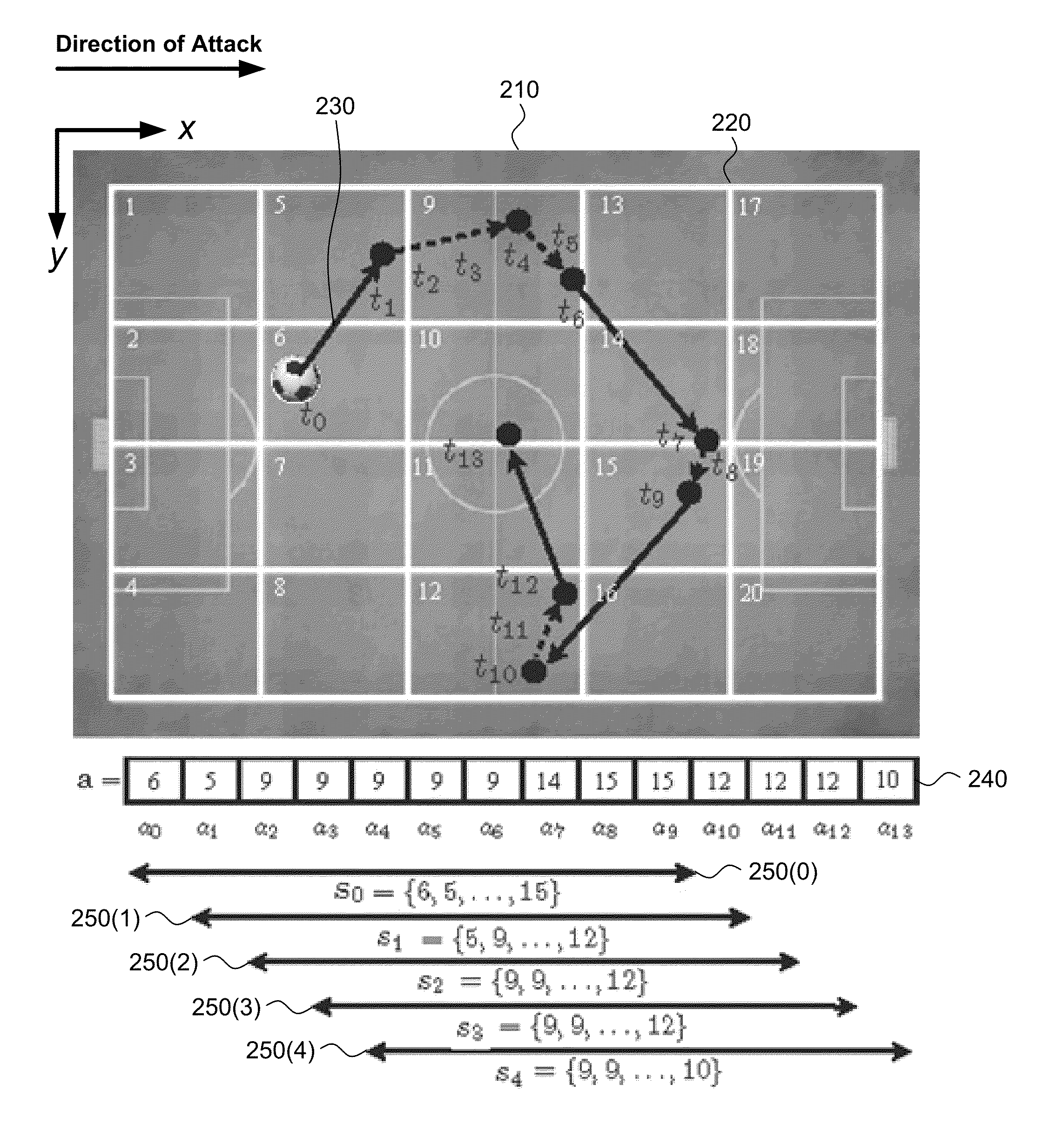
[0022]Embodiments of the invention include a method for characterizing team behaviors for a variety of team sports (e.g., soccer) using partial team tracings such as ball actions. Generally, ball actions refer to any events or actions that occur around the ball (or other object of game play). Rather than use a pre-defined library of labeled plans, team behavior is represented via play segments, i.e., represented via spatiotemporal descriptions of ball movement over fixed windows of time. As such, labeled plan libraries and full team tracings are unnecessary for characterizing important team behaviors. Ball movements may be calculated or inferred from an existing annotated ball action dataset, as is currently used for certain visualizations in sports production. In one embodiment, the annotated ball action data may be entered manually by humans or machine generated by tracking systems. Using the play segment representations, team behavior may be characterized via entropy maps, which ...

the structure of the environmentally friendly knitted fabric provided by the present invention; figure 2 Flow chart of the yarn wrapping machine for environmentally friendly knitted fabrics and storage devices; image 3 Is the parameter map of the yarn covering machine
Login to View More

PUM

No PUM Login to View More

Abstract

Techniques are described to characterize motion patterns of a group of agents engaging in an activity. An analysis system receives input data associated with spatial and temporal information of at least one element of interest associated with the activity, where the object of interest may be a ball, person, animal or any other object in motion. The analysis system partitions the input data into a plurality of spatiotemporal segments and generates one or more representations of one or more sets of segments of the plurality of spatiotemporal segments based on one or more criteria. The analysis system computes a metric, such as an entropy value, for each of the one or more representations. Partial tracing data, such as ball movements in a sporting event, may be created using an inexpensive input device, such as a tablet computer, making the disclosed techniques available for a wide range of events and activities.

Description

BACKGROUND[0001]1. Field of the Invention[0002]The present invention relates to artificial intelligence systems used to analyze participants engaged in a sport and, in particular, to characterizing motion patterns of one or more agents from spatiotemporal data.[0003]2. Description of the Related Art[0004]Automated systems have been deployed that can analyze the plan and tactics of players of certain sports, e.g., tennis. In such cases, a state of the game is updated regularly at short time intervals, such as when a point is scored. Over time, such a system may build a library of successful plans (resulting in winning a point) and unsuccessful plans (resulting in losing a point or losing service) for a specific player. Such a system may then identify a set of proven plans or tactics from the library that characterize a player, given the relative strengths and weaknesses of the player's plans.[0005]One shortcoming is that these systems rely on the game being segmented into short discr...

Claims

the structure of the environmentally friendly knitted fabric provided by the present invention; figure 2 Flow chart of the yarn wrapping machine for environmentally friendly knitted fabrics and storage devices; image 3 Is the parameter map of the yarn covering machine
Login to View More

Application Information

Patent Timeline
no application Login to View More
IPC IPC(8): G06N5/02G06F17/30
CPCG06N5/043
Inventor LUCEY, PATRICKBIALKOWSKI, ALINAMATTHEWS, IAINCARR, G. PETERFOOTE, ERIC
Owner DISNEY ENTERPRISES INC