Line guide for working vehicle implement

a technology for working vehicles and implements, applied in the field of work vehicles, can solve the problems of individual hoses being damaged or disconnected, poor routing of working lines extending from the vehicle to the implement attachment, and trip hazards for operators

US20140224941A1Inactive Publication Date: 2014-08-14DEERE & CO
11 Cites 20 Cited by

Patent Information

Authority / Receiving Office
US · United States
Current Assignee / Owner
Publication Date
2014-08-14
Estimated Expiration
Not applicable · inactive patent

Smart Images

  • Figure 1
    Figure 1
  • Figure 2
    Figure 2
  • Figure 3
    Figure 3
Patent Text Reader

Abstract

A line guide assembly constrains the movement of working lines, such as hydraulic, pneumatic and electrical lines, that connect an implement attachment, such as a mulching head, to the main power and controls of a working vehicle, such as a skid steer loader. In one form, the line guide assembly has a mounting bracket for connecting to the mounting ear of the implement. An extension arm is coupled to the mounting bracket to accommodate articulation or other movement of the implement. A guide is connected to the extension arm, directly or via an additional cross-member. In one form, the guide defines a catch or loop that receives the working lines running to the implement. As the implement moves the extension arm pivots and the guide engages the working lines, which move through the guide opening, to constrain the working lines to a desired area between the loader and the implement.
Need to check novelty before this filing date? Find Prior Art

Description

CROSS-REFERENCE TO RELATED APPLICATION(S)

[0001] Not applicable.STATEMENT OF FEDERALLY SPONSORED RESEARCH OR DEVELOPMENT

[0002] Not applicable.FIELD OF THE DISCLOSURE

[0003] This disclosure relates to work vehicles, and in particular to work vehicles having powered implements attached thereto.BACKGROUND OF THE DISCLOSURE

[0004] Work vehicles such as front-end loaders are well known. Front-end loaders can have a drivetrain that includes either wheels or endless tracks. It is conventional to refer to compact wheeled loaders as “skid steer loaders” because to change direction the wheels at either the left or right side of the loader are braked, such that they do not turn over, but rather skid, as the loader turns. Compact loaders with tracks instead of wheels are commonly referred to as either skid steer loaders or “compact track loaders.” For simplicity, the terms “loader” and “skid steer loader” will be used herein to refer to both types of loaders.

[0005] Skid steer loaders also typically hav...

Examples

Embodiment Construction

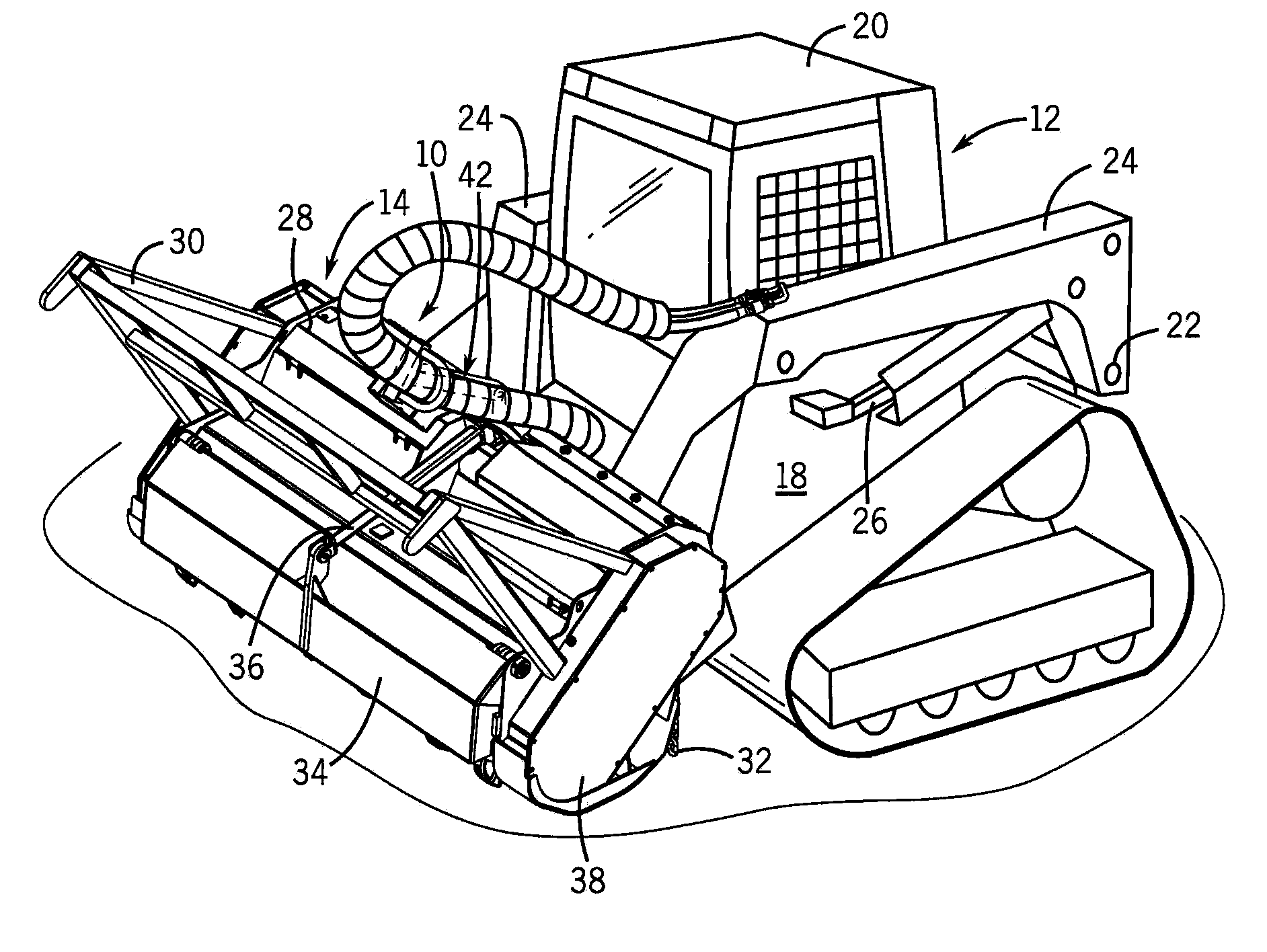
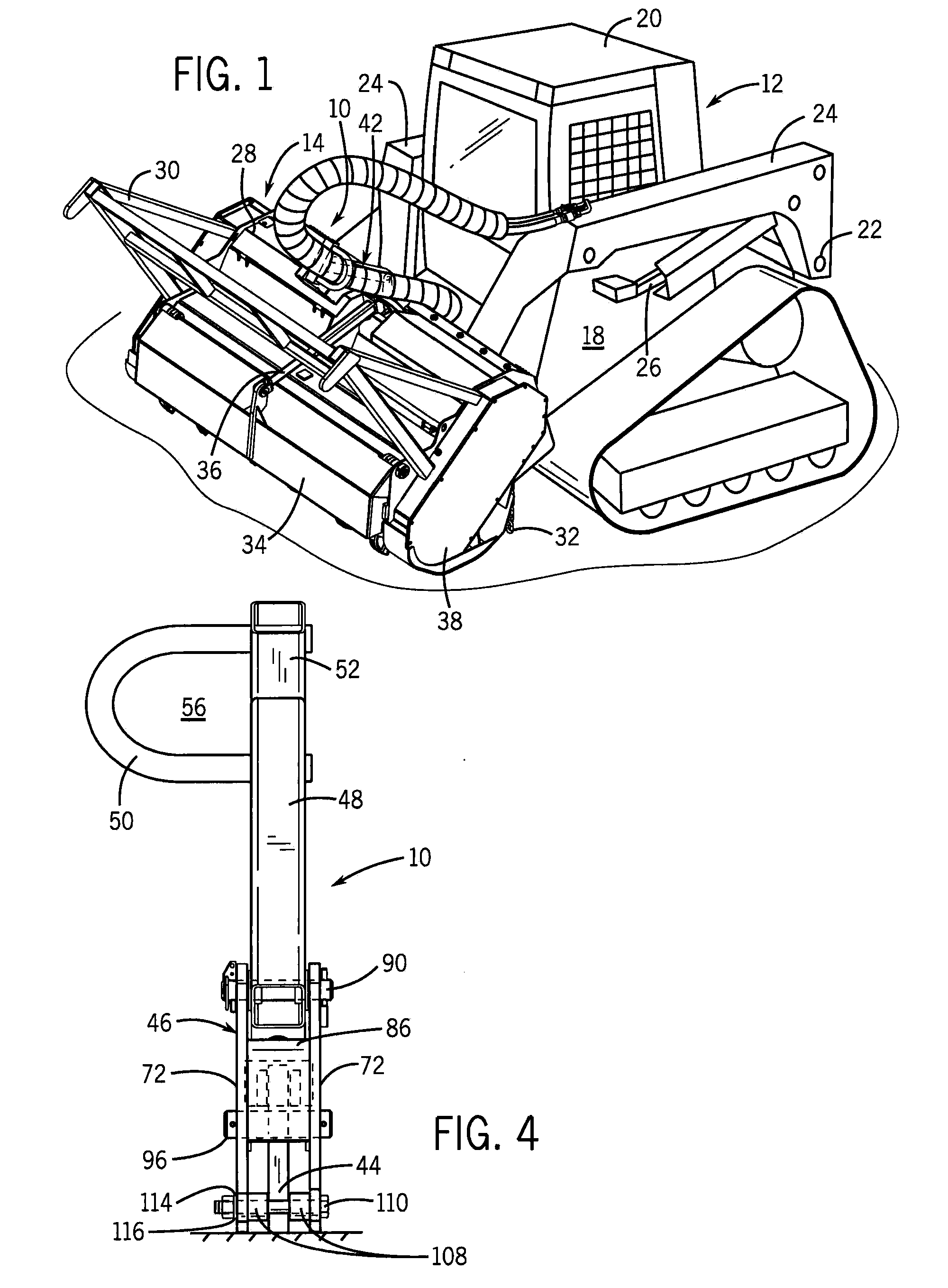
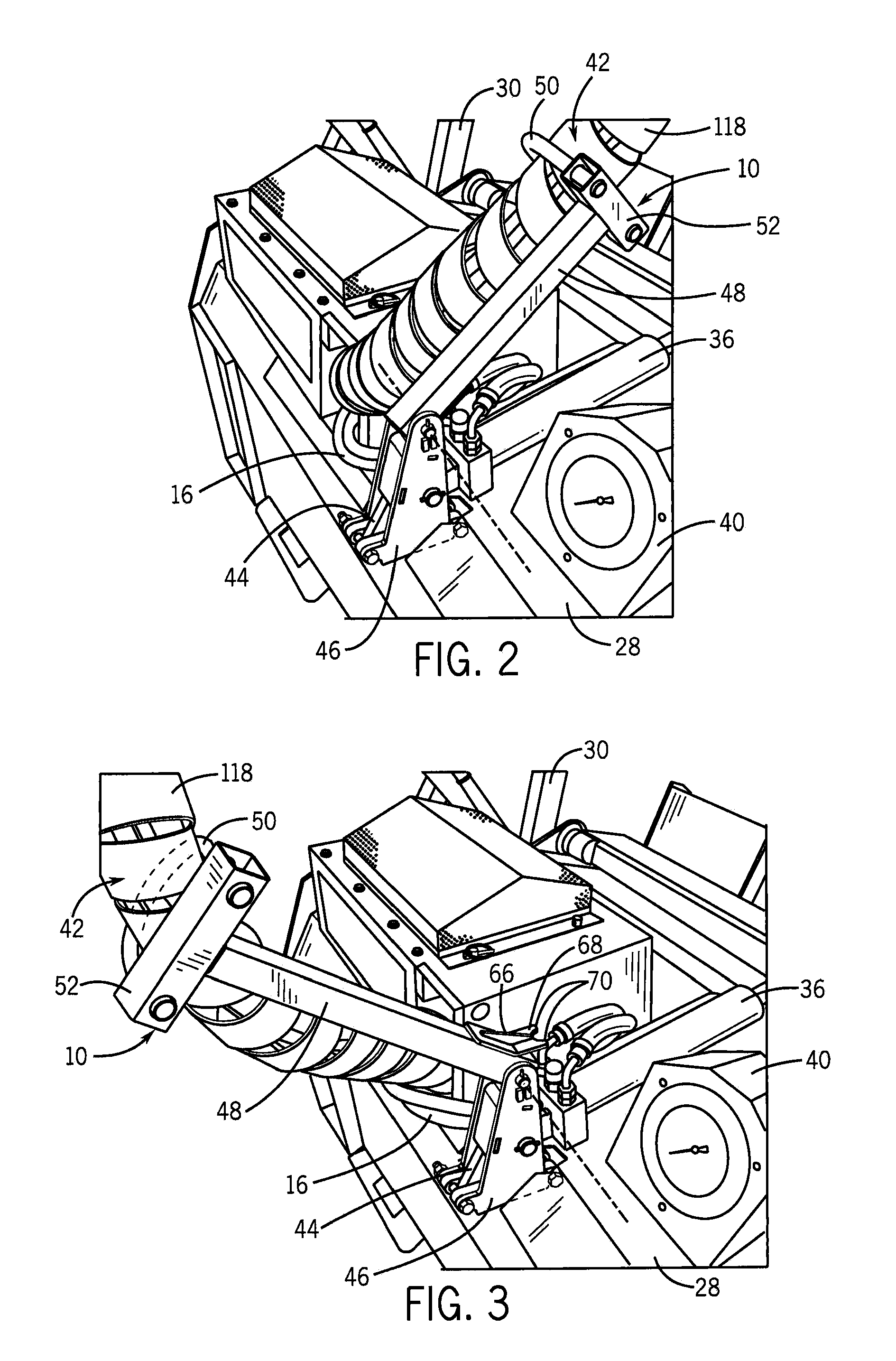
[0023]The following describes one or more example constructions of a line guide assembly 10, as shown in the accompanying figures of the drawings described briefly above. Various modifications to the example constructions may be contemplated by one of skill in the art.

[0024]FIG. 1 shows an example application of the line guide assembly 10 incorporated into a working vehicle 12 which powers and controls an implement attachment 14 through a bundle of hydraulic plumbing lines 16. In the example shown in FIG. 1 and described herein, the working vehicle 12 is a compact loader and the implement attachment 14 is a mulching head. The line guide assembly 10 can be used advantageously with existing compact loaders and mulching head attachments, for example the 332D Skid Steer Loader and the 333D Compact Track Loader commercially available from Deere & Co. of Moline, Ill., and the MH60 Mulching Head from Deere & Co., or the Bull Hog (SS) Brush Cutting Attachment, commercially available from Fe...