Check patentability & draft patents in minutes with Patsnap Eureka AI!

Radar-based vibration sensor self-calibration method

Inactive Publication Date: 2014-09-18
HONEYWELL INT INC
View PDF2 Cites 4 Cited by
  • Summary
  • Abstract
  • Description
  • Claims
  • Application Information

AI Technical Summary

Benefits of technology

The patent describes a method for calibrating a radar-based vibration sensor that includes a radar head coupled to a vibration device. The method involves transmitting radio frequency (RF) signals towards a target and receiving the reflected signals. An excitation voltage is supplied to the vibration device at different frequencies to cause the vibration sensor to vibrate, and the acceleration of the vibration sensor is measured at each frequency. A calibration curve is generated based on the measured acceleration and the reflected RF signals at each frequency. The method can be used to determine the resonant frequencies of the vibration sensor and to sense background noise frequencies. The calibration curve can be used to accurately measure the vibration sensor acceleration and can be generated at different fixed distances from the target. The technical effect of the patent is to provide a reliable and accurate method for calibrating a radar-based vibration sensor.

Problems solved by technology

This can make the calibration of such sensors relatively difficult.

Method used

the structure of the environmentally friendly knitted fabric provided by the present invention; figure 2 Flow chart of the yarn wrapping machine for environmentally friendly knitted fabrics and storage devices; image 3 Is the parameter map of the yarn covering machine
View more

Image

Smart Image Click on the blue labels to locate them in the text.
Viewing Examples
Smart Image
  • Radar-based vibration sensor self-calibration method
  • Radar-based vibration sensor self-calibration method
  • Radar-based vibration sensor self-calibration method

Examples

Experimental program
Comparison scheme
Effect test

Embodiment Construction

[0015]The following detailed description is merely exemplary in nature and is not intended to limit the invention or the application and uses of the invention. As used herein, the word “exemplary” means “serving as an example, instance, or illustration.” Thus, any embodiment described herein as “exemplary” is not necessarily to be construed as preferred or advantageous over other embodiments. All of the embodiments described herein are exemplary embodiments provided to enable persons skilled in the art to make or use the invention and not to limit the scope of the invention which is defined by the claims. Furthermore, there is no intention to be bound by any expressed or implied theory presented in the preceding technical field, background, brief summary, or the following detailed description.

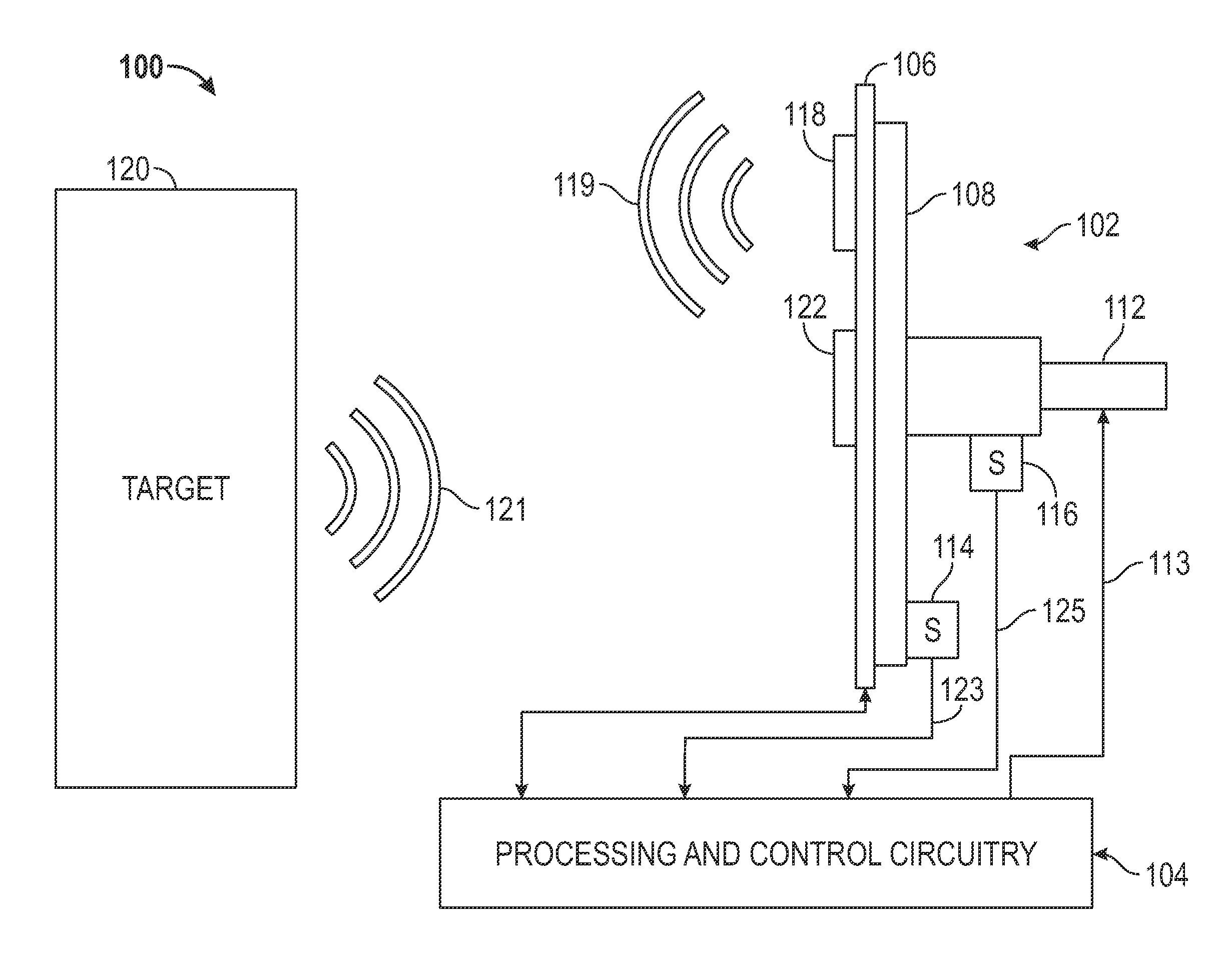
[0016]Referring to FIG. 1, a functional block diagram representation of one embodiment of a radar-based vibration sensor 100 is depicted, and includes a sensor 102 and processing and control ci...

the structure of the environmentally friendly knitted fabric provided by the present invention; figure 2 Flow chart of the yarn wrapping machine for environmentally friendly knitted fabrics and storage devices; image 3 Is the parameter map of the yarn covering machine
Login to View More

PUM

No PUM Login to View More

Abstract

A method of calibrating a radar-based vibration sensor that includes a radar head coupled to a vibration device includes disposing the vibration sensor at a fixed distance from a target, and transmitting radio frequency (RF) signals toward, and receiving RF signals reflected by, the target. An excitation voltage is supplied, at a plurality of different excitation frequencies, to the vibration device to cause the vibration sensor to vibrate. Vibration sensor acceleration is determined at each of the different excitation frequencies. A calibration curve is generated based on the determined vibration sensor acceleration at each of the different excitation frequencies, and on the reflected RF signals at each of the different excitation frequencies.

Description

STATEMENT REGARDING FEDERALLY SPONSORED RESEARCH OR DEVELOPMENT[0001]This invention was made with Government support under W911W6-11-C-0030 awarded by the US Air Force. The Government has certain rights in the invention.TECHNICAL FIELD[0002]The present invention generally relates to radar-based vibration sensor, and more particularly relates to a method of self-calibrating a radar-based vibration sensor.BACKGROUND[0003]Recently, radar-based vibration sensors have been proposed to implement stand-off (e.g., non-contact) vibration sensing for preventive maintenance assessment. A typical radar-based sensor transmits radio frequency (RF) waves toward, and receives RF signals reflected by, the vibrating component being monitored. By measuring the relative phase change along the round trip of the reflected RF wave, such radar-based sensors have been shown to exhibit a wide-field of view and to reliably measure displacements in the nanometer range. These non-contact, radar-based sensors ha...

Claims

the structure of the environmentally friendly knitted fabric provided by the present invention; figure 2 Flow chart of the yarn wrapping machine for environmentally friendly knitted fabrics and storage devices; image 3 Is the parameter map of the yarn covering machine
Login to View More

Application Information

Patent Timeline
no application Login to View More
IPC IPC(8): G01H3/00
CPCG01H3/005
Inventor PECZALSKI, ANDYBHARADWAJ, RAJ MOHANPHAM, HAIWUNDERLIN, DAVIDKIM, KYUSUNGMYLARASWAMY, DINKAR
Owner HONEYWELL INT INC
Features
  • R&D
  • Intellectual Property
  • Life Sciences
  • Materials
  • Tech Scout
Why Patsnap Eureka
  • Unparalleled Data Quality
  • Higher Quality Content
  • 60% Fewer Hallucinations
Social media
Patsnap Eureka Blog
Learn More