Unlock instant, AI-driven research and patent intelligence for your innovation.

Multi resonator non-adjacent coupling

Active Publication Date: 2015-04-02
INTEL CORP
View PDF3 Cites 13 Cited by
  • Summary
  • Abstract
  • Description
  • Claims
  • Application Information

AI Technical Summary

Benefits of technology

The invention allows for the coupling of non-adjacent resonators even when the cavities are arranged in straight lines. This solves the issue of geometric restrictions and ensures the resonators work effectively.

Problems solved by technology

Some of the techniques to couple non-adjacent cavities are to bring non-adjacent cavities physically closer, but this approach may not always be possible or be impractically difficult due to geometry constraints.

Method used

the structure of the environmentally friendly knitted fabric provided by the present invention; figure 2 Flow chart of the yarn wrapping machine for environmentally friendly knitted fabrics and storage devices; image 3 Is the parameter map of the yarn covering machine
View more

Image

Smart Image Click on the blue labels to locate them in the text.
Viewing Examples
Smart Image
  • Multi resonator non-adjacent coupling
  • Multi resonator non-adjacent coupling
  • Multi resonator non-adjacent coupling

Examples

Experimental program
Comparison scheme
Effect test

first embodiment

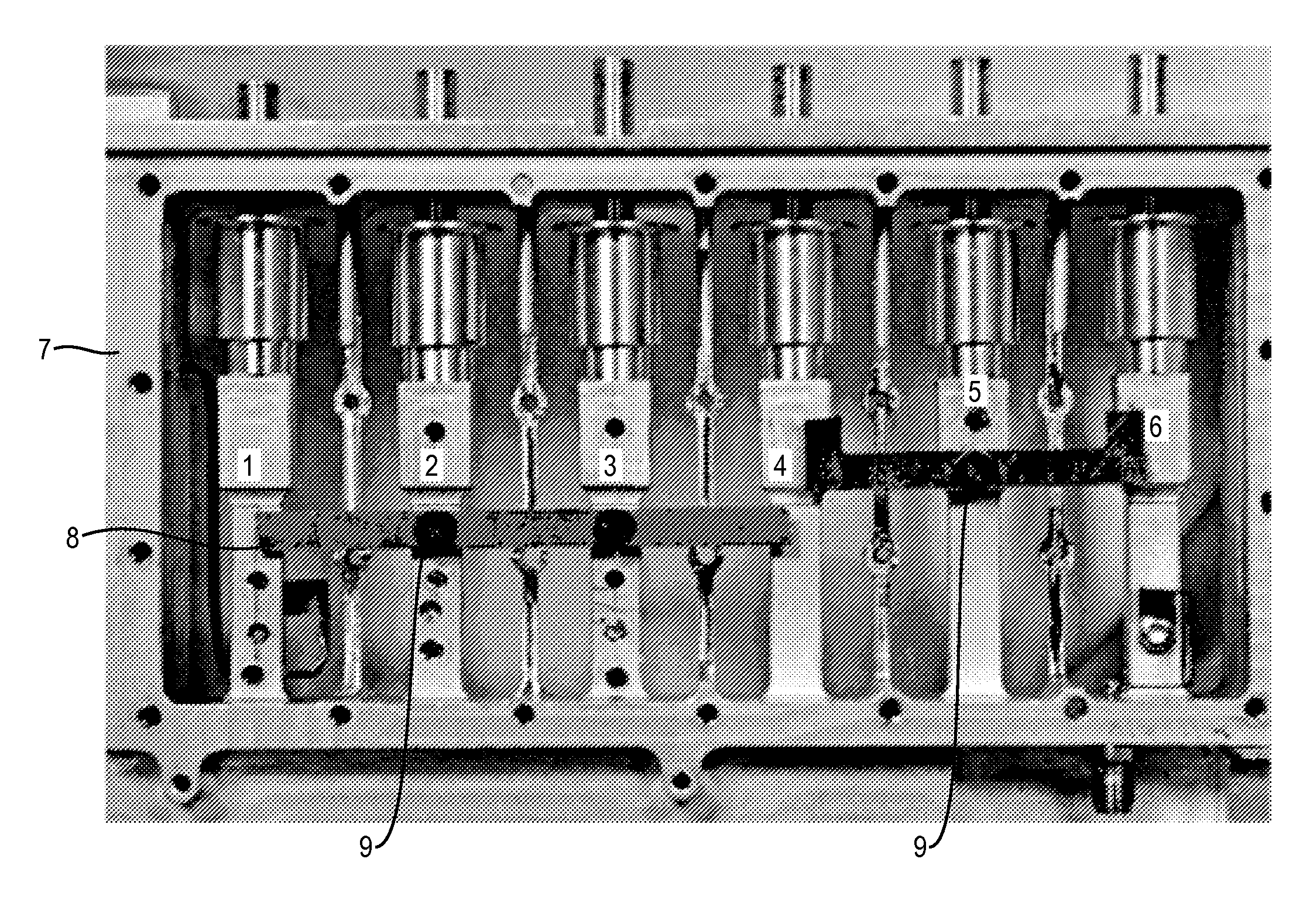
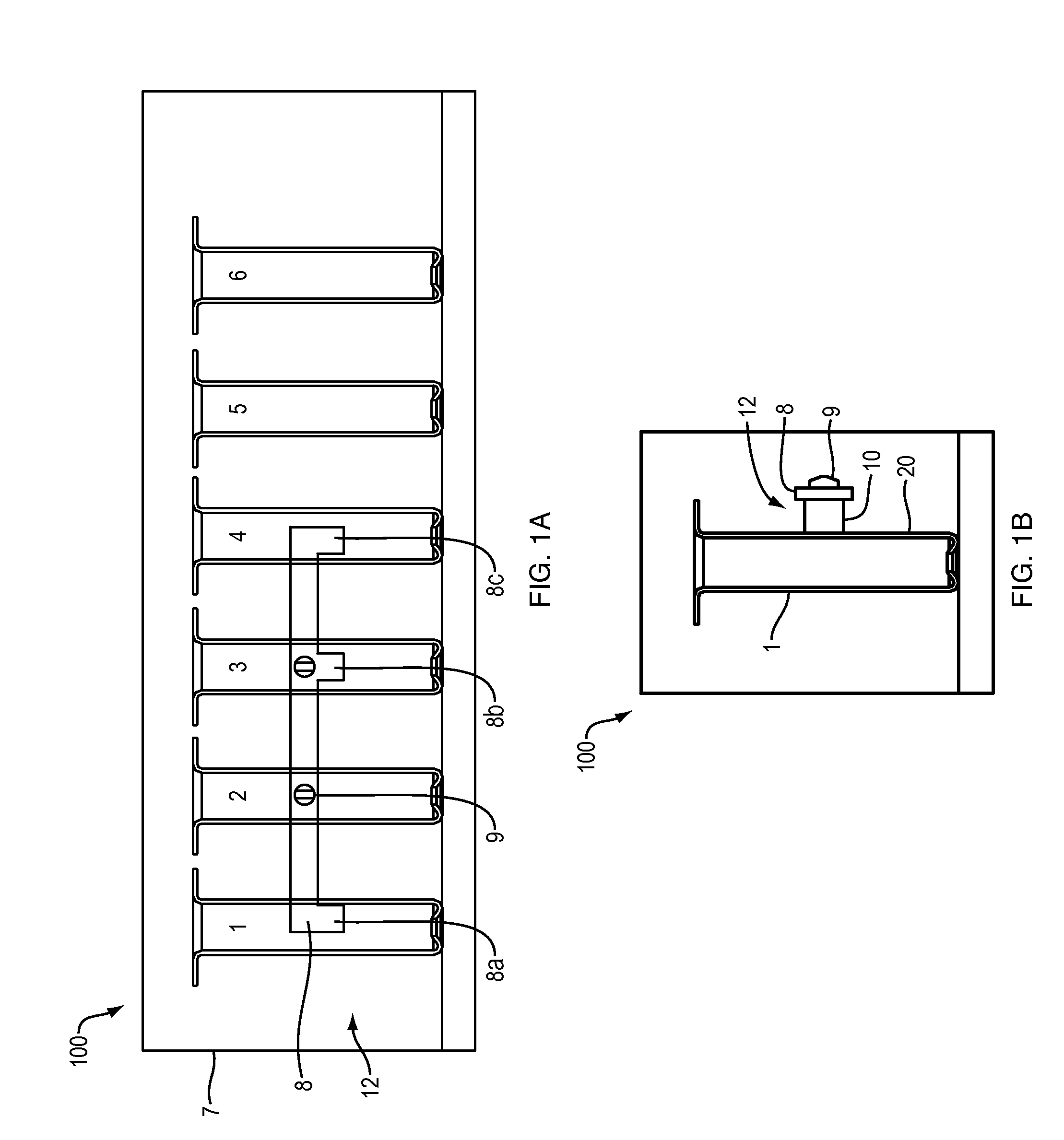
[0016]In reference to FIGS. 1A and 1B, a multi resonator filter 100 includes a set of six resonators, resonators 1-6, that are metal resonators with resonator cavities either forming part of resonator housing 7 or that are mechanically bolted or bonded to the housing 7. The housing 7 may be a metal housing. The filter 100 further includes a coupling 12 that is formed of a metal strip 8 and non-conductive (dielectric) spacers 10 fastened together with non-conductive (dielectric) screws 9. The spacers 10 space the metal strip 8 from a surface 20 of the resonators 2 and 3. That is, the configuration of coupling 12 couples resonators 1 and 4 and allows the jumping in doing so of resonators 2 and 3.

[0017]The present invention, works with any resonator configuration; however, it is more practical when the resonators are laid out horizontally, i.e., the resonators are accessible from the sides normally with a removable side cover of the housing 7.

[0018]Normally, a positive coupling between...

second embodiment

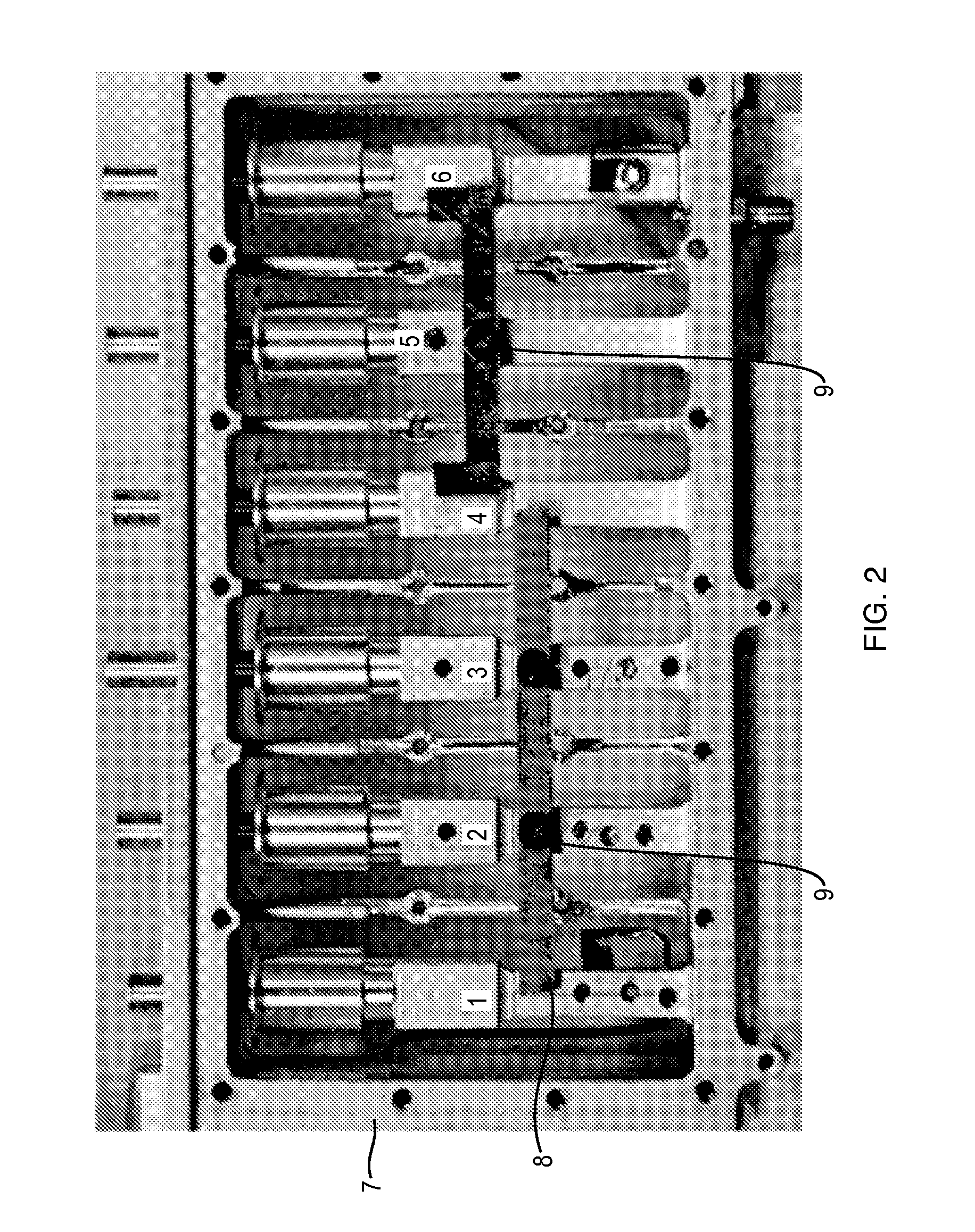
[0020]coupling 24 is shown in FIG. 2 for resonator filter 200. The resonator filter 20 includes the same six resonators 1-6 of FIGS. 1A and 1B. The coupling 24 also includes the coupling 12 of FIGS. 1A and 1B plus additional coupling element 26, which is a second metal strip coupling resonator 4 to resonator 6. For the geometry of the resonator filter 200 of FIG. 2, the measured coupling bandwidth values in frequency are:[0021]Resonators 1˜3=2.1 MHz[0022]Resonators 1˜4=3.3 MHz[0023]Resonators 2˜4=7.5 MHz

The coupling bandwidth values for couplings 1˜3 and 2˜4 are also controllable by adjusting the spacing, i.e., making a thickness of the spacer 10 thicker or thinner so as to adjust the gap between the metal strip 8 and the surface 20 of the resonator cavity.

[0024]Measured phase responses for the coupling bandwidths of Resonators 1-3, 1-4 and 2-4 using the coupling 12 of FIGS. 1A and 1B and the corresponding coupling element of coupling 24, are given in FIGS. 3-5. FIG. 6 shows the out...

the structure of the environmentally friendly knitted fabric provided by the present invention; figure 2 Flow chart of the yarn wrapping machine for environmentally friendly knitted fabrics and storage devices; image 3 Is the parameter map of the yarn covering machine
Login to View More

PUM

No PUM Login to View More

Abstract

A coupling is provided for coupling non-adjacent resonators of a radio frequency filter. The coupling joins together non-adjacent resonators with a metal strip. The metal strip is physically connected to but electrically isolated from resonators located between the connected non-adjacent resonators. The metal strips include tabs the length of which may be varied. The coupling works with different resonator configurations including horizontally aligned resonators. The coupling allows for the jumping of an even number of resonators can produce zeros at high and low bands. A single coupling of this configuration enables two negative couplings.

Description

BACKGROUND OF THE INVENTION[0001]1. Field of the Invention[0002]The present invention relates to resonators. More particularly, the present invention relates to couplings among a plurality of resonators. Still more particularly, the present invention relates to coupling between or among non-adjacent resonators.[0003]2. Description of the Prior Art[0004]Non-adjacent coupling between resonators in RF filters is a widely established technique to achieve transmission zeros at desired frequencies and thus establish sharp rejections in certain frequency ranges without increasing the number of resonators. Most of the real world applications require non-symmetrical frequency response; i.e., one side of the frequency band has much higher rejection requirements than the other and thus the ability to place transmission zeros arbitrarily at desired frequencies can produce both symmetric and non-symmetric frequencies. This very ability allows us to reduce filter sizes while minimizing, insertion...

Claims

the structure of the environmentally friendly knitted fabric provided by the present invention; figure 2 Flow chart of the yarn wrapping machine for environmentally friendly knitted fabrics and storage devices; image 3 Is the parameter map of the yarn covering machine
Login to View More

Application Information

Patent Timeline
no application Login to View More
IPC IPC(8): H01P1/208H01P7/06
CPCH01P7/06H01P1/208H01P1/205H01P7/04H01P1/2053
Inventor SUBEDI, PURNABURKE, IANTRAN, VIEN VAN
Owner INTEL CORP
Features
  • R&D
  • Intellectual Property
  • Life Sciences
  • Materials
  • Tech Scout
Why Patsnap Eureka
  • Unparalleled Data Quality
  • Higher Quality Content
  • 60% Fewer Hallucinations
Social media
Patsnap Eureka Blog
Learn More