Systems for determining eye refraction

US20170150882A1Active Publication Date: 2017-06-01CARL ZEISS SMT GMBH +1
6 Cites 5 Cited by

Patent Information

Authority / Receiving Office
US · United States
Current Assignee / Owner
Publication Date
2017-06-01

Smart Images

  • Figure 1
    Figure 1
  • Figure 2
    Figure 2
  • Figure 3
    Figure 3
Patent Text Reader

Abstract

Mobile computer devices and systems for refraction determination of an eye, for example for objective refraction determination and / or subjective refraction determination, are provided. Here, a display of the mobile computer device can be driven to display an image for refraction determination.
Need to check novelty before this filing date? Find Prior Art

Description

CROSS REFERENCE TO RELATED APPLICATION

[0001] This application is a continuation application of international patent application PCT / EP2015 / 071690, filed Sep. 22, 2015, designating the United States and claiming priority from German applications 10 2014 113 680.2, filed Sep. 22, 2014 and 10 2014 116 665.5 filed Nov. 14, 2014, and the entire content of both applications is incorporated herein by reference.FIELD OF THE INVENTION

[0002] The present application relates to methods, devices and systems for determining eye refraction and corresponding computer program products. In this case, eye refraction should be understood to mean a determination of a refraction of one or both eyes of a living being, in particular of a human being. In this case, values for sphere (in dioptres), cylinder and axis are usually determined. Such a determination of eye refraction is used, for example, to adapt visual aids such as eyeglasses or contact lenses to a respective person.BACKGROUND OF THE INVENTION[000...

Examples

Embodiment Construction

[0075]Various embodiments of the present invention are explained in detail below with reference to the accompanying drawings. These embodiments serve merely for illustration and should not be interpreted as restrictive. By way of example, a description of an embodiment with a multiplicity of elements or features does not mean that all of the elements or features are necessary for implementing embodiments. Rather, other embodiments may have fewer features or elements, alternative features or elements and / or additional features or elements. Moreover, features or elements of different embodiments may be combined with one another, unless indicated otherwise.

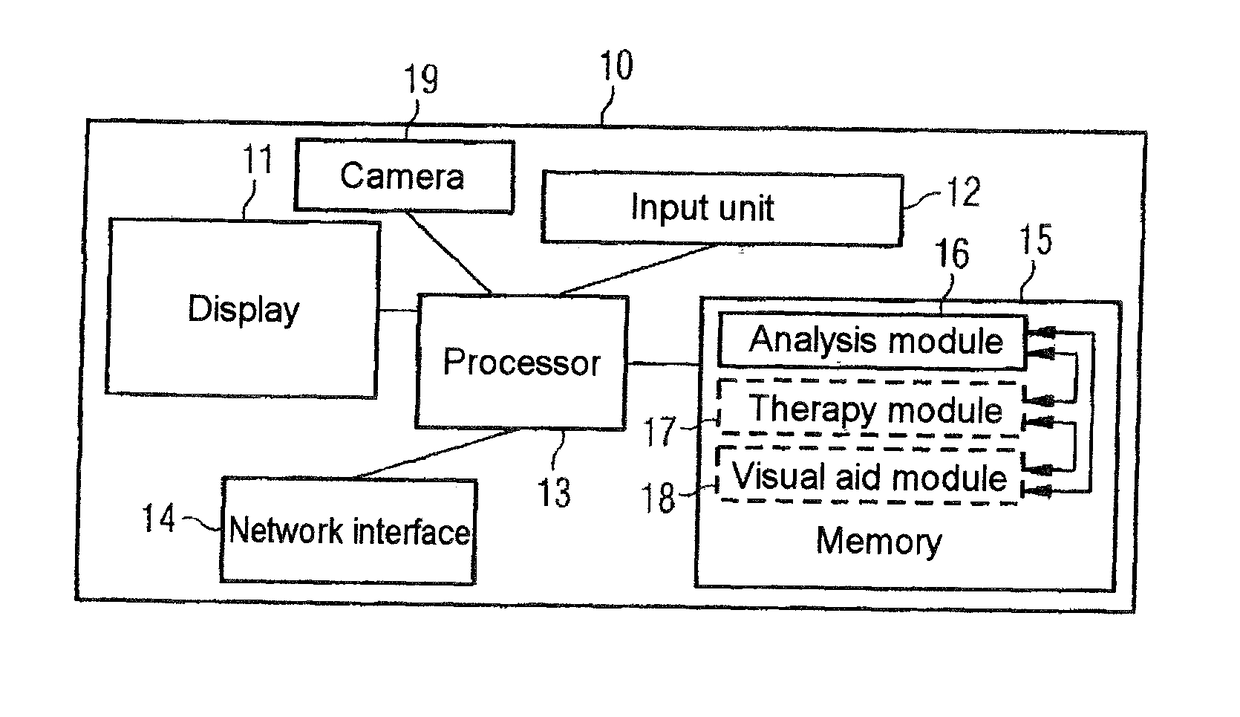
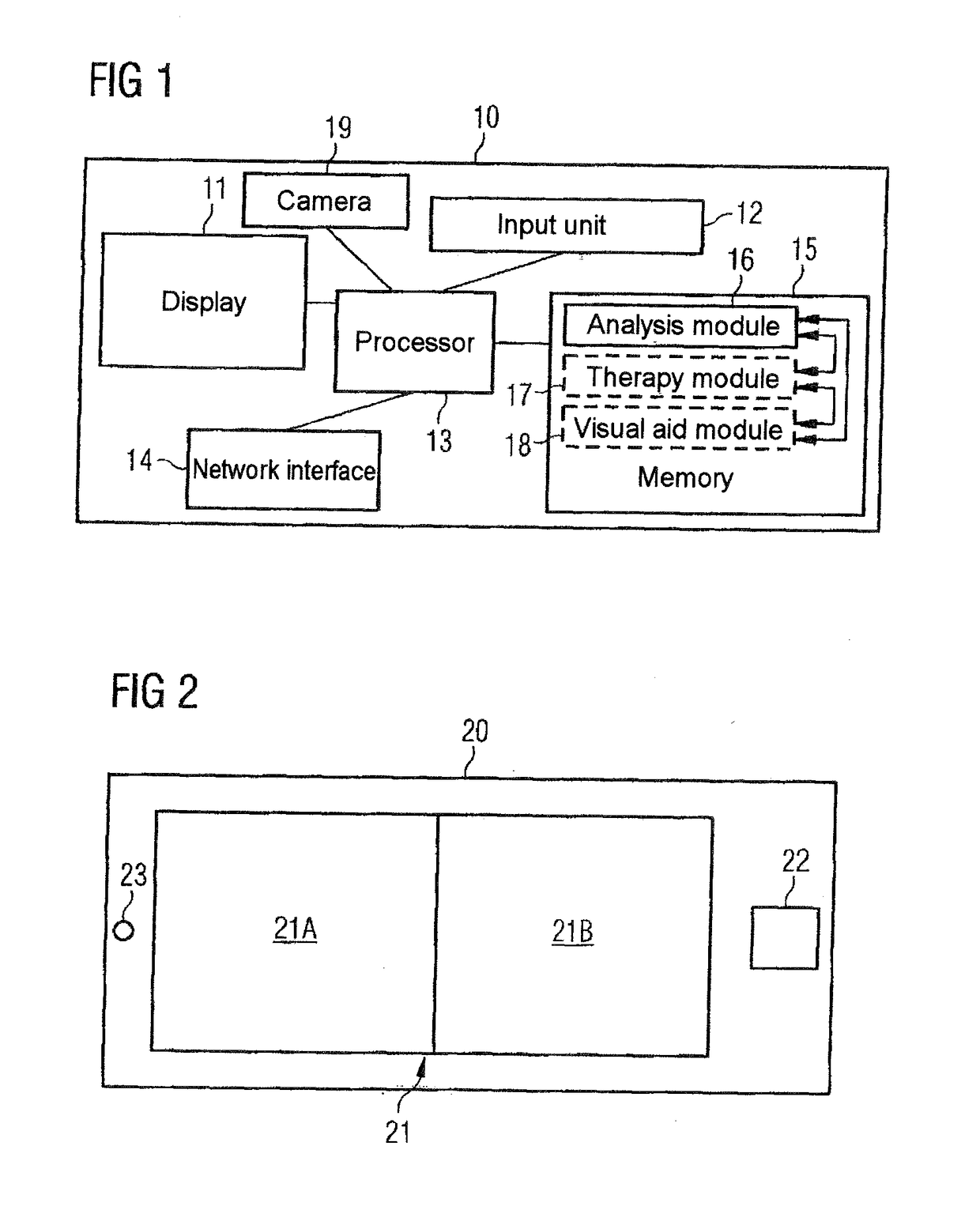
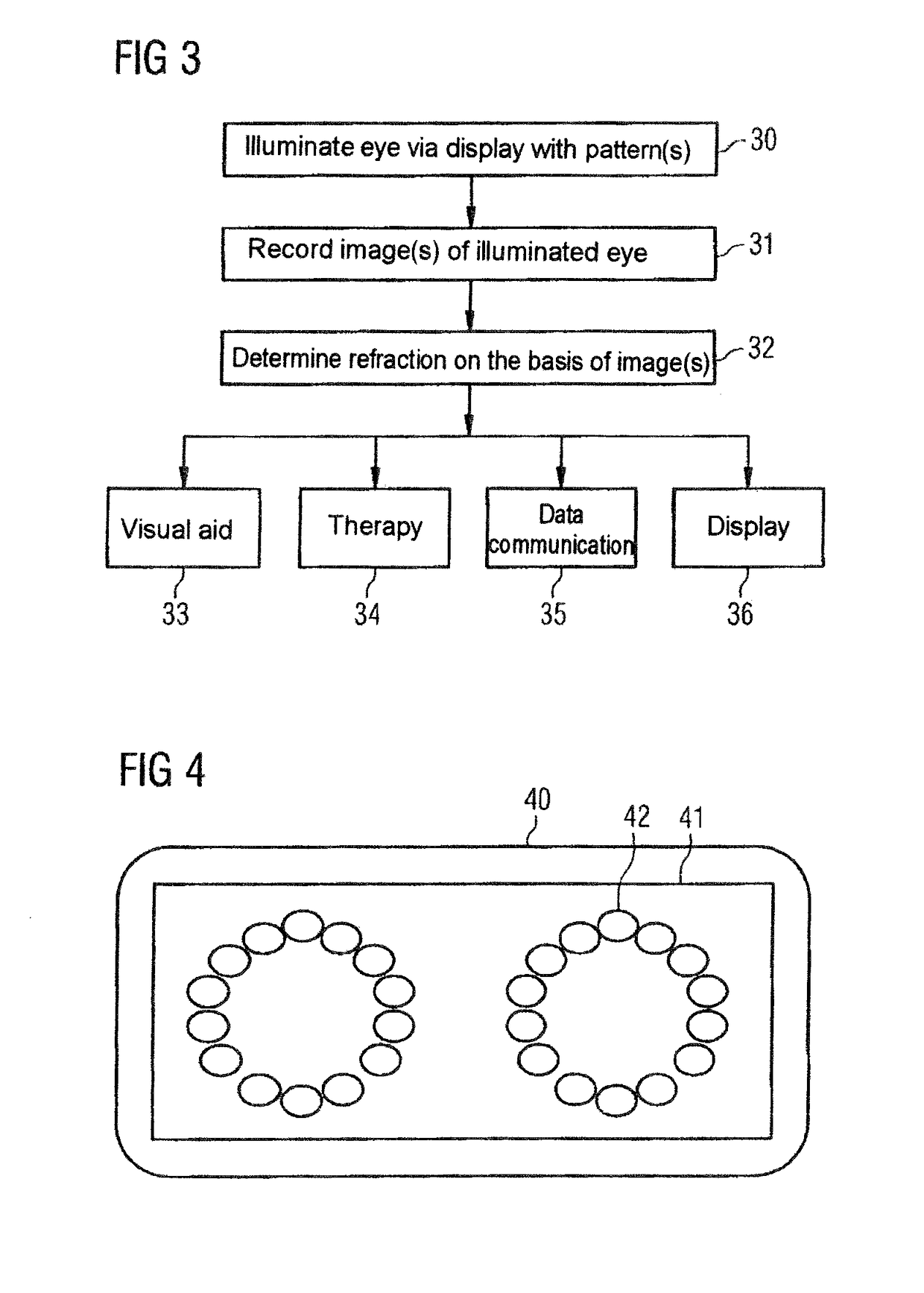
[0076]FIG. 1 illustrates a mobile computer device 10 in accordance with one embodiment. The mobile computer device 10 may be implemented for example by means of a smartphone, a tablet computer or by means of some other mobile computer device (for example a mobile gaming device). Such mobile computer devices which may serve as a basis...