Unlock instant, AI-driven research and patent intelligence for your innovation.

Sensor output correction apparatus

Active Publication Date: 2018-07-05
DENSO CORP +1
View PDF0 Cites 4 Cited by
  • Summary
  • Abstract
  • Description
  • Claims
  • Application Information

AI Technical Summary

Benefits of technology

The invention aims to solve the problem of a sensor output correction apparatus that may result in a deviation of the zero-point correction value from the actual deviation of the sensor. The invention proposes a method to determine the correction value corresponding to the deviation of the current zero point while the vehicle is moving, which minimizes the risk of the correction value differing from the actual deviation of the sensor.

Problems solved by technology

Actually, the center value of a sensor output (i.e., a zero-point) is shifted from a design zero-point (i.e., zero) due to aging or temperature characteristics of the sensor or an initial deviation of the sensor output, thus resulting in an error of the detected value caused by the shift in the zero-point.

Method used

the structure of the environmentally friendly knitted fabric provided by the present invention; figure 2 Flow chart of the yarn wrapping machine for environmentally friendly knitted fabrics and storage devices; image 3 Is the parameter map of the yarn covering machine
View more

Image

Smart Image Click on the blue labels to locate them in the text.
Viewing Examples
Smart Image
  • Sensor output correction apparatus
  • Sensor output correction apparatus
  • Sensor output correction apparatus

Examples

Experimental program
Comparison scheme
Effect test

first embodiment

Summary of First Embodiment

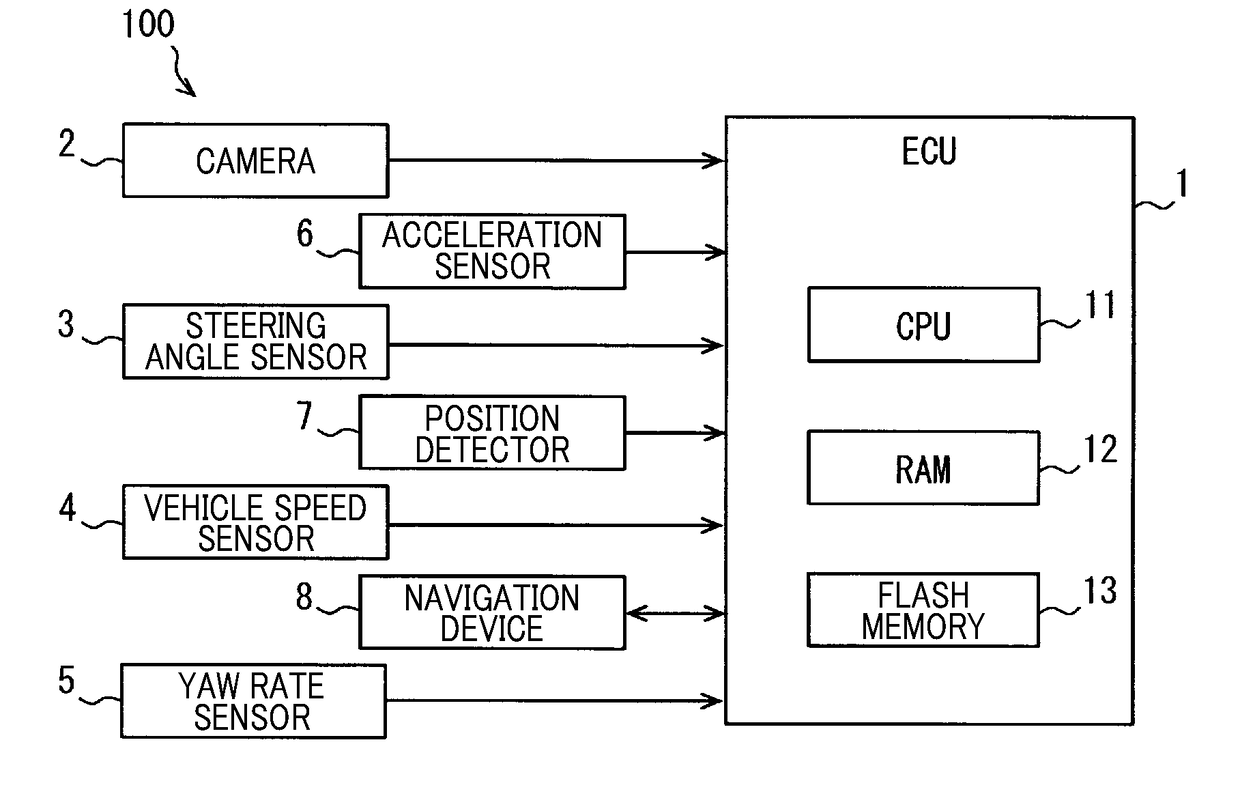
[0071]With the above arrangements, when having acquired N detected values of the yaw rate sensor 5 while the sampling condition is being satisfied (i.e., YES in step S106), the ECU 1 uses the N detected values to update the correction value Q as corresponding to the current zero-point equivalent value Yz. It is, thus, possible to update the correction value Q while the system-mounted vehicle is moving. The fact that the sampling condition is met means that the system-mounted vehicle is moving on the straight road, the travel speed is higher than or equal to the vehicle speed threshold value Vth, and the steered angle θ is less than the steering angle threshold value θth.

[0072]As an alternative to calculate the correction value (which will also be referred to below as a first comparative mode), it is possible to calculate or update the correction value using the detected values sampled when the system-mounted vehicle is stopped. The deviation of the zero po...

second embodiment

[0092]The second embodiment of the invention will be described below using the drawings. In the following discussion, the same reference numbers, as employed in the first embodiment (and the modification thereof), will refer to parts having functions similar to those in the first embodiment, and explanation thereof in detail will be omitted here. When the following discussion refer to only portions of the parts, the explanation in the first embodiment (and the modification thereof) apply to other portions of the parts.

[0093]A major feature in the second embodiment which is different from those in the first embodiment and the modification of the first embodiment is that the zero-point determination portion F5 weights and adds the zero-point equivalent value Yz, as newly determined, and the correction value now being used using a given weight a (≤a≤1) to update the correction value Q. If the correction value, as now being used, is defined as Qa, the correction value Q which will be ne...

third embodiment

[0117]A major feature in the third embodiment which is different from those in the first embodiment and the modification of the first embodiment is that the zero-point equivalent value Yz, as most recently determined using the detected values sampled when the system-mounted vehicle is parked or stopped (which will also be referred to below as a while-stationary determined value Yzstp), and the zero-point equivalent value Yz, as most recently determined using the detected values sampled while the system-mounted vehicle is moving (which will also be referred to as an in-motion determined value Yzrun), are added to each other using a given weight β(T) (0≤β≤1) to newly derive the correction value Q. Specifically, the correction value Q is given by Eq 2 below.

Q=Yzstp×β(T)+Yzrun×{1−β(T)}  Eq. 2

[0118]The weight β(T) is determined as a function of a time T elapsed since the while-stationary determined value Yzstp was obtained. Specifically, the shorter the time T elapsed since the while-sta...

the structure of the environmentally friendly knitted fabric provided by the present invention; figure 2 Flow chart of the yarn wrapping machine for environmentally friendly knitted fabrics and storage devices; image 3 Is the parameter map of the yarn covering machine
Login to View More

PUM

No PUM Login to View More

Abstract

A sensor output correction system is provided which is capable of minimizing a risk that a correction value for use in zero-point correction differs from an actual deviation of a zero-point. An ECU includes a travel road information acquisition portion which obtains a curvature of a travel road on which a system-mounted vehicle is traveling and a vehicle information acquisition portion which obtains a detected value of a yaw rate sensor. The ECU determines whether the system-mounted vehicle is traveling on a straight path or not based on the curvature derived by the travel road information acquisition portion. The ECU determines a value (i.e., a zero-point equivalent value) which corresponds to a deviation of a current zero point of the yaw rate sensor based on detected values of the yaw rate sensor sampled while the system-mounted vehicle is moving on the straight path. The ECU determines a correction value which is subtracted from the detected value using the zero-point equivalent value.

Description

TECHNICAL FIELD[0001]The present invention generally relates to a sensor output correction apparatus designed to correct an output value of a sensor installed in a vehicle.BACKGROUND ART[0002]There are vehicles in which various types of sensors, such as a yaw rate sensor, a steering angle sensor, and an acceleration sensor, are mounted. Errors contained in output values of such sensors (which will also be referred to as detected values) are preferably zero for use in various control operations.[0003]Actually, the center value of a sensor output (i.e., a zero-point) is shifted from a design zero-point (i.e., zero) due to aging or temperature characteristics of the sensor or an initial deviation of the sensor output, thus resulting in an error of the detected value caused by the shift in the zero-point. In order to eliminate such a problem, various structures have been proposed which calculate an amount of deviation of the zero-point of the sensor and correct a detected value of the s...

Claims

the structure of the environmentally friendly knitted fabric provided by the present invention; figure 2 Flow chart of the yarn wrapping machine for environmentally friendly knitted fabrics and storage devices; image 3 Is the parameter map of the yarn covering machine
Login to View More

Application Information

Patent Timeline
no application Login to View More
IPC IPC(8): G01C19/5776G01D18/00G01P21/00G01C21/26
CPCG01C19/5776G01D18/00G01P21/00G01C21/265G01C25/005G01D3/032G01C19/00
Inventor OKA, KAZUMICHIKINUGASA, HIDENOBUOKUDA, YUJI
Owner DENSO CORP