
Guard and Control Apparatus for Safe Operation of a Rotary Cutter
- Summary
- Abstract
- Description
- Claims
- Application Information
AI Technical Summary
Benefits of technology
Problems solved by technology
Method used
Image

Examples
first embodiment
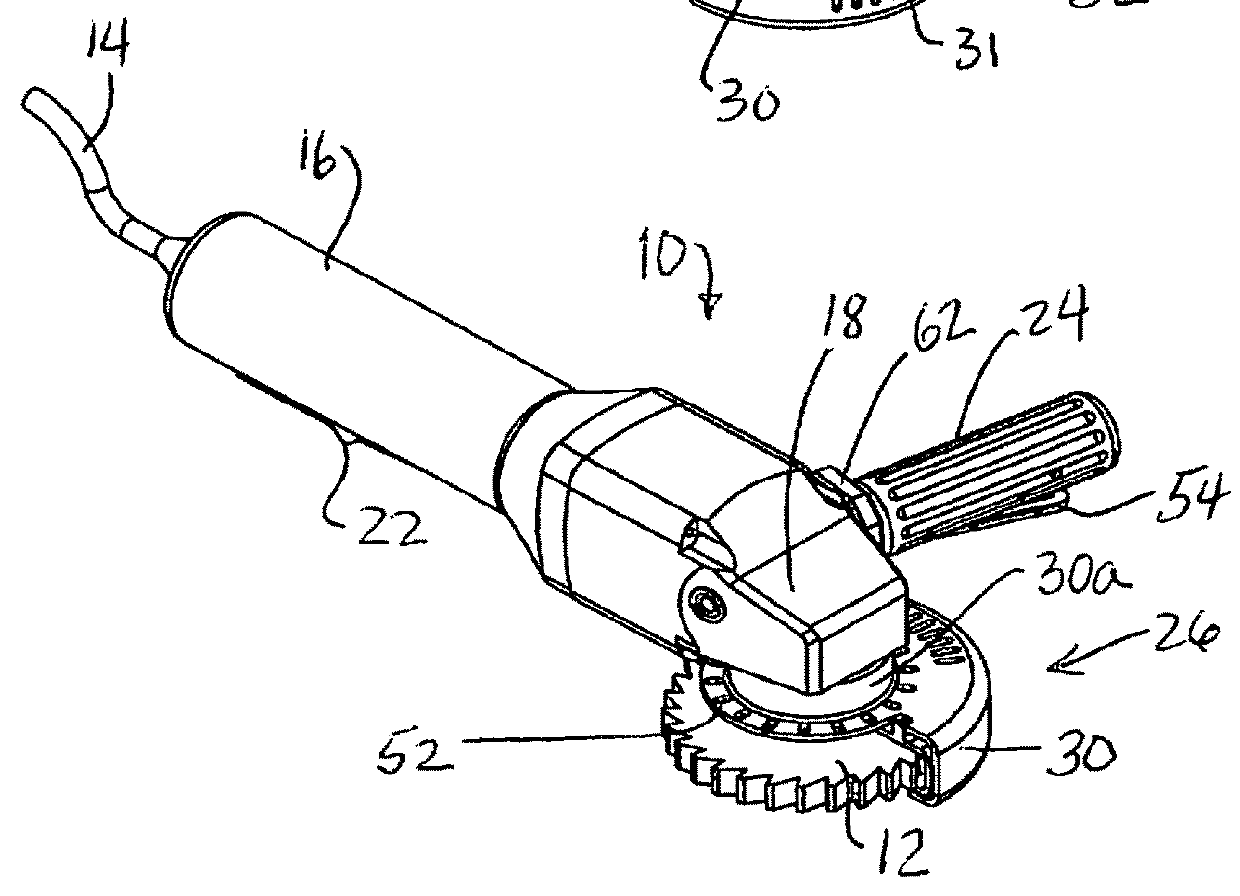
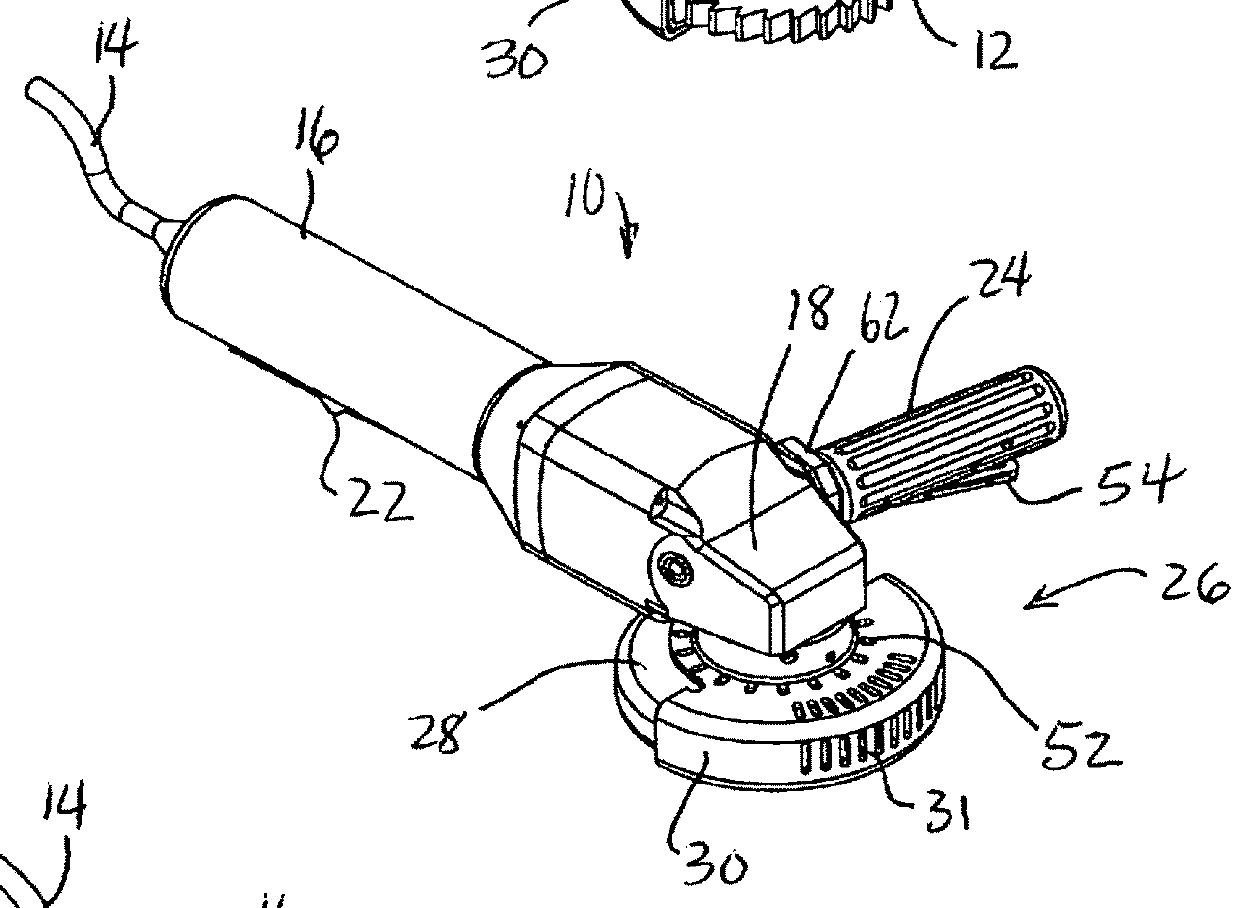
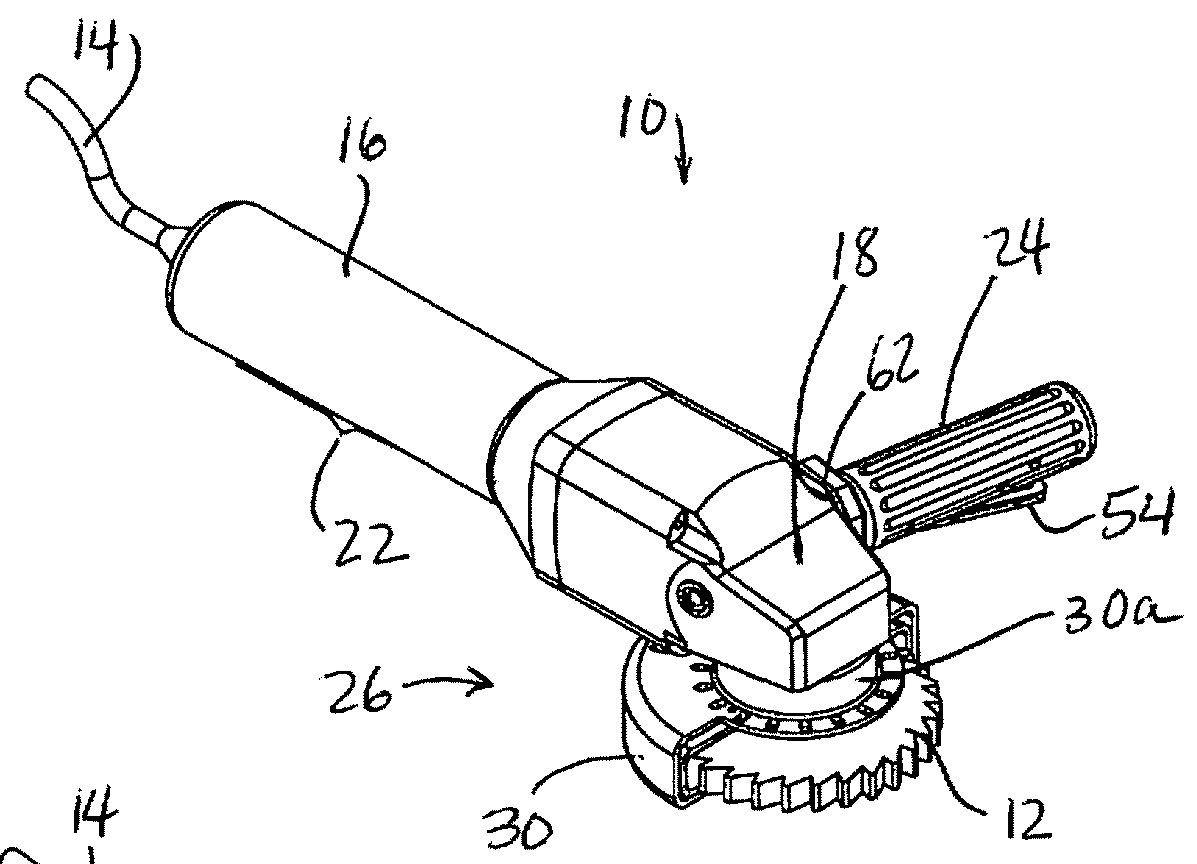
[0026]Referring to the first embodiment, and particularly to FIGS. 2A-2B, the fixed and retractable guard portions 28, 30 have coaxial tubular collars 28a, 30a that axially overlap and fit over the spindle 19. In this embodiment, the rotary orientation of the fixed guard portion 28 can be locked in any desired position, and the locking mechanism for securing the fixed guard portion 28 to the spindle 19 is implemented with a pair of set screws 36 threaded into the collar 28a. When sufficiently tightened, the set screws 36 forcibly engage the spindle 19, preventing further rotation of the fixed guard portion 28 with respect to the spindle 19. As seen in FIG. 2A, the collar 30a of retractable guard portion 30 is provided with openings 46 through which the set screws 36 can be accessed when the retractable guard portion 30 is in the default or un-retracted position. Adjusting the orientation of the guard mechanism 26 as described above is accomplished by loosening the set screws 36 to p...
second embodiment
[0033]Turning now to FIGS. 5-7 and second embodiment of this invention, the elements that correspond but differ from those of the first embodiment are designated by primed like reference numerals. For example, the guard mechanism is generally designated by the reference numeral 26′, and the fixed and retractable guard portions are designated by the reference numerals 28′ and 30′, respectively. As mentioned above, the main functional difference between the two embodiments is that the rotary orientation of the guard mechanism 26′ can be locked in one of limited number of preset positions. While this limits the way the guard mechanism 26′ can be used, it allows a locking mechanism that is more robust than the set screws 36 of the first embodiment, and allows the user to make deeper plunge cuts with the cutting element 12. Another difference, albeit incidental, is that the guard mechanism 26′ of the second embodiment is configured so that its retractable guard portion 30′ retracts throu...
PUM
| Property | Measurement | Unit |
|---|---|---|
| Force | aaaaa | aaaaa |
Abstract
Description
Claims
Application Information
 Login to View More