

Storage tier-based volume placement
a tier-based, volume placement technology, applied in the direction of instruments, input/output to record carriers, computing, etc., can solve the problems of inefficiency and excess cost to both users and providers
- Summary
- Abstract
- Description
- Claims
- Application Information
AI Technical Summary
Benefits of technology
Problems solved by technology
Method used
Image

Examples
Embodiment Construction
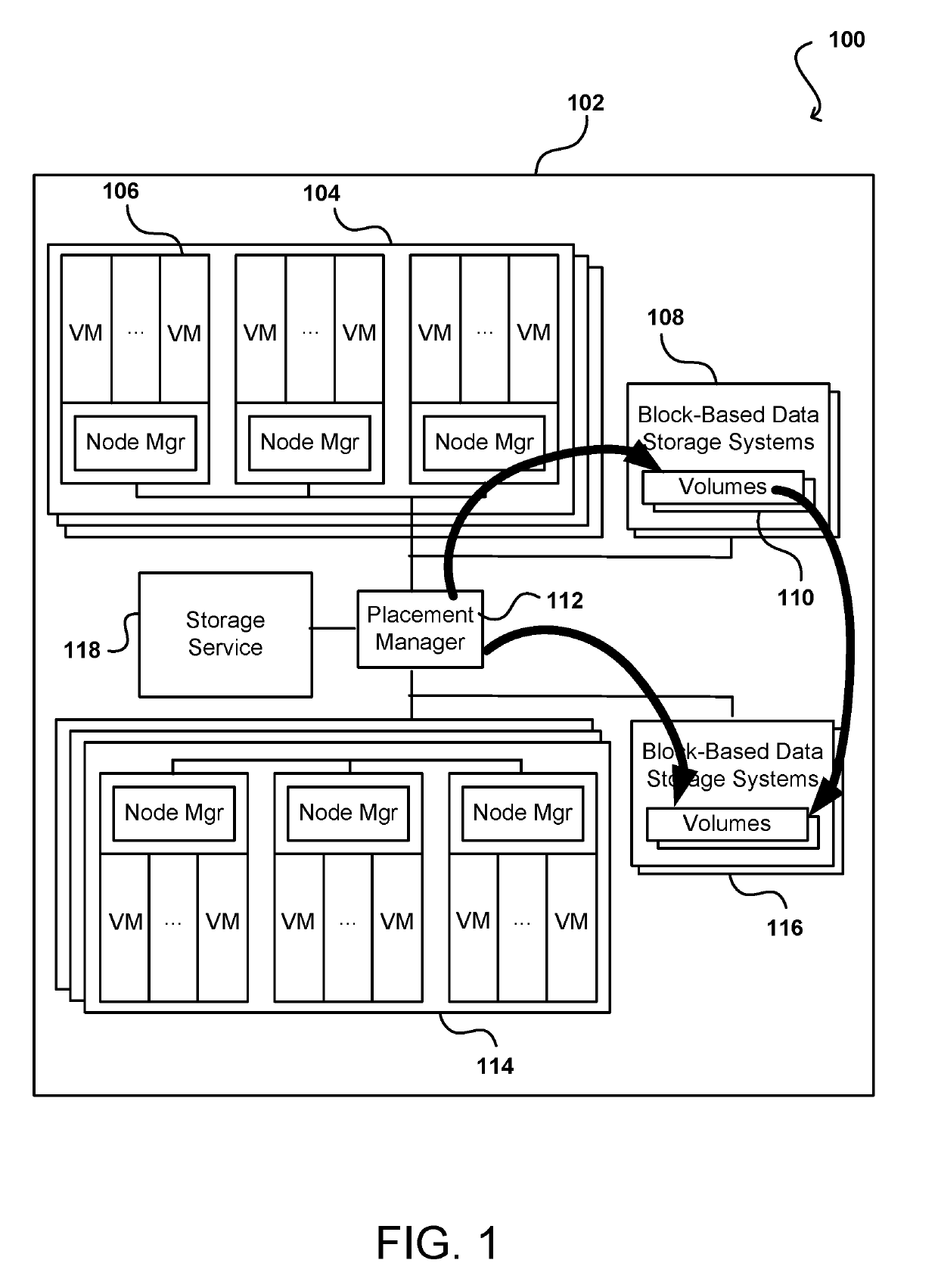
[0013]Systems and methods in accordance with various embodiments of the present disclosure overcome one or more of the aforementioned and other deficiencies experienced in conventional approaches to managing aspects of resource sharing and allocation in an electronic environment. In particular, various embodiments provide for the placement and movement of data volumes, and other such resource allocations, based at least in part upon the types of volumes available and an observed and / or prediction usage pattern for the corresponding customer.
[0014]In some embodiments, data volumes can be created on specific storage tiers that are selected specifically to be of adequate performance for most data volumes. Storage tiers can include, for example, types of storage hardware, such as magnetic (e.g., disk or tape) or solid state drive (SSD) storage, and / or types of storage systems, such as in-memory (local) storage, block storage, object storage, archival storage, or general cloud storage sy...
PUM
 Login to View More
 Abstract
Description
Claims
Application Information
 Login to View More