Mathematical normalization of sequence data sets

a sequence data and mathematical normalization technology, applied in the field of multiplexed data set optimization, can solve problems such as unnecessarily inflating apparent variability

Pending Publication Date: 2019-11-21
ROCHE MOLECULAR SYST INC
View PDF0 Cites 0 Cited by
  • Summary
  • Abstract
  • Description
  • Claims
  • Application Information

AI Technical Summary

Benefits of technology

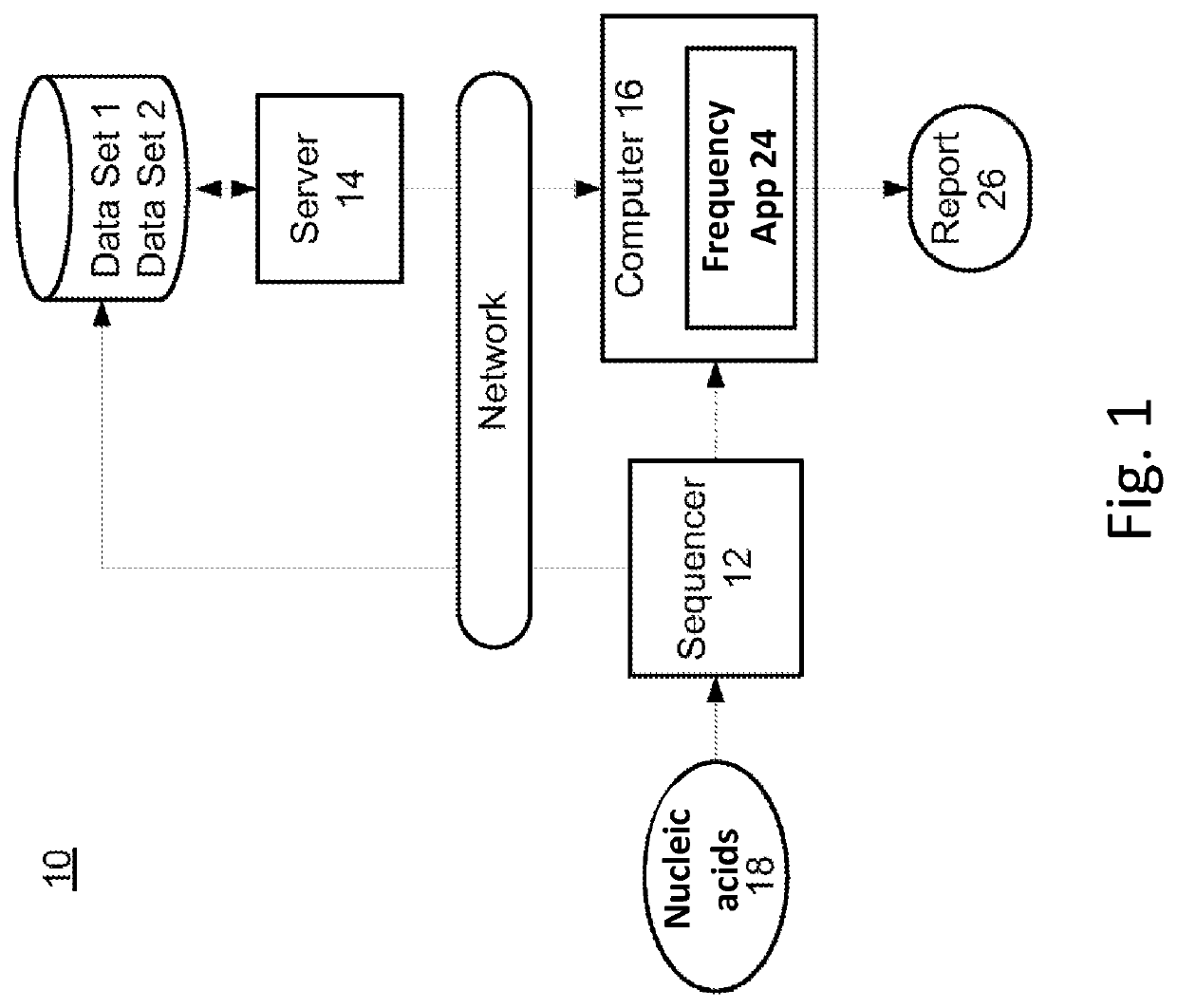
[0008]The invention comprises a system and processes for normalizing frequency data within a single data set using data generated from multiplexed sequencing systems. More particularly, the present invention provides processes to identify differences in sequence frequencies of a locus, a sample, and / or a grouping of multiple loci (e.g., a chromosome or sub-chromosomal region) relative to the other sequences in a multiplexed set of sequence data. The processes of the invention utilize this information to minimize empirically-introduced differences present in sequences within the multiplexed set of sequence data. The multiplexed systems of the invention provide an integrated means for distinguishing between the individual molecules being sequenced, e.g., through the use of indices associated with a locus, sample and / or chromosome and / or sequence differences inherent in different genomic regions, allowing for the simultaneous processing of sequences under the same conditions.
[0012]In one aspect, the invention provides a computer implemented process for the normalization of the frequency data of an individual sequence within a single multiplexed data set, comprising: providing a multiplexed data set having frequency data on at least 16 biological molecules, and subjecting the detected frequency of a sequence from an individual biological molecule to a mathematical transformation based on the frequency of at least 15 other sequences within the data set to reduce experimentally introduced variation of the sequence. This variation can be based on an assumption of expected behavior for those particular sequences. In certain aspects, data on sequences with behavior well outside the expected are masked during the normalization process to improve results. For example, if a locus is more or less efficient than other loci that predicted to have the same behavior, the frequency for that locus can be normalized to be more like the other loci. Similarly, for samples, the frequency of sequences detected per locus within a genetic class (e.g. chromosome or genomic region in the same sample) can be made equivalent, because samples should have the same “typical” frequency per locus in order to make a meaningful comparison.
[0018]The levels of nucleic acids within the multiplexed data set can be used to determine a mean or a median that provides an established reference point. Thus, in some aspects the sequencing counts per sample are standardized so that the median per locus sequencing counts are scaled to such an established reference point. This allows samples to be compared to one another to determine more physiologically meaningful data.
[0022]In a more specific aspect, the processes of the invention are used to normalize sequencing data to determine a fetal chromosomal or sub-chromosomal abnormality (e.g., a trisomy or monosomy) in a mixed sample. In this aspect, the present invention provides processes to identify differences in sequence frequencies of loci from a fetal chromosome or sub-chromosomal region relative to one or more other chromosomes or regions in one or more maternal samples using a multiplexed set of sequence data. The processes of the invention utilize this information to minimize empirically-introduced differences present in sequences from these genomic regions, and optimize the identification of potential duplications, deletions, and / or aneuploidies within the multiplexed set of sequence data. The multiplexed systems of the invention provide an integrated means for distinguishing between the individual molecules being sequenced from different samples, e.g., through the use of indices associated with a sample, allowing for the simultaneous interrogation of chromosomal abnormalities in two or more samples under the same conditions.
[0024]In certain aspects, the individual sequences within a multiplexed data set may be subjected to an amplification reaction of the individual molecules prior to sequence determination. The invention thus comprises processes for quantifying nucleic acid sequences present in a single, multiplexed data set that have been subjected to such amplification. Specifically, the invention provides systems and processes comprising the steps of: amplifying at least 16 biological molecules; sequencing the amplification products of the at least 16 biological molecules in a single, multiplexed data set, wherein the sequencing data is indicative of a detected quantity of progeny sequences arising from amplification of the individual sequences in the set; comparing the sequence data frequency on the biological molecules to the frequency of an individual sequence to identify overall differences in the sequence levels of the biological molecules, and subjecting the detected frequency of the individual sequences to a mathematical transformation based on the frequency data of at least 16 other sequences within the data set to reduce experimentally introduced variation in the frequency data of the biological molecules.

Problems solved by technology

However, if a reference demonstrates substantial batch effects or lab to lab systemic effects, this may unnecessarily inflate apparent variability and lead to erroneous results.

Method used

the structure of the environmentally friendly knitted fabric provided by the present invention; figure 2 Flow chart of the yarn wrapping machine for environmentally friendly knitted fabrics and storage devices; image 3 Is the parameter map of the yarn covering machine
View more

Image

Smart Image Click on the blue labels to locate them in the text.
Viewing Examples
Smart Image
  • Mathematical normalization of sequence data sets
  • Mathematical normalization of sequence data sets
  • Mathematical normalization of sequence data sets

Examples

Experimental program
Comparison scheme
Effect test

example 1

spects of the Processes of the Invention

[0087]To assess chromosome proportion, assays were performed against 576 non-polymorphic loci on each of chromosome 18 and chromosome 21, where each assay consisted of three locus specific oligonucleotides: a left oligo with a 5′ universal amplification tail, a 5′ phosphorylated middle oligo, and a 5′ phosphorylated right oligo with a 3′ universal amplification tail. To assess fetal fraction, we designed assays against a set of 192 SNP-containing loci on chr1-12, where two middle oligos, differing by one base, were used to query each SNP. SNPs were optimized for minor allele frequency in the HapMap 3 dataset. Oligonucleotides were synthesized by IDT and pooled together to create a single multiplexed DANSR assay pool.

[0088]Products from 96 independent samples were pooled and used as template for cluster amplification on a single lane of a TruSeq v2 SR flow slide (Illumina, San Diego, Calif.). The slide was processed on an Illumina HiSeq 2000 to...

example 2

fect Removal

[0089]In a first example, the processes of the invention were utilized to remove variations in sequence counts between multiple samples in a multiplexed sequence data set. The raw per-sample sequence counts were determined as per Example 1. FIGS. 2A and 2B are a plot of such determined sequences. Each box plot demonstrates the raw, unadjusted sequence counts for all chromosomes within a sample, with each smaller box representing a set of all loci for a given sample. As illustrated, certain samples generated more or less median sequence counts than other samples. In the bottom panel, the same samples are plotted after median-centering normalization by scaling each sample's median count to a reference count of 1000. Noticeably, the systematic biases pertaining to certain samples were removed.

example 3

ect Removal

[0090]In a next example, sequences from a multiplexed sequence data set with counts representing a single locus were normalized using the processes of the invention. The processes of the invention were utilized to remove variations in sequence counts between the same locus from various samples. Raw per-locus sequence counts for chromosome 21 determined as per Example 2 are plotted as box-plots in FIG. 3A. Each box is a plot of all samples for a given locus. Each box is a plot of all samples for a given locus. FIG. 3B illustrates the same loci in FIG. 3A from chromosome 21 after normalization was performed using the Median-Polish algorithm [Tukey, J W. Exploratory Data Analysis. Reading Mass.: Addison-Wesley. 1977] with other sequences within the multiplexed data set. Noticeably, the systematic biases pertaining to certain loci were removed.

the structure of the environmentally friendly knitted fabric provided by the present invention; figure 2 Flow chart of the yarn wrapping machine for environmentally friendly knitted fabrics and storage devices; image 3 Is the parameter map of the yarn covering machine
Login to View More

PUM

No PUM Login to View More

Abstract

The invention provides processes of the present invention provide normalization procedures for sequences within multiplexed data sets using the sequence information from multiplexed sequencing data set itself rather than the utilization of any external references.

Description

CROSS-REFERENCE TO RELATED APPLICATIONS[0001]This application claims the benefit of U.S. provisional Patent Application Ser. No. 61 / 577,013, filed Dec. 17, 2011 and is incorporated herein by reference.FIELD OF THE INVENTION[0002]This invention relates to methods for optimizing data in multiplexed data sets.BACKGROUND OF THE INVENTION[0003]In the following discussion certain articles and methods will be described for background and introductory purposes. Nothing contained herein is to be construed as an “admission” of prior art. Applicant expressly reserves the right to demonstrate, where appropriate, that the articles and methods referenced herein do not constitute prior art under the applicable statutory provisions.[0004]Detection of nucleic acid levels in biological samples has wide applicability in numerous areas of biological enquiry. Identification of nucleic acid levels in a sample, including levels of DNA associated with copy number variation and levels of RNA associated with...

Claims

the structure of the environmentally friendly knitted fabric provided by the present invention; figure 2 Flow chart of the yarn wrapping machine for environmentally friendly knitted fabrics and storage devices; image 3 Is the parameter map of the yarn covering machine
Login to View More

Application Information

Patent Timeline
no application Login to View More
Patent Type & AuthorityApplications(United States)
IPC IPC(8): G16B99/00G16B20/00G16B30/00G16B20/10G16B20/20
CPCG16B30/00G16B20/00G16B99/00G16B20/20G16B20/10C12N15/1003C12N15/1082
InventorOLIPHANT, ARNOLDSPARKS, ANDREWWANG, ERICSTRUBLE, CRAIG
OwnerROCHE MOLECULAR SYST INC