
Hppd variants and methods of use
a polypeptide and variant technology, applied in the field of plant molecular biology, can solve the problems of chlorophyll destruction by ultraviolet radiation and reactive oxygen species, deficiency of accessory light-harvesting pigments, and uncoupling of photosynthesis, and achieve the effects of increasing the tolerance of hppd, reducing the risk of toxicity, and increasing the tolerance of inhibitors
- Summary
- Abstract
- Description
- Claims
- Application Information
AI Technical Summary
Benefits of technology
Problems solved by technology
Method used
Image

Examples
example 1
of Mutated HPPD Polypeptides by Site-Directed Mutagenesis
[0352]The Pseudomonas fluorescens HPPD nucleotide sequence (SEQ ID NO:70) as described in WO2009 / 144079 encoding the HPPD polypeptide corresponding to SEQ ID NO:1 was cloned according to well known methods in the art and as described in WO2014 / 043435. Subsequent site-saturated mutagenesis, site-directed mutagenesis and combinatorial variants with one or more mutations of the nucleic acid encoding sequence of wild-type PfHPPD polypeptide encoding the recombinant HPPD polypeptide corresponding to SEQ ID NO: 1 were carried out using standard PCR-based technologies well known in the art (and as described likewise in WO2014 / 043435). All designed and synthesized mutant clones were confirmed by DNA sequencing using plasmid specific oligonucleotides. Table 2, below, summarizes the exemplary mutant HPPD polypeptides (SEQ ID NO:2 to NO:69).
TABLE 2Overview of exemplary amino acid exchanges corresponding to amino acidposition in SEQ ID NO...
example 2
Expression, and Purification of Recombinant Wild-Type and Mutant HPPD Polypeptides
[0354]All resulting nucleic acid encoding sequences of wild-type and mutant HPPD encoding the recombinant HPPD polypeptide were cloned, produced and purified using methods well known in the art (Sambrook et al., Molecular Cloning: A Laboratory Manual, 3rd ed., CSH Laboratory Press, 2001, Cold Spring Harbor, N.Y.). All resulting nucleic acid encoding sequences were cloned into pSE420(RI)NX fused with an N-terminal His-tag (encoding the amino acid sequence M1-A2-H3-H4-H5-H6-H7-H8-), as described in WO2014 / 043435, and were expressed in Escherichia coli strain BL21 (DE3) (New England Biolabs, Frankfurt, Germany). For clarity, all listed positions with the respective amino acid exchanges from mutant HPPD polypeptides in Tables 1 to 5 corresponding to SEQ ID NO:2 to NO:69 in this invention, refer to the native wild-type HPPD amino acid sequence without the N-terminal His-tag corresponding to SEQ ID NO:1.
[035...
example 3
me Assay to Analyse Mutant HPPD Polypeptides with Improved HPPD Inhibitor Herbicide Tolerance
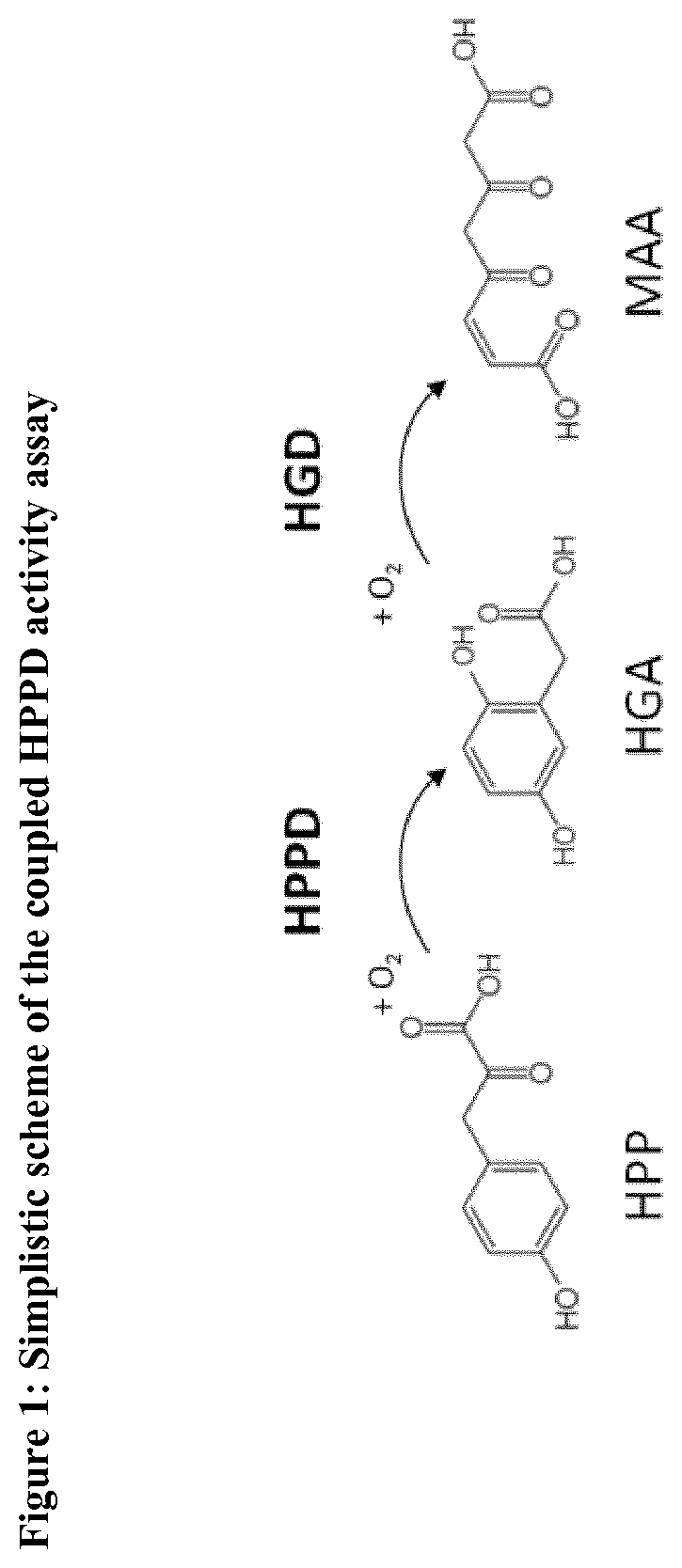
[0360]The activity of HPPD polypeptides was determined in absence or presence of HPPD inhibitors using the coupled HPPD activity assay (FIG. 1).
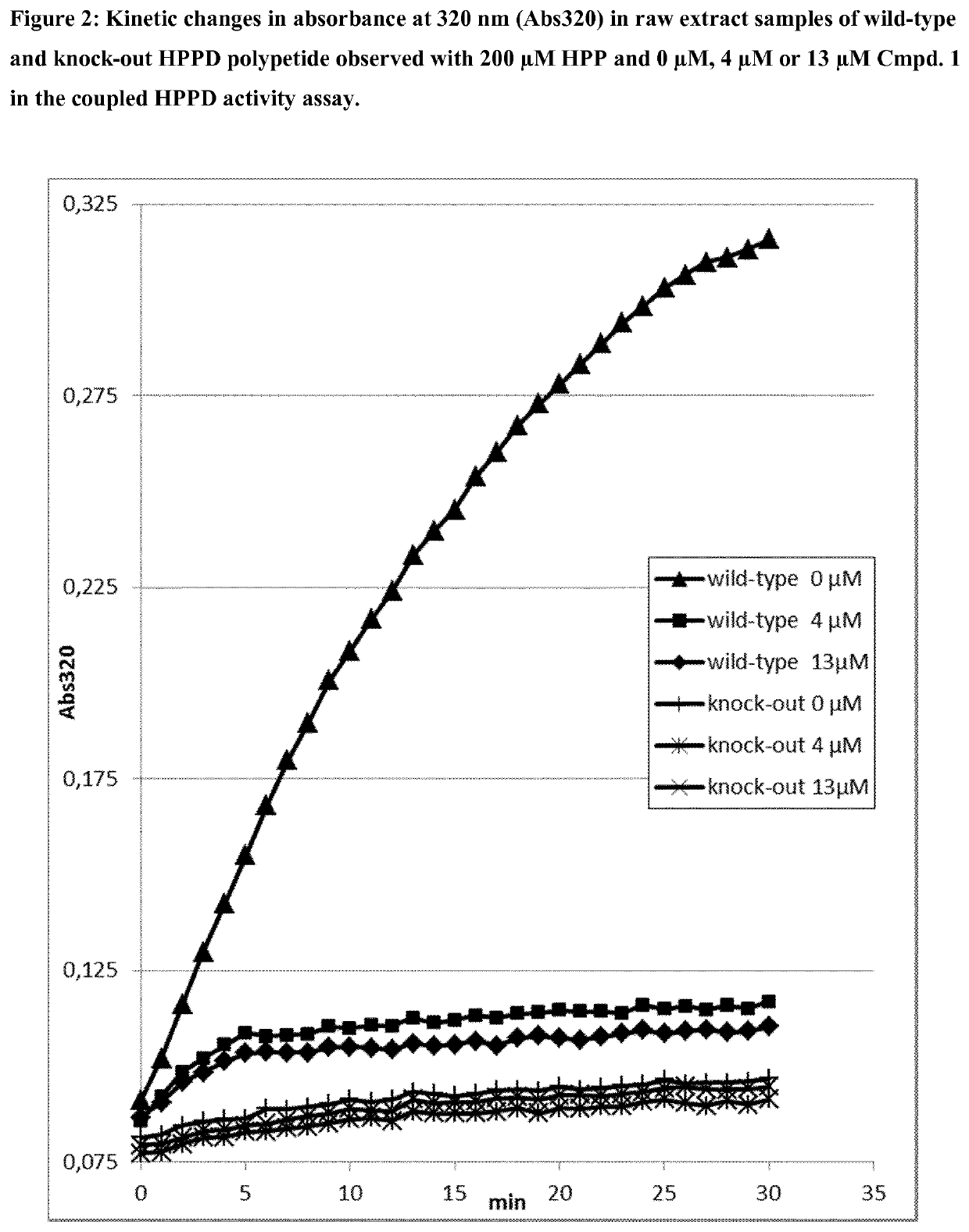
[0361]For the determination of the residual activity, the apparent kinetic constant (kapp) of the determined substrate conversion was measured as kinetic changes in absorbance (OD) at 320 nm in a coupled assay, in that homogentisate (HGA) formed by HPPD from HPP is directly converted into the well absorbing molecule maleylacetoacetate (MAA) by a second enzyme homogentisate dioxygenase (HGD), applied in excess uniformly in all assays (see FIG. 1). The measurements were performed in 384 micro titer plates (Greiner Bio-One GmbH, Frickenhausen, Germany) by plate readers (Tecan infinite M1000 or M1000PRO, Tecan, Minnedorf, Switzerland). The kat / kM ratio of an enzymatic activity is proportional to the apparent kinetic constant kapp and is proportional to k...
PUM
| Property | Measurement | Unit |
|---|---|---|
| temperature | aaaaa | aaaaa |
| pH | aaaaa | aaaaa |
| pH | aaaaa | aaaaa |
Abstract
Description
Claims
Application Information
 Login to View More