Image processing apparatus and non-transitory computer readable medium
a technology of image processing and computer readable media, which is applied in the direction of electrical equipment,pictoral communication, etc., can solve the problems of separating one value into two values, affecting the visibility of images, so as to achieve the effect of improving the visibility of images
- Summary
- Abstract
- Description
- Claims
- Application Information
AI Technical Summary
Benefits of technology
Problems solved by technology
Method used
Image



Examples
first exemplary embodiment
[0031]A first exemplary embodiment of the present disclosure will be described below with reference to the drawings. In the drawings, identical or equivalent components and sections are given the same reference signs. Furthermore, the dimensional ratios in the drawings are exaggerated for the sake of convenience and may sometimes differ from the actual ratios.
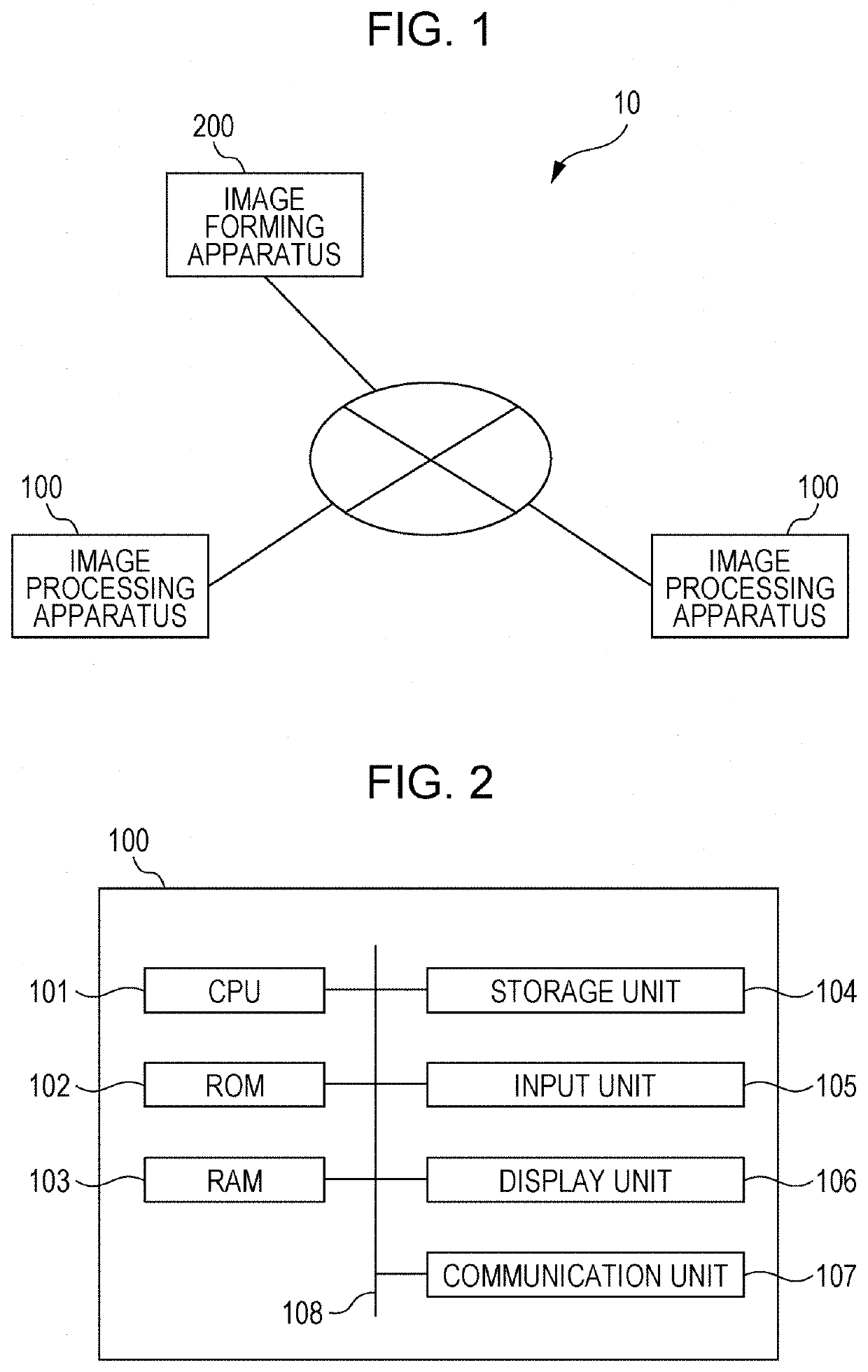
[0032]FIG. 1 schematically illustrates the configuration of an image processing system 10 according to the first exemplary embodiment.
[0033]As shown in FIG. 1, in the image processing system 10, image processing apparatuses 100 and an image forming apparatus 200 are connected to a communication unit, such as a network. As will be described later, the communication unit used may be any of various types of networks, such as the Internet, an intranet, and Ethernet (registered trademark). Although two image processing apparatuses 100 and a single image forming apparatus 200 are shown in FIG. 1, the number of image processing appara...
second exemplary embodiment
[0091]Next, a second exemplary embodiment will be described.
[0092]The first exemplary embodiment described above relates to an example where a reproduction parameter is estimated by using the average brightness of a dark area alone (see Expression 8). In the second exemplary embodiment, a reproduction parameter is estimated in view of the percentage of the size (i.e., the number of pixels) of a dark area.
[0093]The following description focuses on differences from the first exemplary embodiment described above, and redundant explanations will be simplified or omitted.
[0094]In order to take into account the percentage of the number of pixels in a dark area, the coefficient a in Expression 8 described in the first exemplary embodiment is replaced with a coefficient a(r) serving as a function of the percentage of the number of pixels in the dark area, as indicated in Expression 10.
α=a(r)×*ave Expression 10
[0095]For example, assuming that the coefficient a(r) in Expression 10 is a line...
third exemplary embodiment
[0104]Next, a third exemplary embodiment will be described.
[0105]In the first exemplary embodiment and the second exemplary embodiment described above, the compression rate of the color gamut of the output device relative to that of the input device is saved in advance as information, and the calculation is performed uniformly by using the compression rate. Thus, the compression rate varies depending on the device, but does not vary depending on the image. In the third exemplary embodiment, the compression rate is calculated based on pixel information of an input image, so that the compression rate varies depending on the image. Accordingly, an output-device optimal reproduction parameter may be set more appropriately in accordance with the image.
[0106]The following description focuses on differences from the first exemplary embodiment and the second exemplary embodiment described above, and redundant explanations will be simplified or omitted.
[0107]FIG. 16 illustrates a block diagr...
PUM
 Login to View More
 Abstract
Description
Claims
Application Information
 Login to View More