In the case of this female terminal, when it is inserted into a
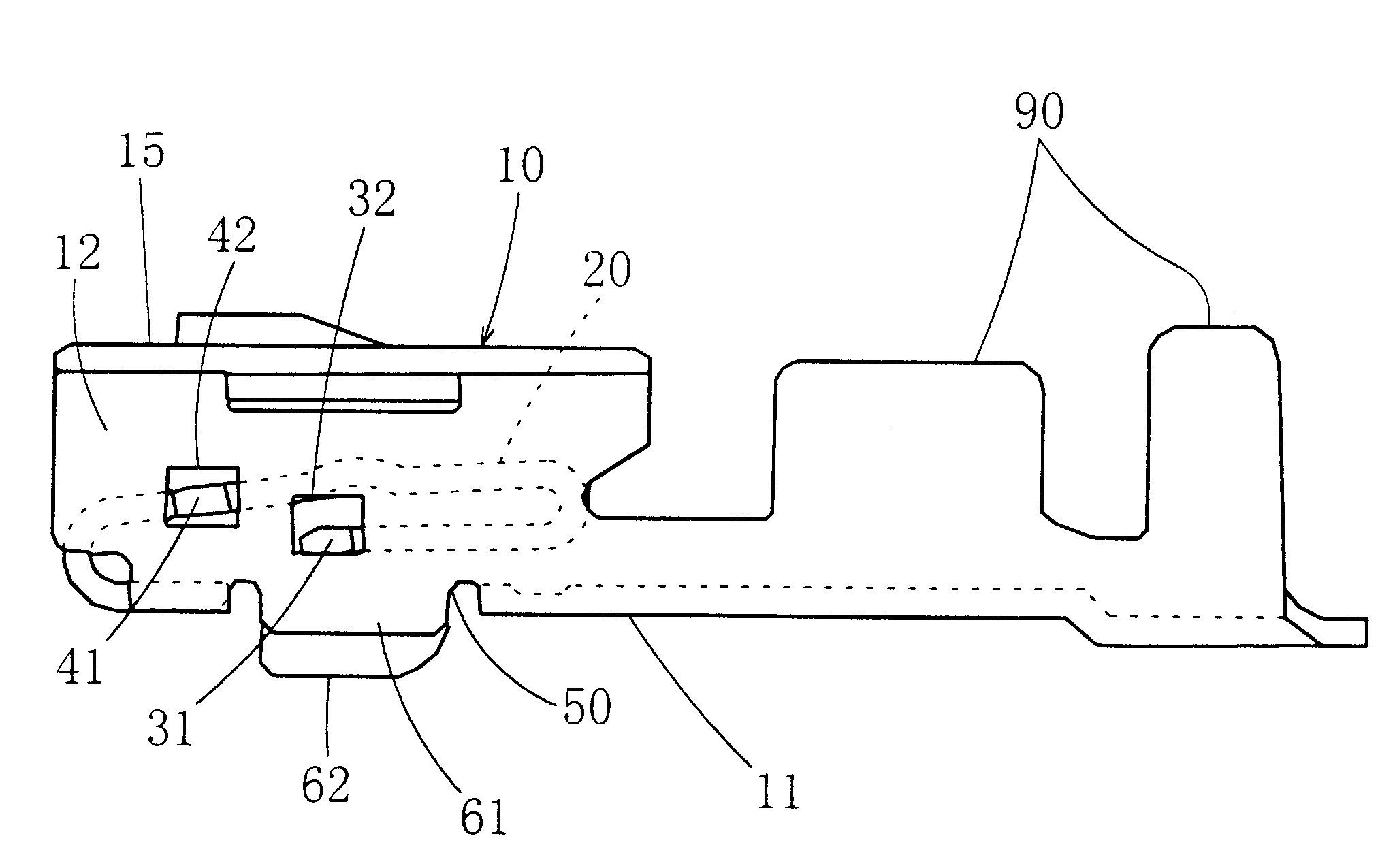
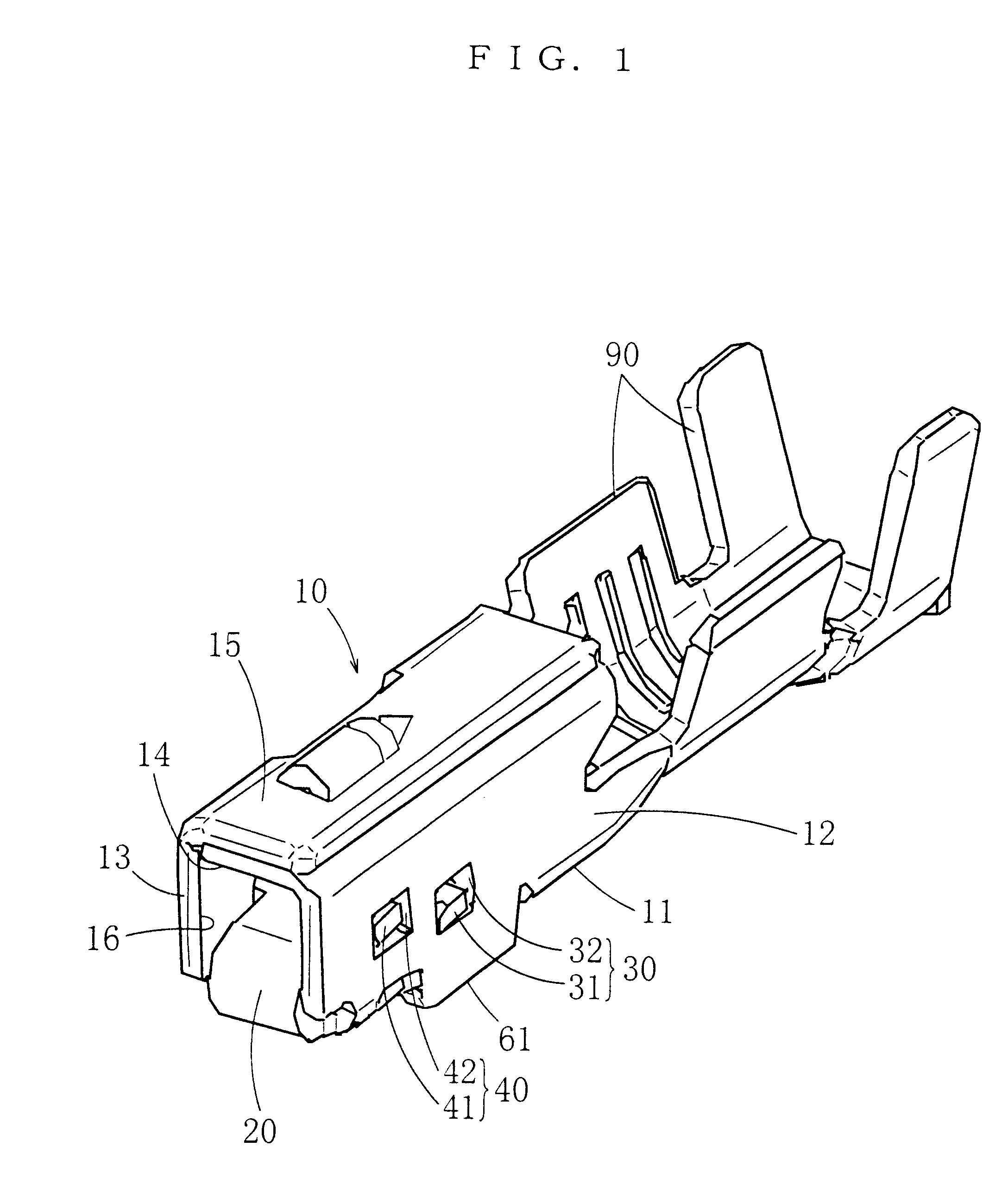
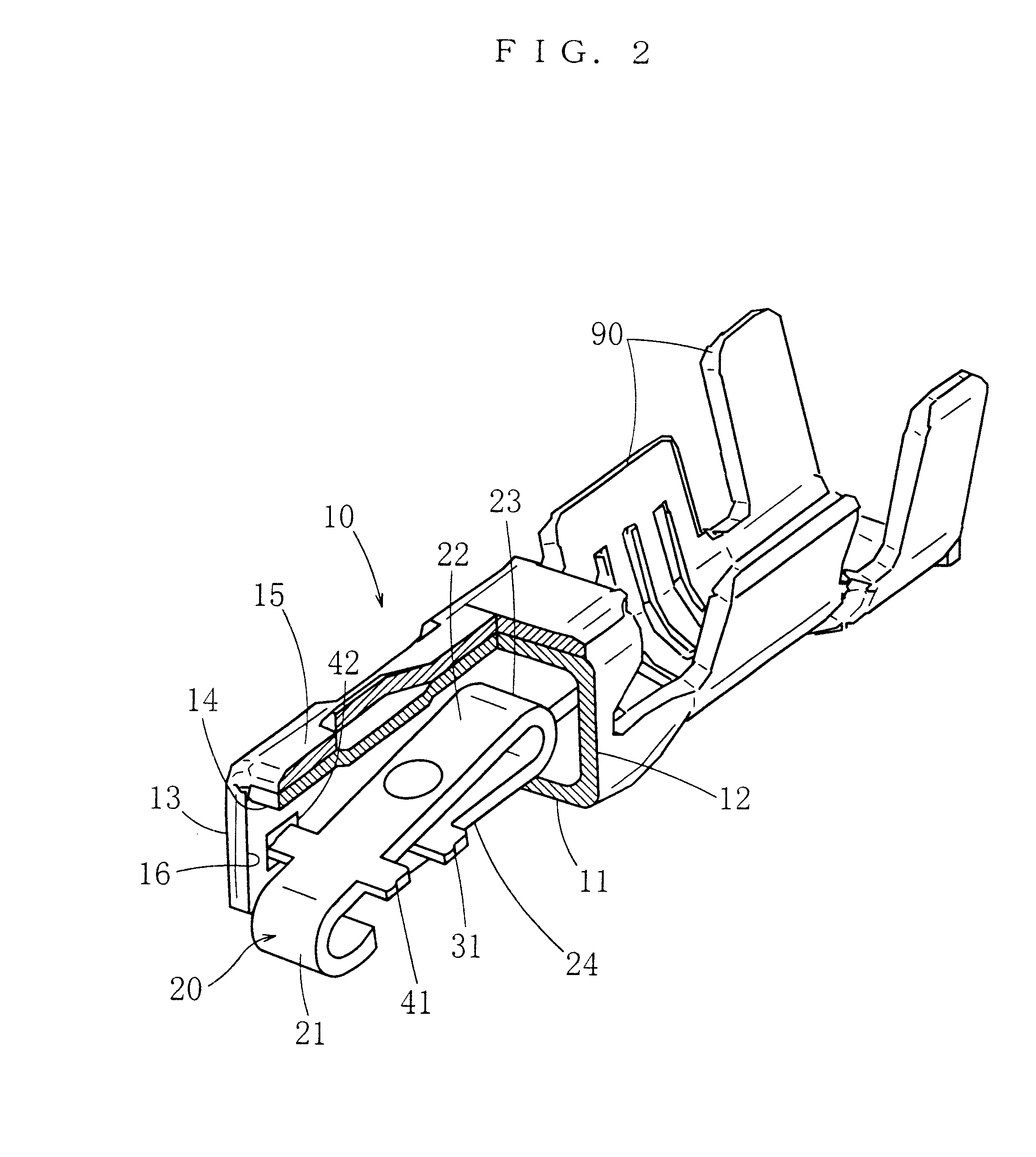
cell of a housing, a flexible piece will fit into the flexible-piece-receiving hole to fit the female terminal in the housing. If a male terminal is inserted through the front opening of the body, as the front end of the top end part of the leaf spring is fitted onto the side walls by the first fitting means, when the male terminal is inserted between the upper wall and the leaf spring and comes to the regular position, the leaf spring will exhibit its elastic
restoring force for its elastic range between the front end of the top end part and the first bent part to provide an appropriate
contact force between the male terminal and the leaf spring. If a prying force or the like acts, the second bent part of the leaf spring or the rear end of the top end part thereof will be displaced downward to contact the bottom wall, and in turn, the leaf spring will exhibit an elastic
restoring force for an elastic range of only the intermediate part to balance the prying force or the like and prevent the leaf spring from excessive deformation. If the prying force or the like gets greater, the intermediate part of the leaf spring will be displaced downward to contact the top end part of the leaf spring, and in turn, the prying force or the like will be balanced by this contact and the leaf spring will be prevented from excessive deformation. If the prying force or the like increases much more, a part of the intermediate part ahead of the above-mentioned contact part of the intermediate part of the leaf spring will be displaced downward, and it will be stopped at a bottom dead point and fitted onto the side walls by the second fitting means. The prying force or the like will be balanced by this and the leaf spring will be prevented from excessive deformation. In this way, the prying force or the like is balanced in three stages to prevent the leaf spring from being deformed excessively.
In this case, as the front end of the top end part of the leaf spring is fitted onto the side walls by the first fitting means, the part of the leaf spring to contact the bottom wall is the second bent part or the rear end of the top end part, in other words, a part around the rear end of the leaf spring. Moreover, as the intermediate part of the leaf spring is fitted onto the side walls by the second fitting means, a rising piece that was explained in the related art is not needed, and in turn, there is no need of securing a part, in the bottom wall, from which the rising piece is
cut and raised. With these arrangements, a flexible-piece-receiving hole can be opened in the bottom wall between the first bent part of the leaf spring and the part the second bent part or the rear end of the top end part of the leaf spring contacts when it is displaced downward. As a result of this, the operation of disengaging the flexible piece from the female terminal can be done near the front end of the body. As the operation can be done under
visual observation, the workability is improved. Moreover, as there is a space beneath the intermediate part of the leaf spring between the first bent part and the front end of the top end part, the height of the female terminal can be kept low by accommodating the flexible piece in this space. As a result, the female terminal can be compactified. Moreover, costs can be reduced through common use of
metal molds for this female terminal and a female terminal without any flexible-piece-receiving hole made in the bottom wall thereof. Further, the
elimination of the conventional rising pieces results in a more compact development of the female terminal, reduced number of bending processes, a reduced course of production, and improved precision of working.
To sum up, in the female terminal of the present invention the front end of the top end part of the leaf spring and a part of the intermediate part of the leaf spring ahead of the contact part of the intermediate part are fitted onto the side walls. As a result, the female terminal of the present invention provides an appropriate
contact force between itself and a male terminal, prevents the leaf spring from being deformed excessively, enables opening a flexible-piece-receiving hole in the bottom wall, and in turn, allows operation of disengaging the flexible piece from the female terminal near the front end of the body, enables the operation under
visual observation, and enhances the workability. Moreover, as the flexible piece can be accommodated in a space beneath the intermediate part of the leaf spring between the first bent part and the front end of the top end part, the female terminal can be compactified. Furthermore, through the common use of
metal molds with a female terminal having no flexible-piece-receiving hole in the bottom wall, the costs can be reduced.
Elimination of the conventional rising pieces results in a more compact development of the female terminal, a reduced number of bending processes, a shorter production process, and an improved accuracy of working.



 Login to View More
  Login to View More