Method and system for encoding data for transmission over a serial link

a serial link and data encoding technology, applied in the direction of code conversion, time-division multiplexing selection, synchronisation signal speed/phase control, etc., can solve the problems of high bandwidth overhead incurred in the encoding process, waste a large portion of the available bandwidth on the serial link, and the scheme has not as good transition density and dc-balance properties

US6628725B1Inactive Publication Date: 2003-09-30CIENA
9 Cites 42 Cited by

Patent Information

Authority / Receiving Office
US · United States
Patent Type
Patents(United States)
Current Assignee / Owner
Publication Date
2003-09-30
Estimated Expiration
Not applicable · inactive patent

Smart Images

  • Figure 1
    Figure 1
  • Figure 2
    Figure 2
  • Figure 3
    Figure 3
Patent Text Reader

Abstract

An exemplary embodiment of the invention is a method for encoding data into a 48B / 50B format for transmission over a serial link. A data stream that includes characters is received and segmented into a six-character block. The block of six characters is translated into a 50-bit byte frame in 48B / 50B format. A 48-bit word is created from the block of six characters by encoding the characters contained in the block. The 48-bit word is scrambled and a 2-bit synchronization sequence is appended to the scrambled 48-bit word. The result is the 50-bit byte frame in 48B / 50B format. An alternate embodiment of the present invention includes a method for decoding data from the 48B / 50B format.
Need to check novelty before this filing date? Find Prior Art

Description

1. Field of InventionThe invention relates generally to a method and system for encoding data that is transmitted over a serial link.2. Description of Related ArtData in communication systems is often encoded before being serialized and transmitted over serial links. Encoding can increase the transition density of the serial stream and assure the DC-balance of the serial stream. Transition density refers to the rate of transitions from zero to one and from one to zero in the serial bit stream. A high rate of transition is required so that the electrical component receiving the serial stream can accurately recover the bits in the serial stream. The transitions aid the receiver in deducing the bit alignment of the serial stream. DC-balance refers to having an equal number of ones and zeros in the serial stream on average. Having DC-balance is helpful because optical lasers used for communication operate effectively when the serial stream they are transmitting is DC-balanced.An example...

Examples

Embodiment Construction

The following detailed description of the invention refers to the accompanying drawings. The same reference numbers in different drawings identify the same or similar elements. Also, the following detailed description does not limit the invention. Instead, the scope of the invention is defined by the appended claims and equivalents thereof.

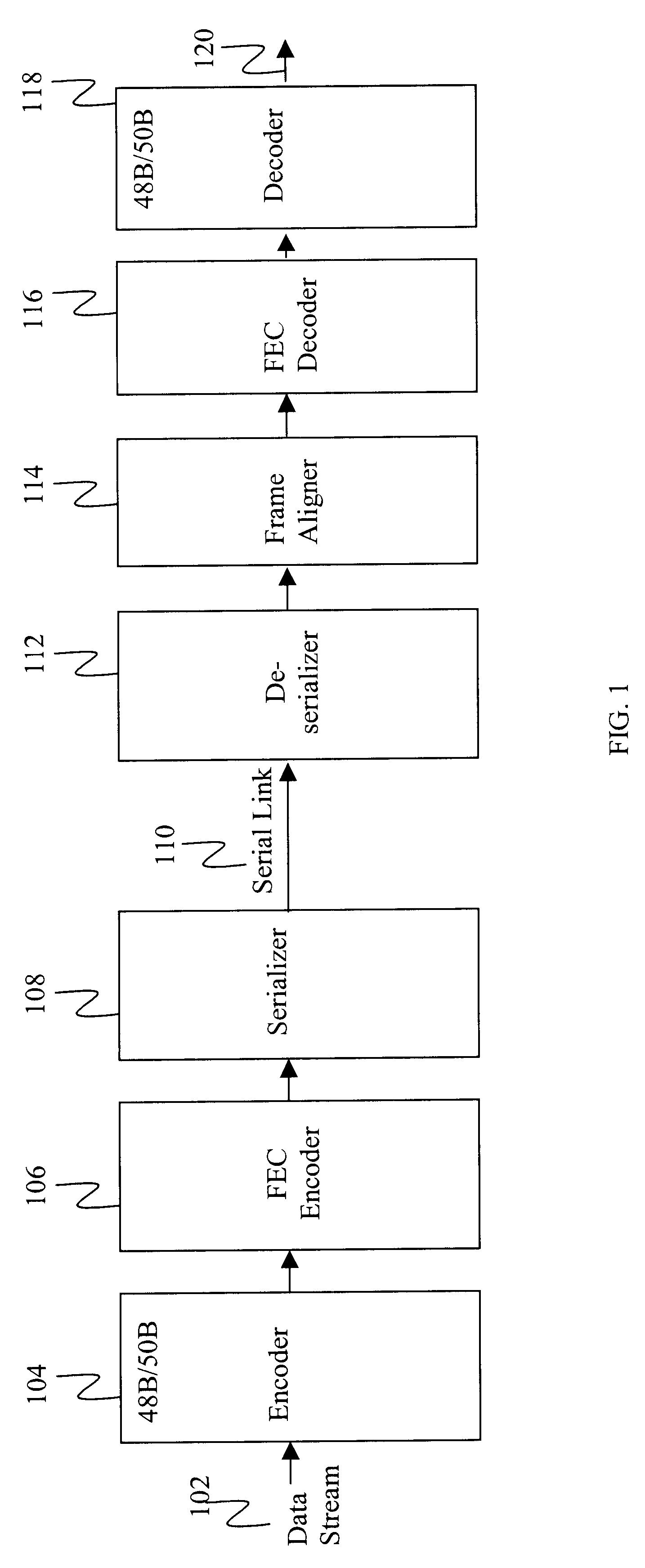
An exemplary embodiment of the present invention includes an encoding scheme, referred to as the 48B / 50B encoding scheme, for data transmission over serial links. In an exemplary embodiment, the 48B / 50B format includes a 50-bit byte frame that contains six 8-bit words and two synchronization sequence bits.

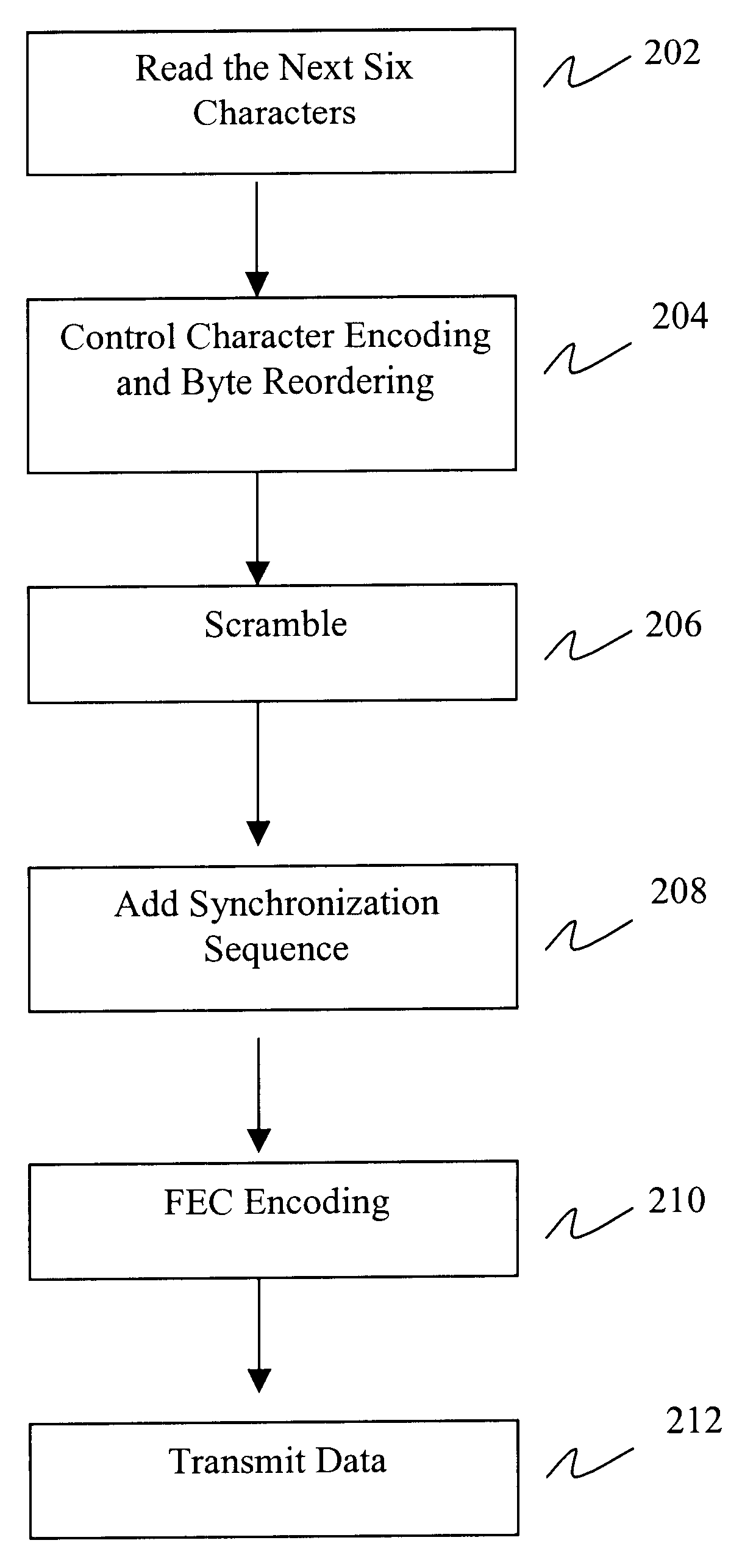
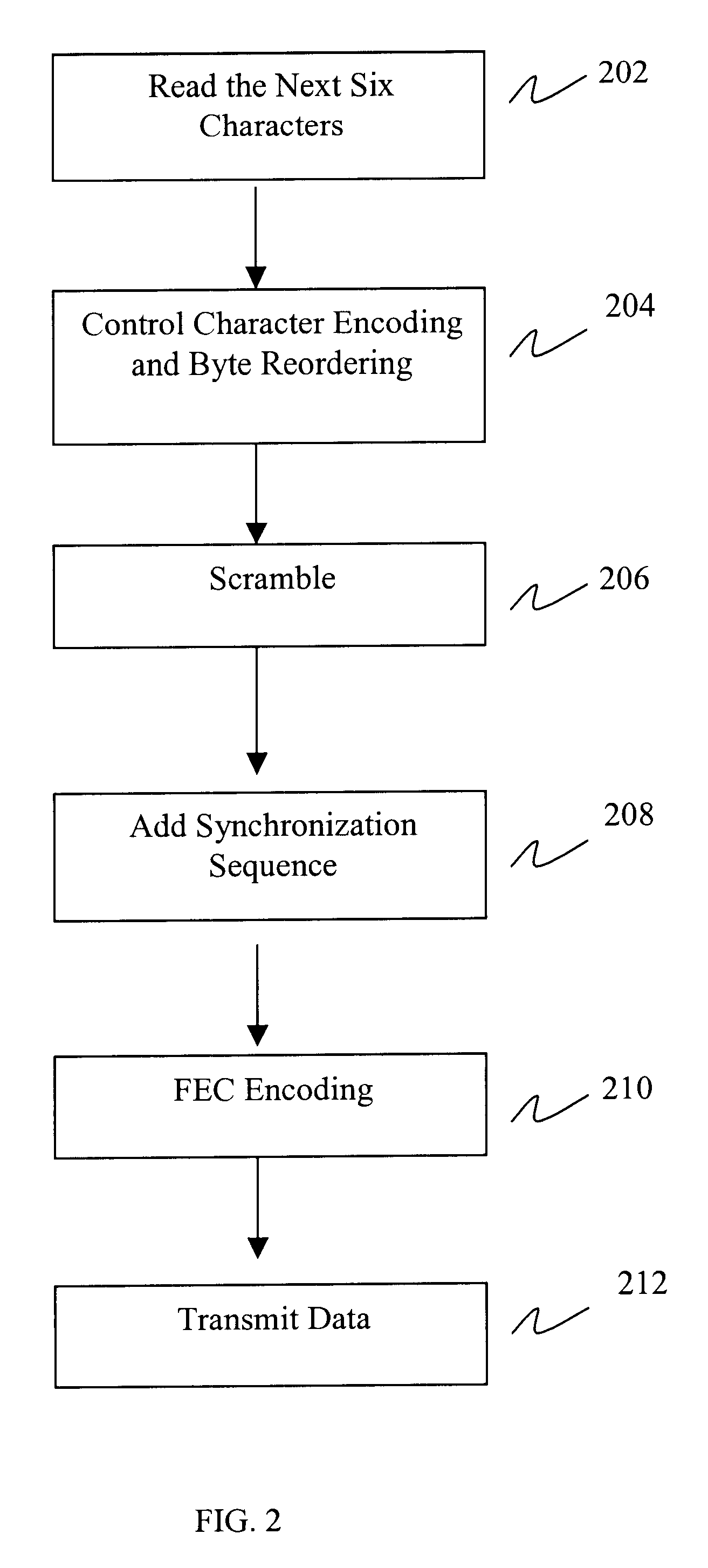
Referring to FIG. 1, a data stream 102 is input into an exemplary 48B / 50B encoder 104. The data stream is encoded, using the steps outlined in FIG. 2, steps 202 through 208, into an exemplary 48B / 50B format. The result of the 48B / 50B encoding process is a 50-bit byte frame that is transmitted to an FEC encoder device 106 that performs forward err...