The
receipt of extraneous messages in a node amounts to an unnecessary CPU overhead.
However, with the efficiency of multicast, there are difficulties.
Unfortunately, not all routers presently support multicast routing.
Also, due to
system administrators preferences, the availability of multicast routing can never be assumed (routers may not be configured to
route multicast, even if they support such routing).
A common problem that affects
tree routing algorithms is that any of the routing nodes may fail due to hardware or
software problems.
In most cases the failure is not detected because there is no mechanism for monitoring the health of the routing nodes.
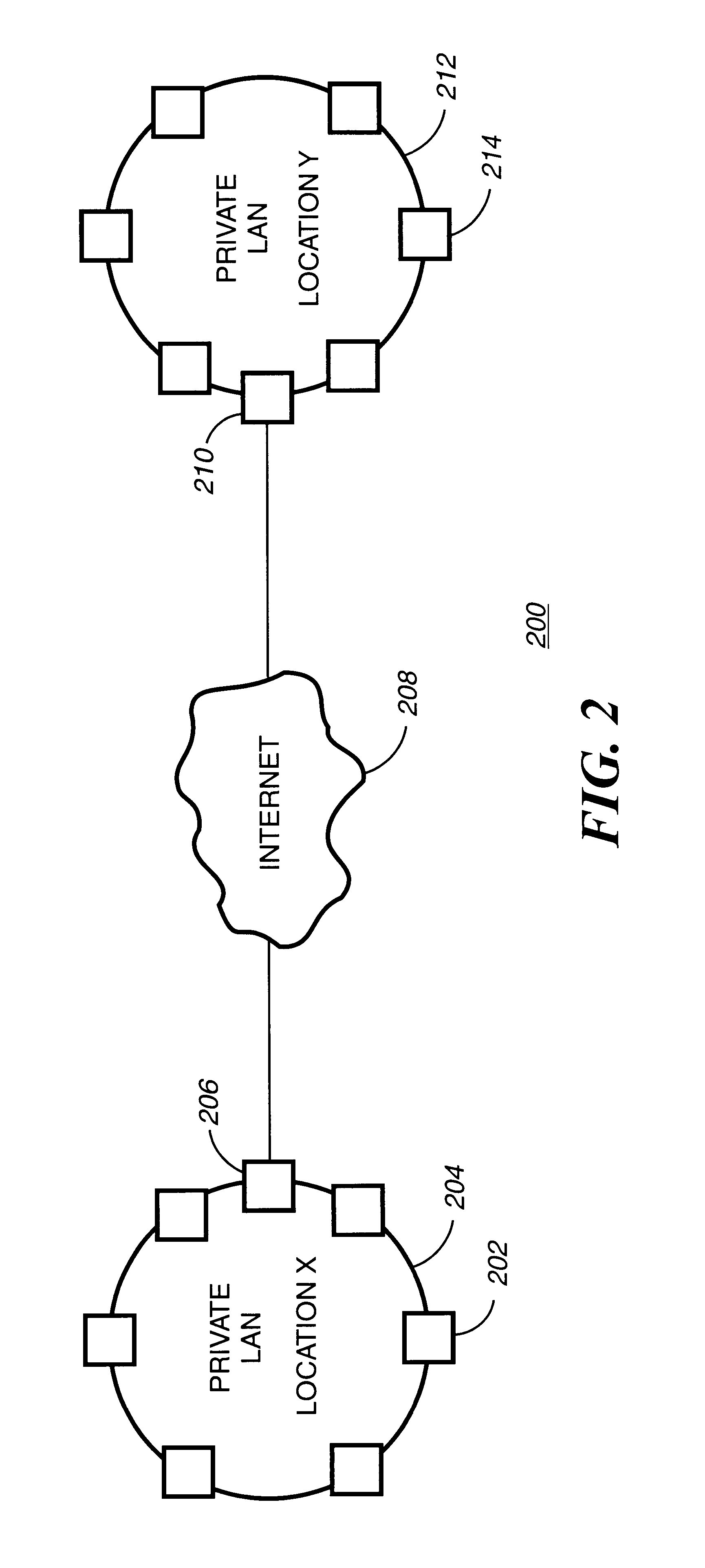
Another problem related to the routing of multicast messages is that traditionally most WAN do not support multicast communications.
This can be especially problematic in a
network topology where two or more LANs (Local Area Networks) are separated by a WAN.
Another problem related to the routing of multicast messages is that it becomes difficult to contain the spread of the routing of multicast messages.
More specifically, it becomes very difficult to contain multicast traffic to only selected subnetworks, if they are attached to the same routing node.
Still another problem related with multicast routing is that the shortest path optimization made by multicast tree algorithms may overload routing points which are connected to several nodes with an excess of
datagram messages to. forward.
Typical multicast routing protocols do not take into account the balancing of the routing burden which is imposed to the routing nodes.
Another aspect of the multicast technology is that not all hardware is capable of n routing multicast datagrams.
The problem that arises in the deployment of tunnels is that typically the configuration of the tunnel is fixed.
In this case, a disruption of multicast links will happen if the hardware in any of the tunneling endpoints fails.
A problem similar to the one faced by multicast tree algorithms arises when any of the tunneling endpoints fails, and the communication path or multicast datagrams is broken.
The problem of detecting hardware failures in a communications network, or in a
distributed computing system is very difficult to solve.
Typical heartbeating solutions are not based on multicast protocols, since the failure of the routing points amounts to a disruption in multicast communications.
However, the use of non-multicast protocols, cannot take
advantage of the flexibility of the multicast messages, which reduce network traffic and such non-multicast algorithms demand too much bandwidth from the communications network.
Still other problems that exist with management of current communications networks is the need to provide a simple program that can work across a variety of disperse, distinct and non-homogeneous network architectures with a small code foot print to work in small computers and routers, but that provides a correct hierarchal structure that is self contained and to enable the leveraging of multicast tunneling structure which is capable of dynamically routing the multicast messages to the entire communications network, independently of the
network topology.



 Login to View More
  Login to View More