Elastomeric force module for orthodontic treatment

a force module and orthodontic technology, applied in the field of elastomeric devices, can solve the problems of long treatment time, unsatisfactory headgear, and embarrassment, and achieve the effects of avoiding concentrated stresses in certain areas, preventing material degradation, and reducing the number of patients

US6935858B2Inactive Publication Date: 2005-08-303M INNOVATIVE PROPERTIES CO
20 Cites 27 Cited by

Patent Information

Authority / Receiving Office
US · United States
Patent Type
Patents(United States)
Current Assignee / Owner
Publication Date
2005-08-30
Estimated Expiration
Not applicable · inactive patent

Smart Images

  • Figure 1
    Figure 1
  • Figure 2
    Figure 2
  • Figure 3
    Figure 3
Patent Text Reader

Abstract

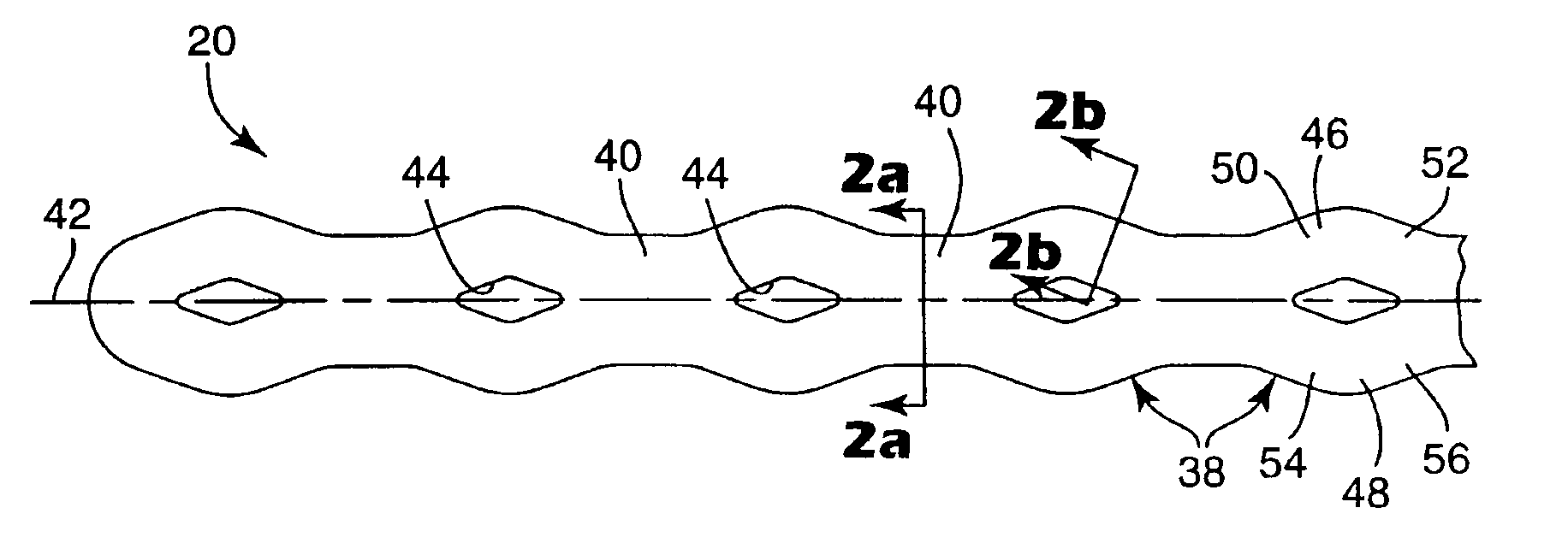
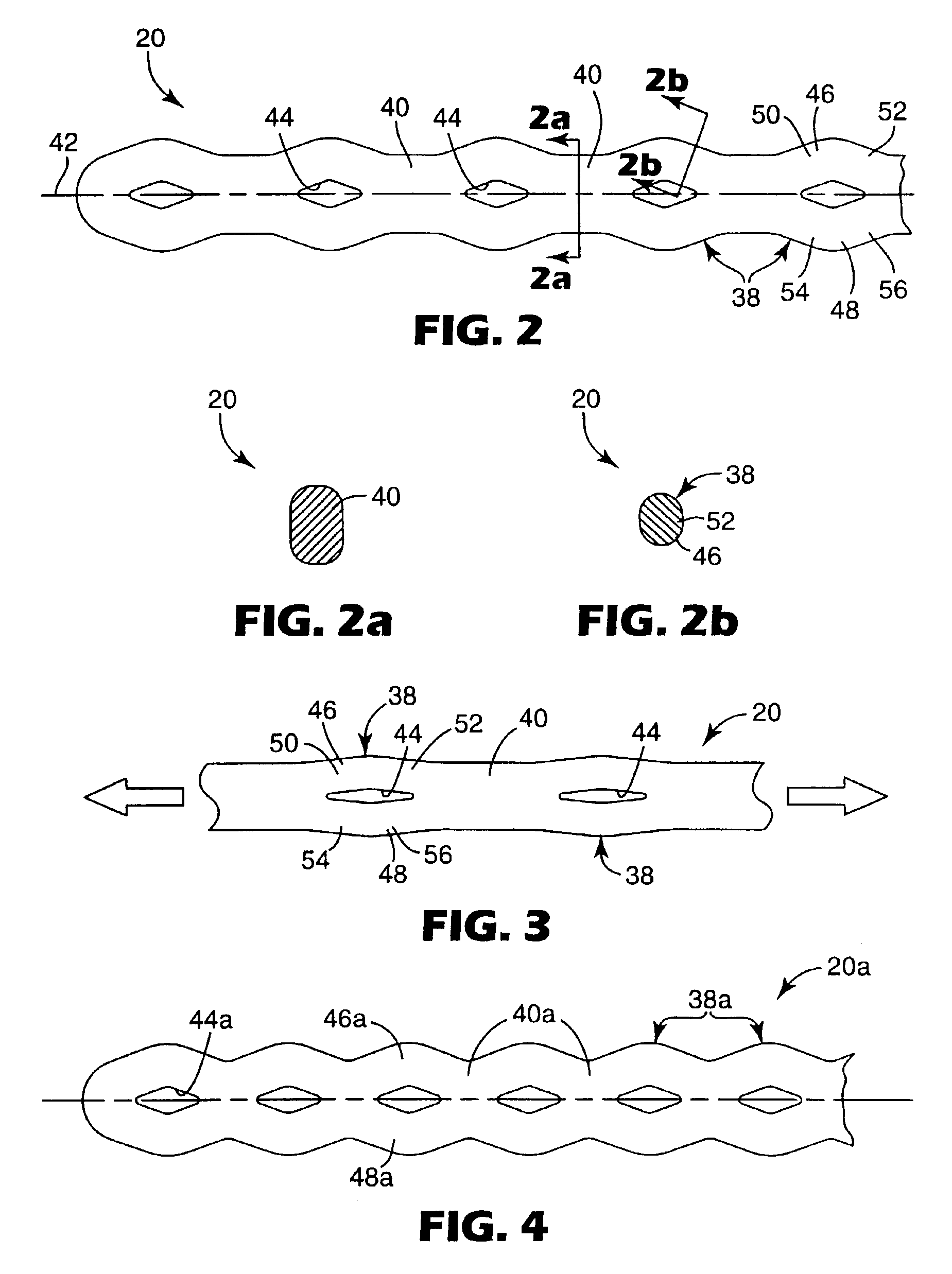
An orthodontic force module is made of an elastomeric material and includes one or more eyelet segments along with one or more connector segments coupled to the eyelet segments. The configuration of the eyelet segments and the connector segments is arranged so that a substantially constant cross-sectional area is provided throughout the working length of the force module. As a result, the resistance to elongation is substantially uniform throughout the working range of the force module and premature degradation and failure due to relatively high, concentrated stresses are avoided.
Need to check novelty before this filing date? Find Prior Art

Description

BACKGROUND OF THE INVENTION

[0001] 1. Field of the Invention

[0002] This invention relates to an elastomeric device that is used in the oral cavity during orthodontic treatment. More particularly, the present invention is directed to an elastomeric orthodontic force module that is useful for moving one or more teeth to desired locations along a dental arch, or for moving one dental arch relative to the other.

[0003] 2. Description of the Related Art

[0004] Orthodontia is a specialized field within the general subject area of dentistry. Orthodontic treatment involves movement of malpositioned teeth to correct locations along the dental arch. In some instances, orthodontic treatment also includes movement of one dental arch as a unit relative to the other dental arch. Orthodontic treatment can result in improved occlusion as well as a more pleasing aesthetic appearance.

[0005] One type of orthodontic treatment involves the use of a set of components that are collectively known as “braces”. In t...

Examples

Embodiment Construction

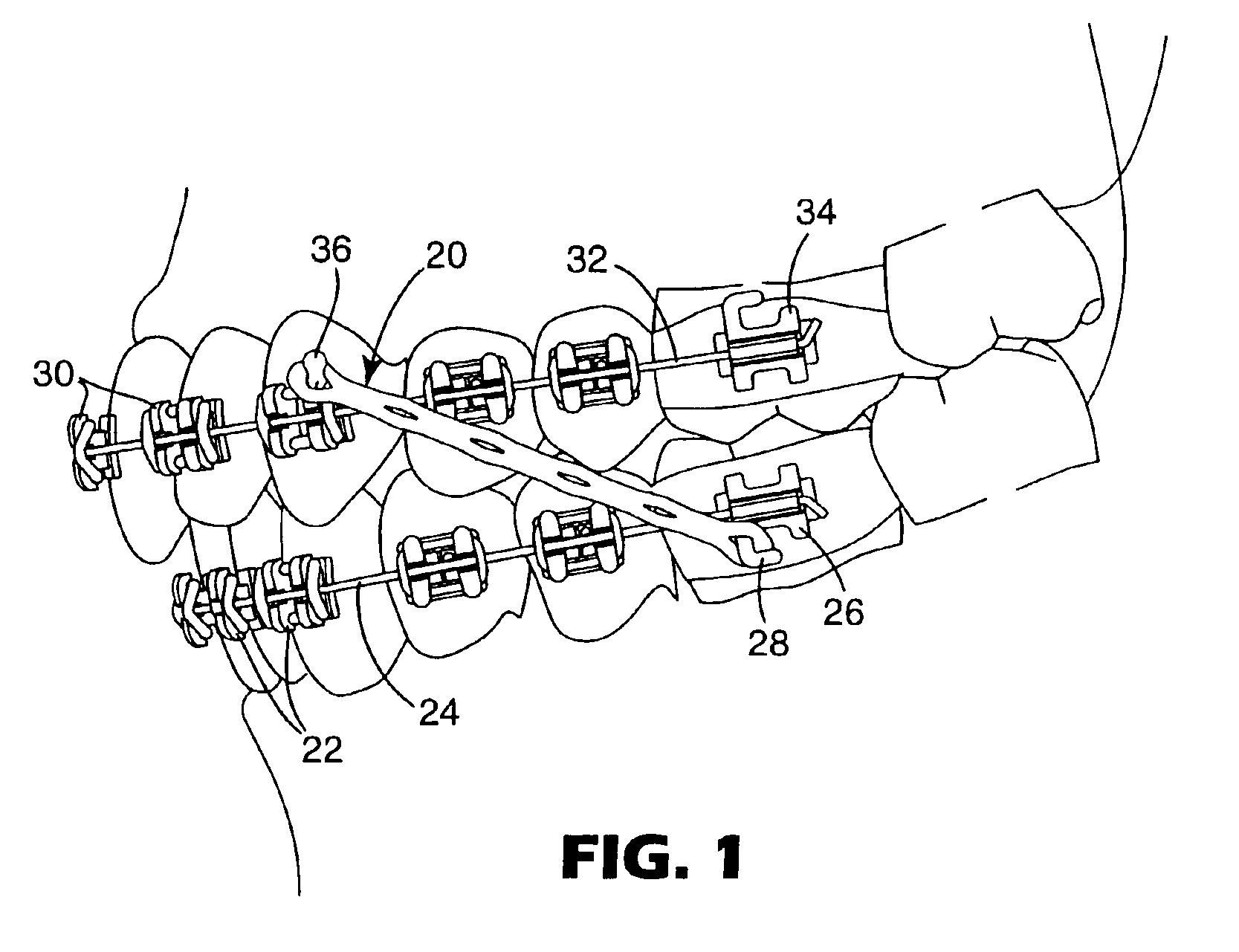
[0040]FIG. 1 is an illustration showing an exemplary use of an orthodontic force module 20 that is constructed according to one embodiment of the present invention. The force module 20 is installed in the oral cavity of an orthodontic patient undergoing treatment. The force module 20 in this example is arranged to correct a Class II malocclusion by urging the patient's lower dental arch in a forward direction relative to the patient's upper dental arch.

[0041]In more detail, a set of lower dental brackets 22 is secured to corresponding teeth of the patient's lower dental arch and an archwire 24 is placed in the slots of the brackets 22. Ends of the archwire 24 are received in buccal tubes 26 (only one shown) that are mounted on the patient's lower molar teeth. Each of the lower buccal tubes 26 has a hook 28 that extends in a distal direction (i.e., in a direction away from the middle of the patient's dental arch).

[0042]Similarly, a set of upper orthodontic brackets 30 is secured to t...