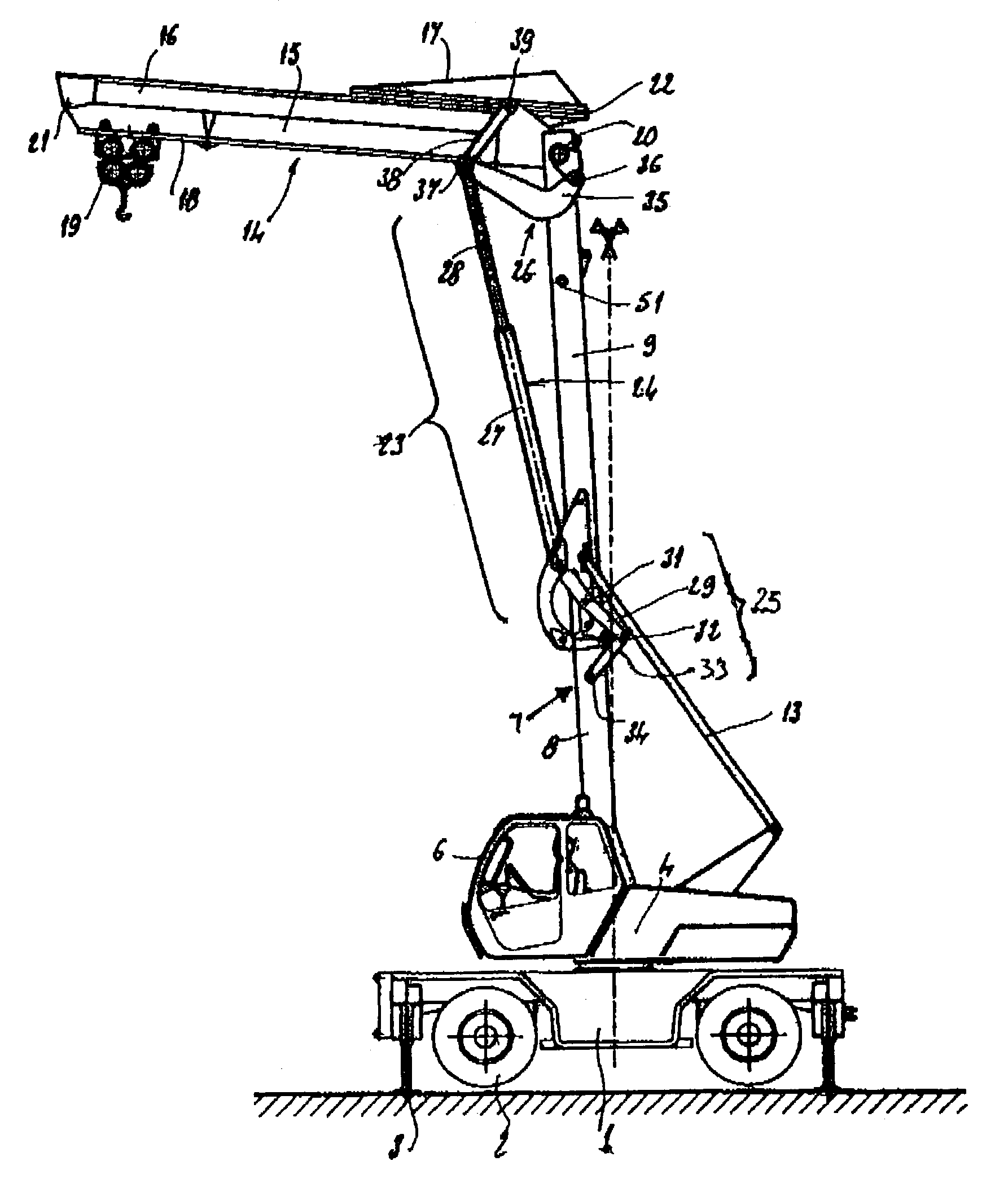
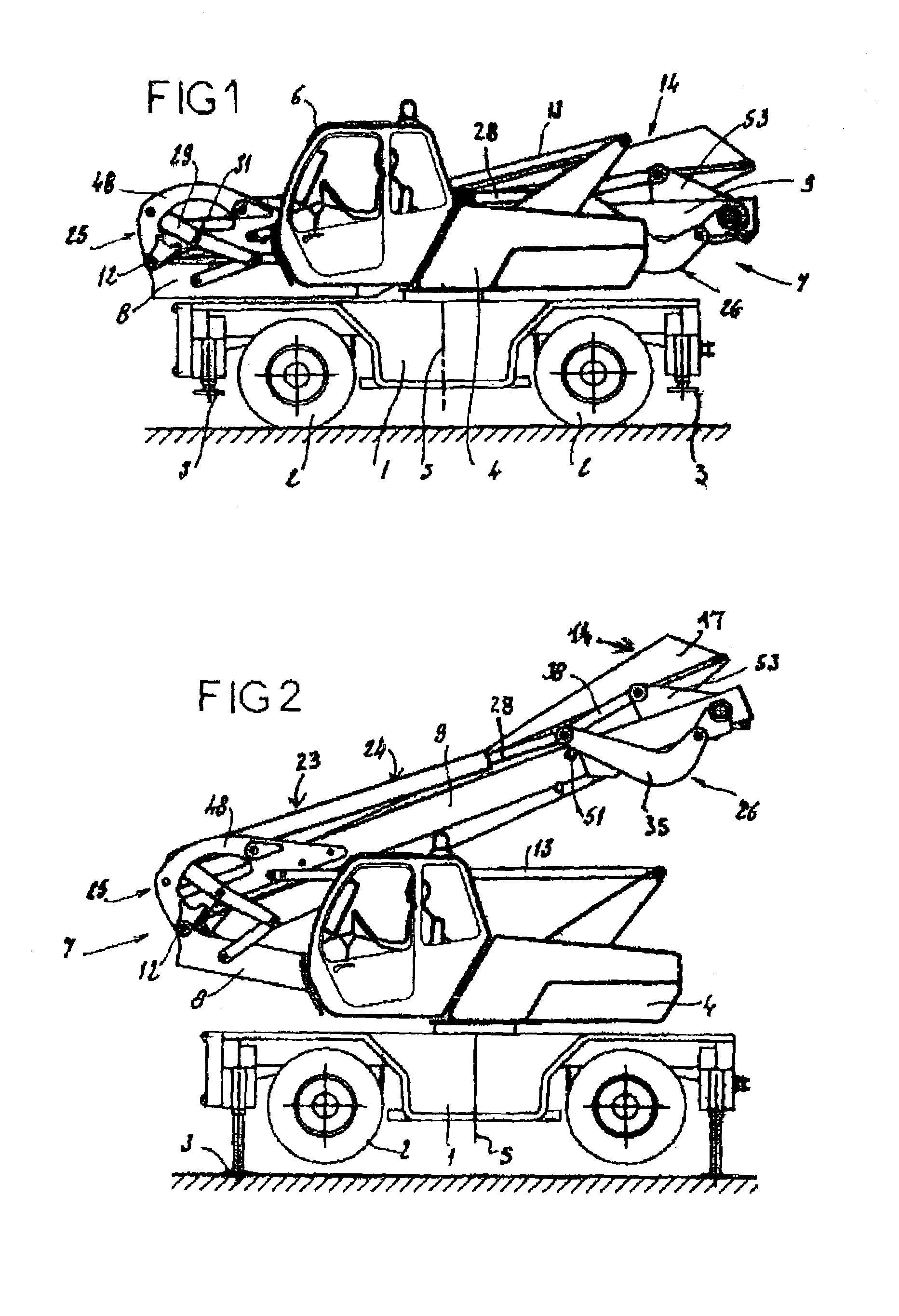
[0010]The present invention is aimed at avoiding the disadvantages set out above by providing an improved device for raising and unfolding the mast and for raising the jib of a crane, said device being more particularly suitable for a crane with a jib having multiple functions, this device comprising a minimum number of jacks capable of being used both for raising / unfolding and for the work of the crane, by making it possible to have various configurations of this crane, while at the same time possessing a small bulk, particularly for reducing the height of the crane in the folded transport position.
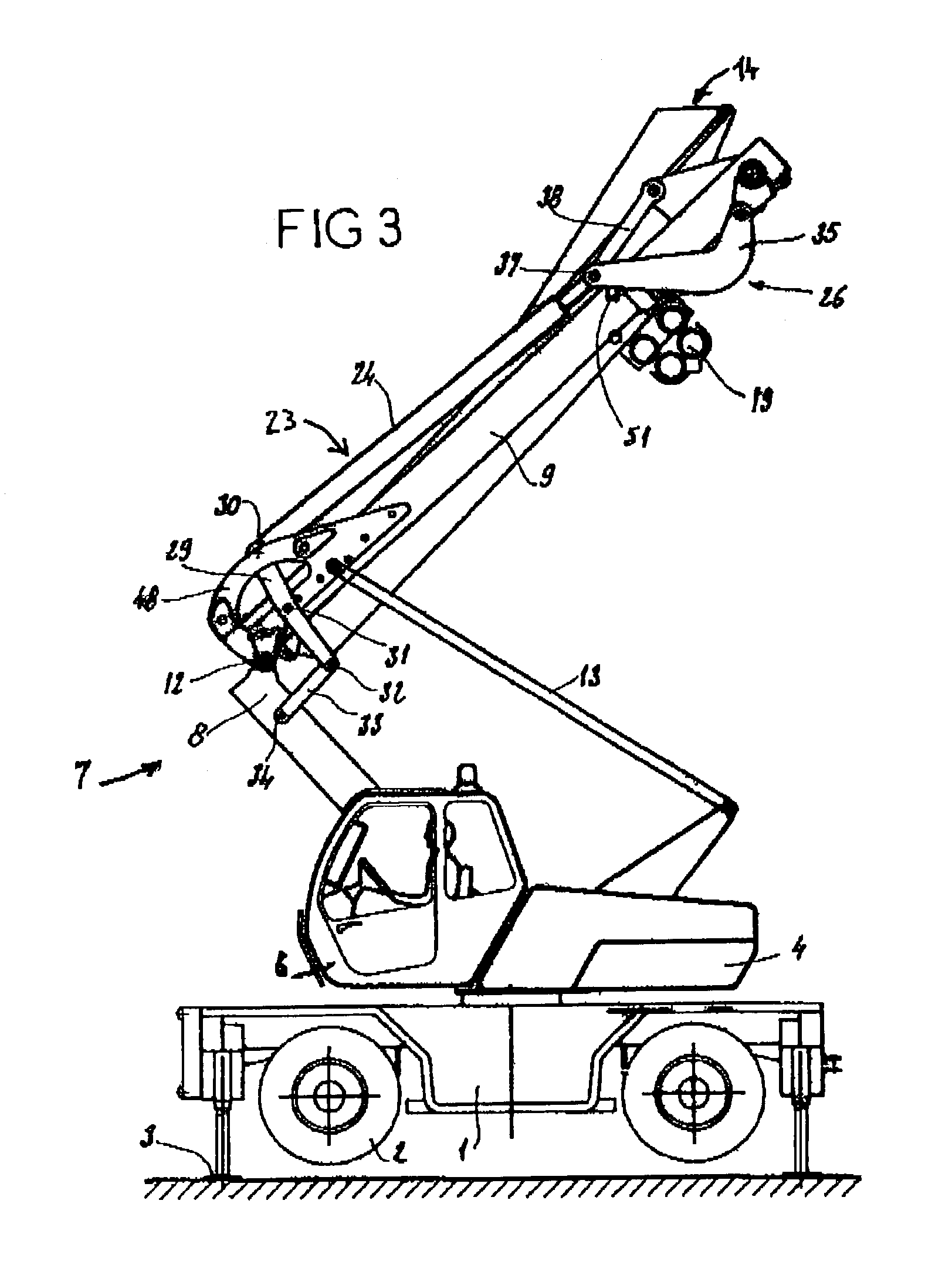
[0012]Thus, the inventive idea involves providing a single jack, associated with two rod assemblies, for performing both the functions of unfolding / folding the mast, of raising / lowering the jib and of working with “luffing motion”, that is to say with a jib raising movement. The two locking positions of the jack occur respectively in the “mast unfolded” position and in the “mast folded” position. The proposed
system possesses simple and reliable
kinematics: it does not entail either a combination of movements or manual action on its functioning. It also affords complete independence of the movements and positions of the mast and of the jib, thus allowing all possible configurations, particularly from a position with the mast folded substantially horizontally or from a position with the mast unfolded substantially vertically.
[0013]The need for a single jack for various movements or functions also leads to economical implementation. Moreover, the jack is not positioned between the two mast elements when these are folded, but, instead, it rests on the upper mast element, thus making it possible to increase the driver's angle of
sight from his cab.
[0015]As regards the upper rod assembly, the latter advantageously comprises a bent rod, preferably a double rod, articulated at one of its ends on the upper part of the upper mast element and articulated, at its other end, both on the corresponding end of the jack and on one end of another rod, preferably a single rod, the other end of which is articulated on the jib foot. The bent rod here allows the upper rod assembly to “bypass” the articulation of the jib foot on the top of the mast.
[0019]The locking means have the function of not introducing useless stresses into the lower rod assembly, particularly by preventing the rotation of the first rod (three-point) of this rod assembly in the folded transport position.
[0020]The main jack makes it possible not only to raise the mast and the jib foot when the crane is initially being put in place, but also to obtain all intermediate jib positions via control of the greater or lesser extension of the stem of this jack. Inasmuch as the jib is itself composed of two or more elements articulated on one another, the unfolding of these jib elements in relation to one another is obtained by means of auxiliary motorization, in particular by jack and rod assembly, with which the present invention is not directly concerned.


 Login to View More
  Login to View More