Data transmission in an SDH network

a data transmission and sdh network technology, applied in the field of sdh network and data transmission, can solve the problems of inability to carry out the necessary processing to support contiguous concatenation, inability to perform the conversion between contiguously concatenated signals and virtually concatenated signals, and inability to carry out suitable modification of such a network

US7277459B1Inactive Publication Date: 2007-10-02TELEFON AB LM ERICSSON (PUBL)
12 Cites 11 Cited by

Patent Information

Authority / Receiving Office
US · United States
Patent Type
Patents(United States)
Current Assignee / Owner
Publication Date
2007-10-02
Estimated Expiration
Not applicable · inactive patent

Smart Images

  • Figure 1
    Figure 1
  • Figure 2
    Figure 2
  • Figure 3
    Figure 3
Patent Text Reader

Abstract

A method for the transmission of data in a synchronous digital hierarchy (SDH) network comprising the steps of transmitting to a node of the network a form of data signal from outside the network, converting the signal into a to a virtually concatenated information structure and transporting the signal through the network in the virtually concatenated information structure; means for carrying out the method and tributary cards arranged and configured to process signals received in contiguously concatenated form to convert them into virtually concatenated form for transfer across the network; thus providing for data transmitted in high-bandwidth, contiguously concatenated signals (ie VC-4-4c) to be transported across a SDH network, not itself capable of carrying contiguously concatenated signals.
Need to check novelty before this filing date? Find Prior Art

Description

BACKGROUND OF THE INVENTION

[0001] 1. Field of the Invention

[0002] The present invention relates to the field of synchronous digital hierarchy (SDH) networks and data transmission therein.

[0003] 2. Description of the Related Art

[0004] In SDH data is transferred in information structures known as virtual containers. A virtual container (VC) is an information structure within SDH which consists of an information payload and path overhead (POH). There are two types of VC: low order (LOVC) and high order (HOVC). LOVC's (eg. VC-12, VC-2 and VC-3) are for signals of less than 140 Mb / s and HOVC's (ie. VC-4) are for 140 Mb / s signals.

[0005] With the ever increasing demand for higher data rates there is a continuing need to improve the data transfer capability of networks such as those based on SDH. One way of providing higher bandwidth is concatenation.

[0006] Concatenation is a method for the transport over SDH networks of a payload of a bandwidth greater than the capacity of the defined informatio...

Examples

Embodiment Construction

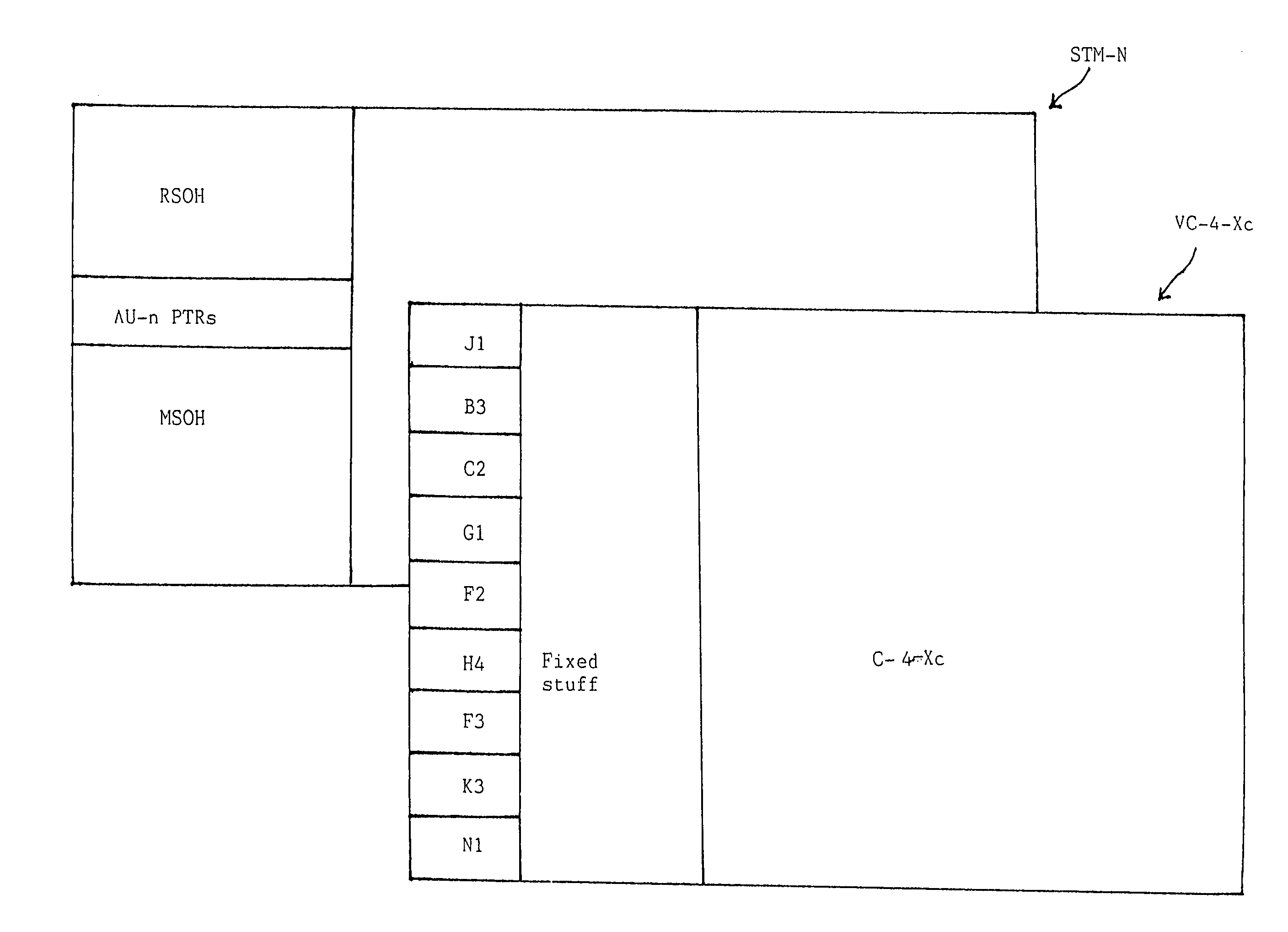
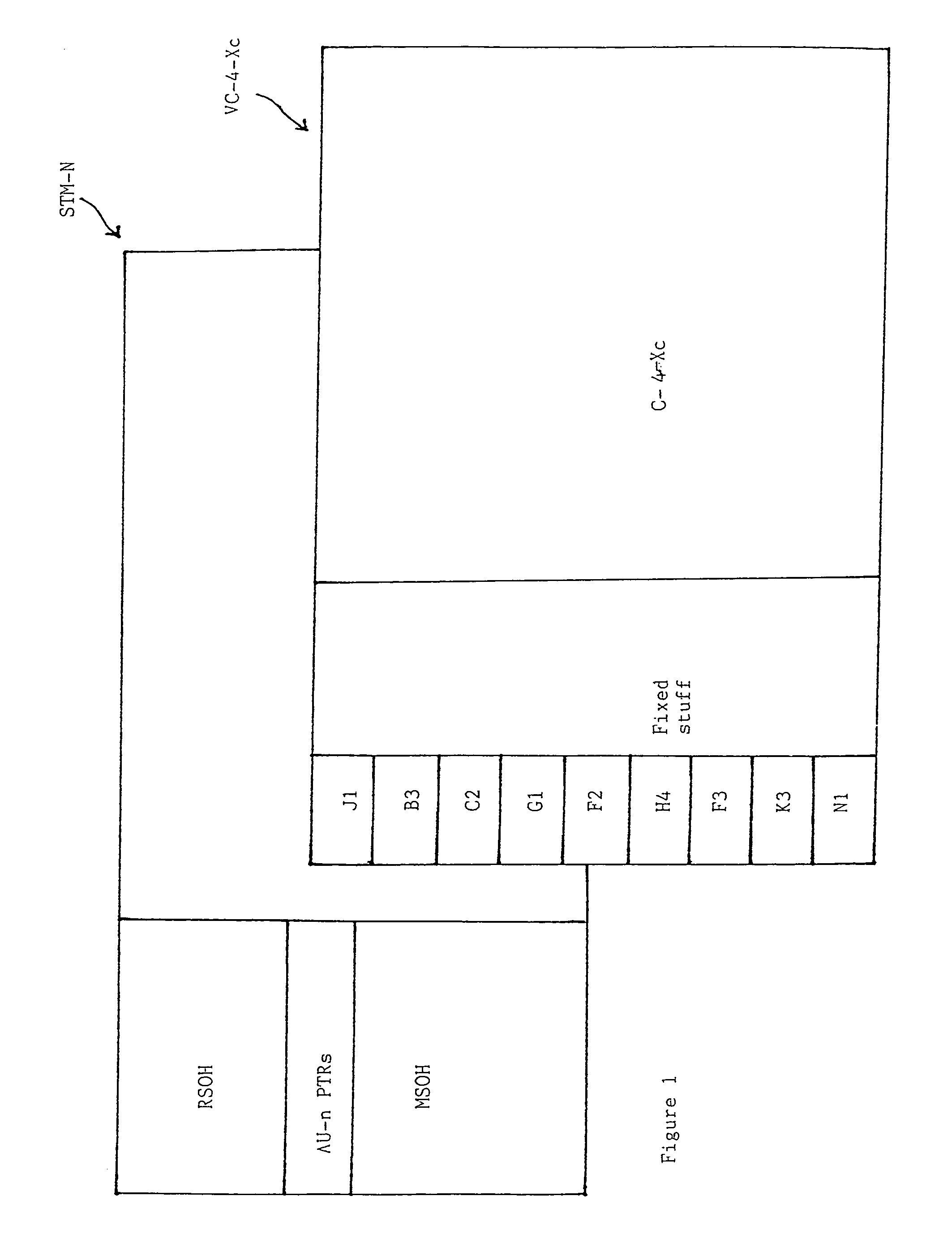
[0020]Referring to FIG. 1, this shows synchronous transfer module STM comprising a section overhead SOH, a pointer and a virtual container VC. The VC in turn comprises a path overhead POH, fixed stuff bytes and a container C for the payload.

[0021]A network management system manages the transfer of virtually concatenated VC-4's without any modification being required to network equipment. The only hardware modification required is the provision of modified tributary cards capable of identifying the receipt at the network boundary of contiguously concatenated VC-4's and processing them accordingly. Individual VC-4's and virtually concatenated VC-4's are transported in the SDH network in the same way. Hence, four VC-4's, when virtually concatenated, will still have four path overheads.

[0022]In the standard configuration a tributary card accepts at its input and delivers at its output an STM-4 signal containing four independent VC-4's (by way of example, each may contain a 140 Mb / s, 3×3...