
Method for finding disconnection of conductive wires formed on plate glass and apparatus therefor
a technology of conductive wires and plate glass, which is applied in the field of finding the disconnection of conductive wires formed on plate glass and apparatus therefor, can solve the problems of poor productivity, impaired function of conductive wires, and difficulty in distinguishing a first conductive wire having disconnection from a second conductive wire having no disconnection, so as to achieve efficient disconnection of conductive wires
- Summary
- Abstract
- Description
- Claims
- Application Information
AI Technical Summary
Benefits of technology
Problems solved by technology
Method used
Image

Examples
example 1
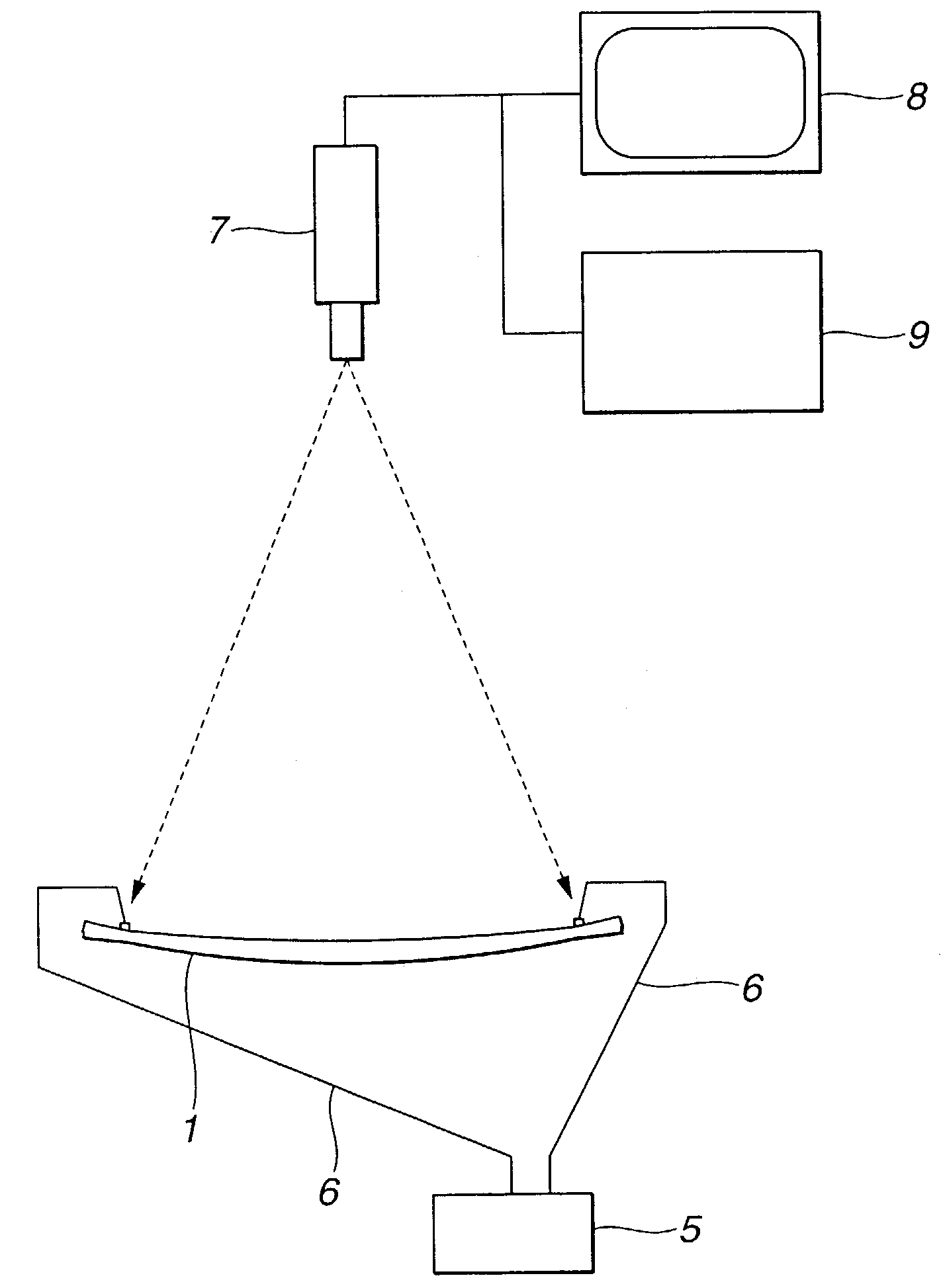
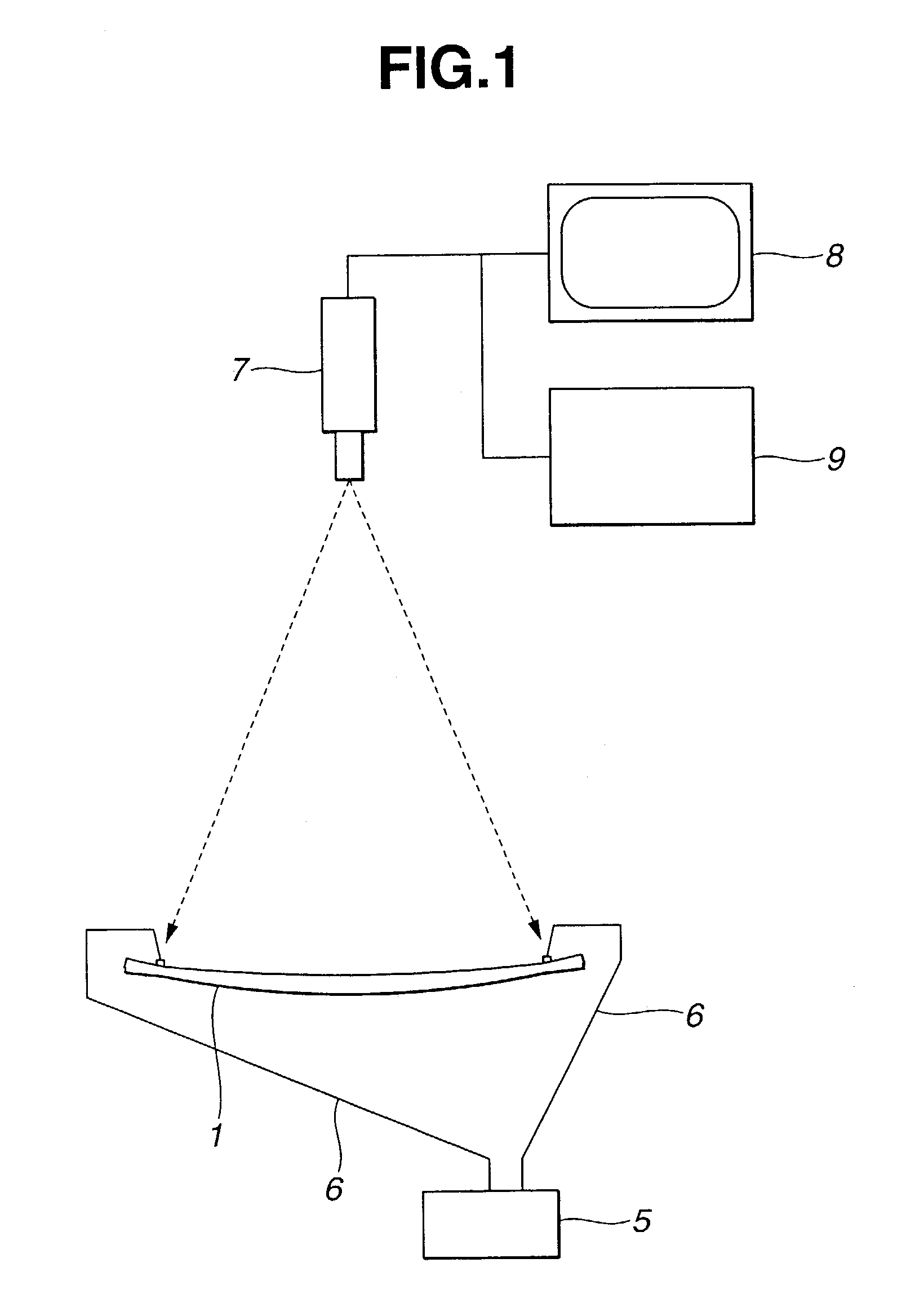
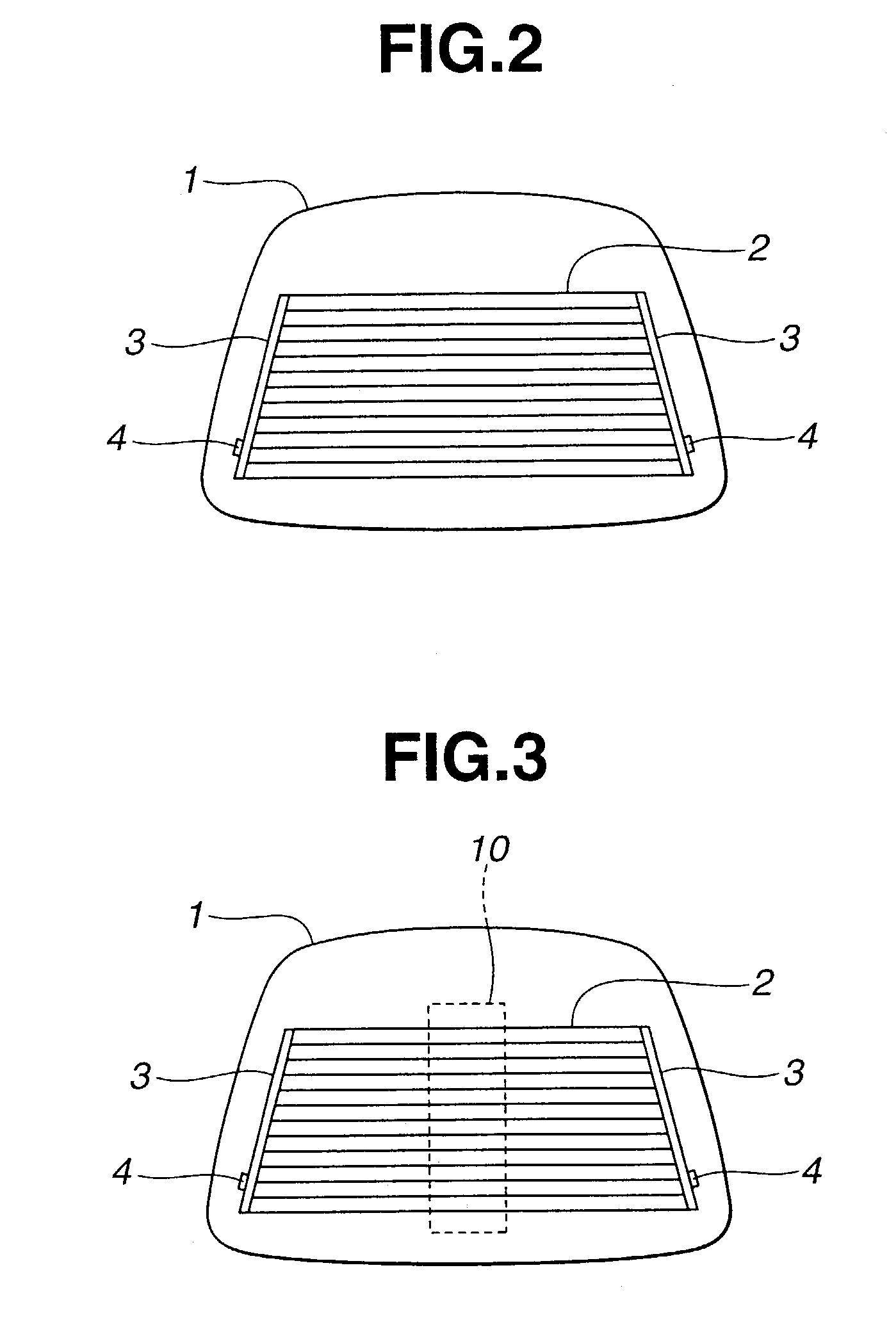
[0031]Prior to the voltage application, the image of the pattern of heating wires 2 of an antifogging glass 1 (shown in FIG. 2) was taken by an infrared image sensor (i.e., an infrared camera of Nippon Avionics Co., Ltd.) 7 of FIG. 1.
[0032]Then, a voltage of 20V was applied by connecting a voltage stabilizer (constant voltage device) 5 to feeding terminals 4 of an antifogging glass 1 through feeding wires 6. Under this condition, the image of the pattern of the heating wires 2 was taken by the infrared camera 7. This image taken by the infrared camera 7 was shown in a monitor 8 and compared with the image prior to the voltage application to find the existence or nonexistence of disconnection of the heating wires.
example 2
[0033]The two images (prior to and under the voltage application) obtained in Example 1 were subjected to a binarization by an image processor 9 made by Yokogawa MAT Corporation, thereby obtaining two image data showing only the heating wires. These two image data were subjected a subtraction, and the result was shown in the monitor 8. In fact, each image remaining after the subtraction was judged as representing one heating wire having disconnection. This judgement was conducted automatically.
example 3
[0034]The same steps as those of Examples 1 and 2 were conducted sequentially, except in that the infrared camera of Example 1 was replaced with a thermo-tracer made by NEC san-ei Instruments Co. With this, it was possible to find the existence or nonexistence of disconnection of the conductive wires (heating wires) 2.
PUM
| Property | Measurement | Unit |
|---|---|---|
| voltage | aaaaa | aaaaa |
| voltage | aaaaa | aaaaa |
| conductive | aaaaa | aaaaa |
Abstract
Description
Claims
Application Information
 Login to View More