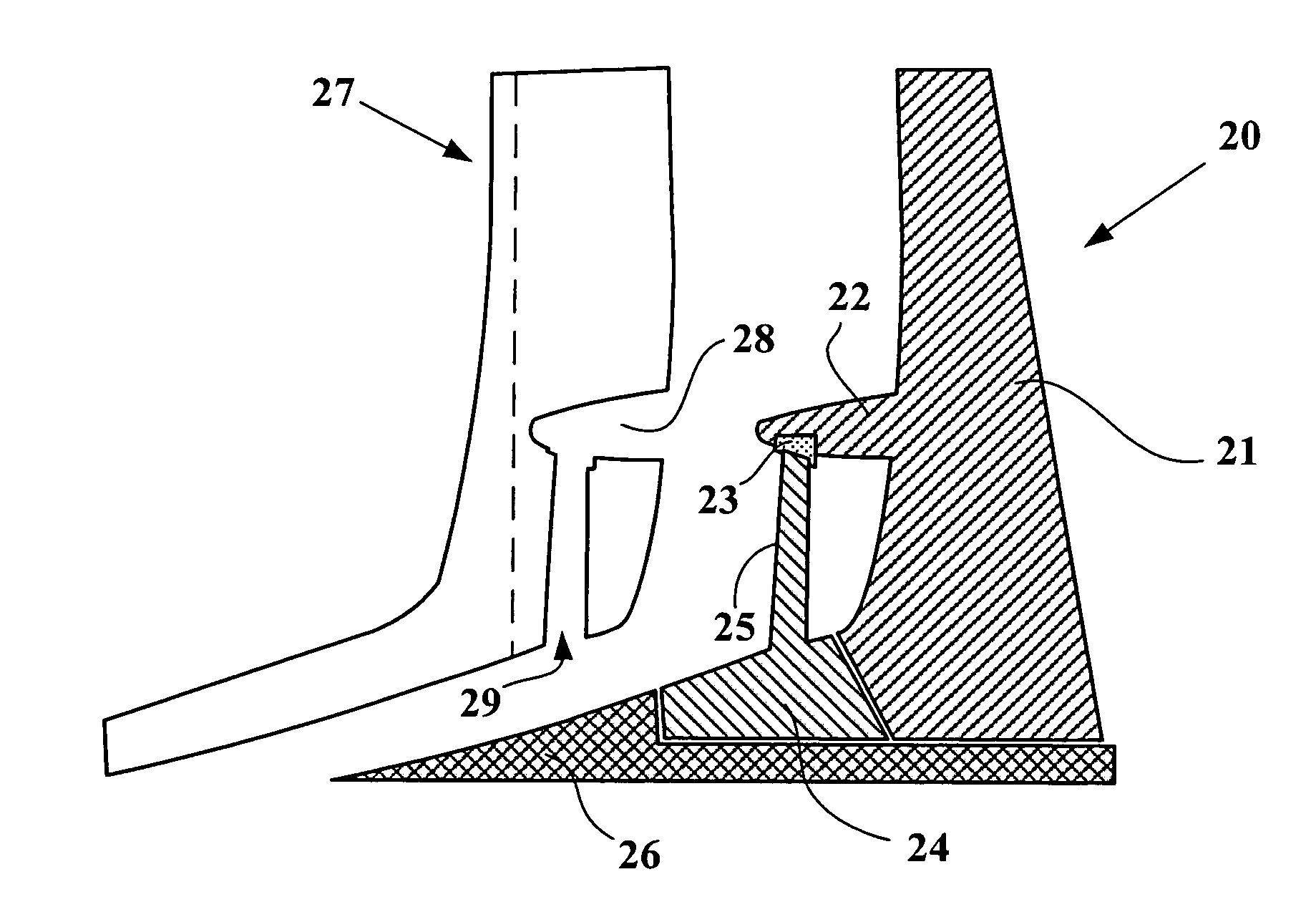
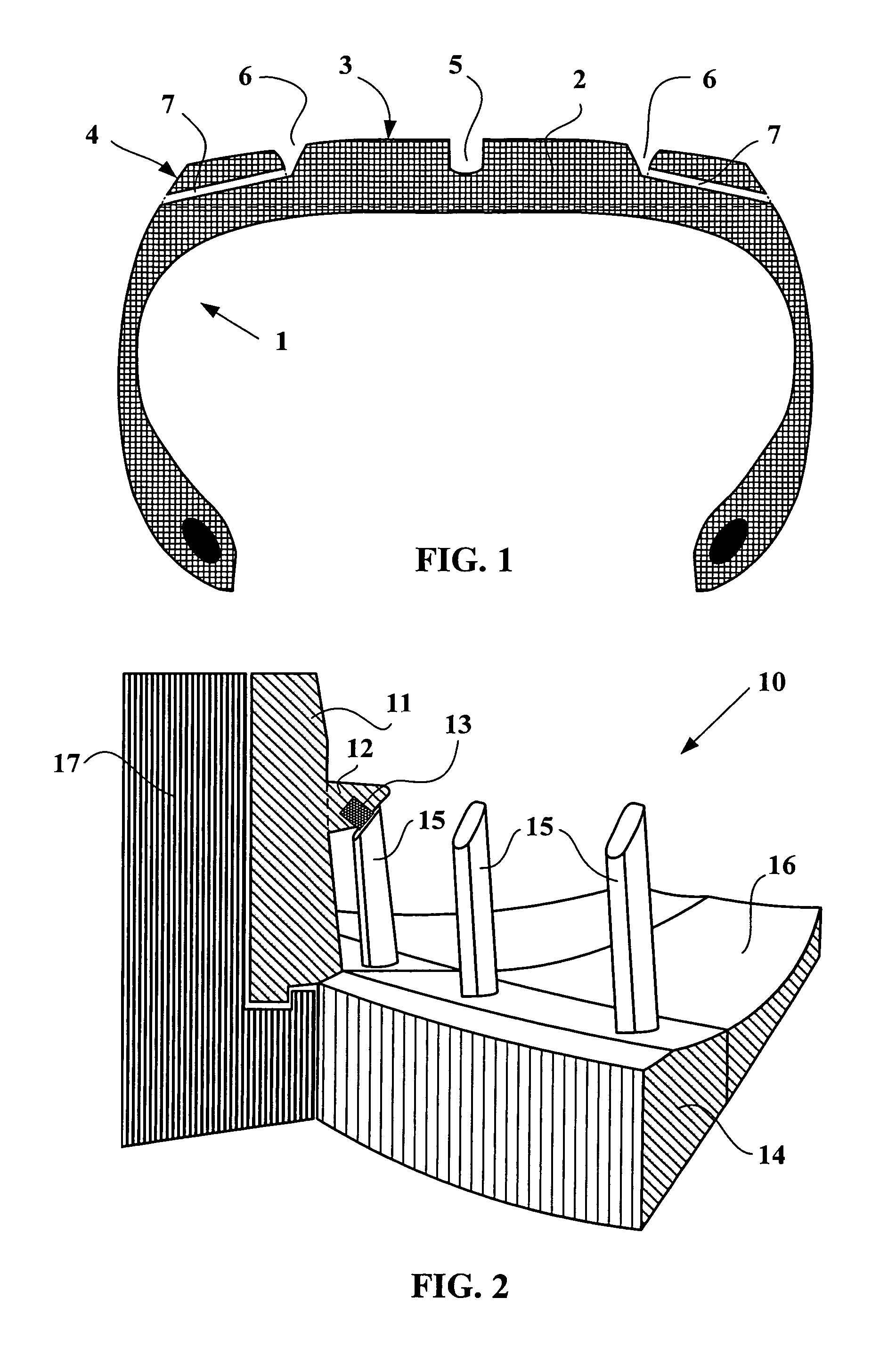
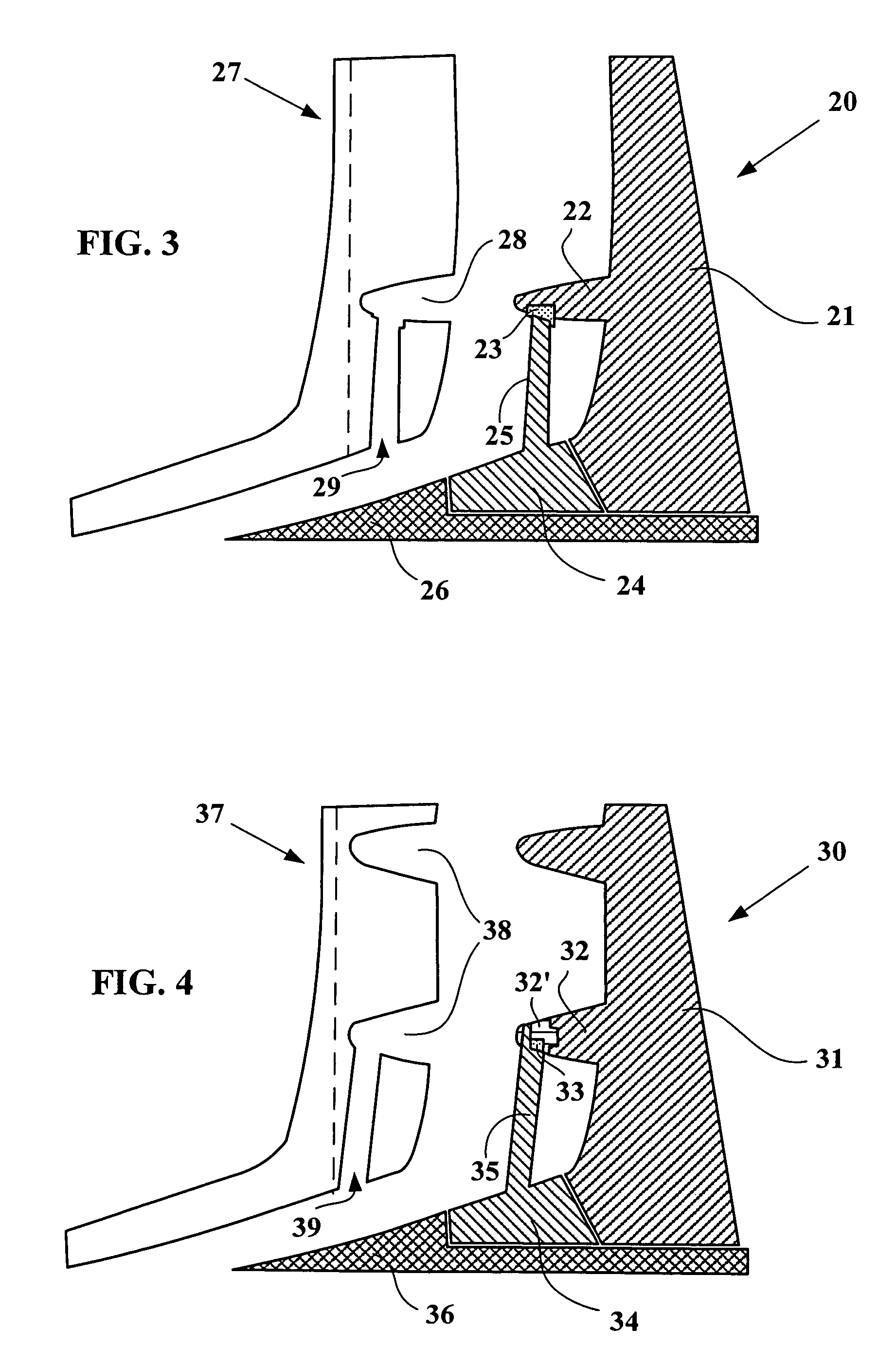
[0022]at least one pin for molding a channel inside the tread, this pin being anchored in one of the lateral parts;and in which, when the mold is closed, a contact surface is formed between the pin and the rib and the pin and / or the rib comprise at least one buffer made of a deformable material, deformation of which makes it possible to fill in the clearance between the pin and the rib at the contact surface when the mold is closed.
[0023]The presence of the buffer has the advantage of preventing any air from being enclosed between the pin and the rib. Generally speaking, fixing the buffer on the rib (rather than on the pin) has the advantage that the buffer experiences less strain and friction when the pin is withdrawn from the molded tire, which increases its service life.
[0032]According to a first preferred embodiment, the contact surface between the pin and the rib comprises a first part and a second part, the first part being substantially perpendicular to the radial direction and the second part being inclined with respect to the first part, and the buffer fills the clearance between the pin and the rib at said second part of the contact surface. The first and second parts are preferentially flat, as this allows a good contact between the pin and the rib. The angle of inclination α between the first part and the second part, measured in a plane comprising both the radial direction and the mean direction of the pin (see FIGS. 8 and 18) is preferentially greater than 45° and even more preferentially greater than 70°. This embodiment allows to reduce the strain experienced by the deformable buffer when the mold is closed. At that moment, the radial forces exerted upon the assembly formed by the pin and the corresponding rib are mainly taken up by the first part. The buffer that covers the second part, which is inclined with respect to the radial direction, undergoes little or no strain, which significantly increases its service life. This is true irrespective of whether the buffer is integral with the pin or with the rib.
[0033]According to a second preferred embodiment, the buffer is integral with the rib and has the shape of a strip, extending, for example, in a direction that is substantially perpendicular to the radial direction, such that it may serve as a support for a plurality of pins. This embodiment allows to reduce the manufacturing cost of the mold, in particular when a great number of pins is used. Moreover, as the buffer is fixed on the rib, there is more space and a thick buffer may be used, which allows to make up for more severe misalignment of pins.
[0034]According to a third preferred embodiment, the buffer comprises a deformable zone and a docking zone made of rigid material, preferably of metal, which is intended to come in contact with the pin. This makes it possible to avoid any direct contact between the pin and the deformable material, with the intention of reducing the friction suffered by the material, and, consequently, of increasing the buffer's service life. Preferentially, the buffer further comprises a rigid, preferably metallic, fixing zone for fixing the buffer on the rib, for example by means of a thread. In this embodiment, the deformable zone is sandwiched between the fixing zone and the docking zone.
[0035]The deformable buffer may be made of a plastic material (such as a metal foam) or an elastic material (such as for example silicone). According to a preferred embodiment, the deformable buffer is made of an elastic material, because this characteristic makes it possible to prevent the formation of any clearance between pin and rib even after a plurality of molding stages. If deformation is purely plastic, the buffer will not be in a position to ensure compensation of the clearance stemming from wear of the molding elements or due to assembly. It is thus advantageous to use materials whose deformation has an elastic component. Preferably, a material will be used which is both elastic and incompressible, such as silicone.


 Login to View More