Unlock instant, AI-driven research and patent intelligence for your innovation.

Electronic camera

a technology of electronic cameras and shutters, applied in the field of electronic cameras, can solve the problems of inability to prevent saturation on through-images before shutter operation, and achieve the effect of high luminance and adequate clamping process

Inactive Publication Date: 2009-05-12
SANYO ELECTRIC CO LTD
View PDF12 Cites 0 Cited by
  • Summary
  • Abstract
  • Description
  • Claims
  • Application Information

AI Technical Summary

Benefits of technology

[0010]Another object of the present invention is to provide an electronic camera capable of performing a precise clamping process on an image signal even when a high luminance object enters the end of a screen.
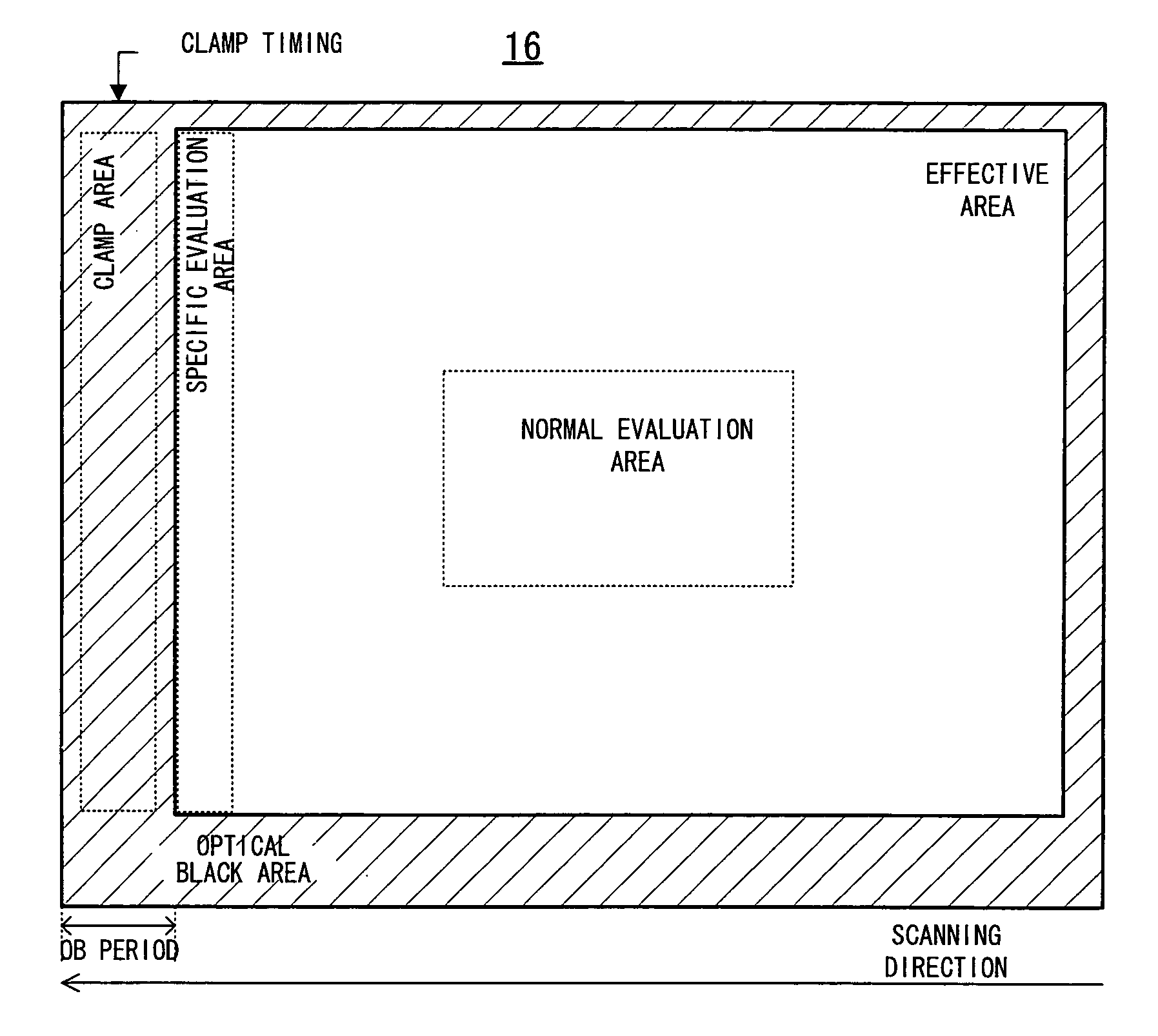
[0013]According to an invention of claim 1, an exposure time period is adjusted on the basis of the image signal at the center of the screen, and therefore, it is possible to perform photographing at an adequate exposure amount depending on brightness of a main object. Furthermore, when a high luminance light is irradiated on the end of the screen, an incident light amount to the imaging device, especially, an incident light amount to the end of the screen is restricted by contracting the aperture member, and as a result, it is possible to prevent a leakage charge from flowing into the clamp area placed on the periphery of the screen, capable of performing an adequate clamping process.
[0016]According to an invention of claim 2, when photographing a motion image, or when photographing a still image by a pre-exposure and a primary exposure, it is possible to perform an adequate exposure amount control depending on the brightness of the main object, and perform an adequate clamping process when a high luminance object enters the end of the screen.
[0021]According to an invention of claims 3 and 4, it is possible to easily perform adjustment of the aperture amount on the basis of the evaluated value.
[0025]According to an invention of claims 5 and 6, only the area adjacent to the optical black area (clamp area) corresponding to the optical black period during which a clamping process is performed can be an object of a brightness evaluation, and therefore, it is possible to efficiently perform an aperture amount control.

Problems solved by technology

However, in the above-described prior art in which a clamping process is performed during the optical black period and the idle feed period, in a case of occurrence of blooming, since this is detected only when a shutter operation is performed, and an exposure amount adjustment or a clamp timing control is executed after the detection, it is impossible to prevent saturation from occurring on the through-image before the shutter operation.

Method used

the structure of the environmentally friendly knitted fabric provided by the present invention; figure 2 Flow chart of the yarn wrapping machine for environmentally friendly knitted fabrics and storage devices; image 3 Is the parameter map of the yarn covering machine
View more

Image

Smart Image Click on the blue labels to locate them in the text.
Viewing Examples
Smart Image
  • Electronic camera
  • Electronic camera
  • Electronic camera

Examples

Experimental program
Comparison scheme
Effect test

Embodiment Construction

[0039]Referring to FIG. 1, a digital camera 10 of this embodiment includes an optical lens 12 and an aperture unit 14. An optical image of an object is irradiated onto a CCD imager 16 through these members. On an acceptance surface of the CCD imager 16, a primary color filter (not illustrated) is attached, and onto each of the photosensors 16a shown in FIG. 2, a light having any one of primary color components is irradiated. The photosensor 16a generates an electric charge (camera signal) in correspondence to an irradiance level by photoelectronic conversion.

[0040]A vertical synchronization signal (Vsync) and a horizontal synchronization signal (Hsync) signal are applied to a timing generator (TG) 26 from a signal generator (SG) 27. The TG 26 generates a charge reading pulse, a vertical transfer pulse, a horizontal transfer pulse, and a clamp pulse on the basis of the applied Vsync and Hsync.

[0041]The electric charge generated by the photosensor 16a is read by a vertical transfer re...

the structure of the environmentally friendly knitted fabric provided by the present invention; figure 2 Flow chart of the yarn wrapping machine for environmentally friendly knitted fabrics and storage devices; image 3 Is the parameter map of the yarn covering machine
Login to View More

PUM

No PUM Login to View More

Abstract

A digital camera (10) includes a CCD imager (16). An image signal corresponding to an optical image is output from the CCD imager (16), and an incident light amount to the CCD imager (16) is restricted by an aperture unit (14). A CPU (40) adjusts an exposure time period of the CCD imager (16) on the basis of an average luminance value of a normal evaluation area assigned to the center of a screen out of the image signals output form the CCD imager (16). The CPU (40) also adjusts an aperture amount of the aperture unit (14) on the basis of an average luminance value of a specific evaluation area assigned to the end of the screen out of the image signals output form the CCD imager (16).

Description

TECHNICAL FIELD[0001]The present invention relates to an electronic camera which is applied to a digital camera. More specifically, the present invention relates to an electronic camera which clamps an image signal output from an image sensor.PRIOR ART[0002]As to a digital camera, in general, when a shutter button is operated, a CCD imager is pre-exposed, and an image signal thus generated is subjected to a clamping process during an optical black period. The luminance of an object image is evaluated on the basis of the image signal on which the clamping process is performed, and whereby, a primary exposure amount is thus set to an optimum value.[0003]However, when a high luminance light is irradiated onto the CCD imager, an electric charge flows into an optical black area by blooming, resulting in a variation of an optical black level. Thus, in a prior art in which a clamping process is performed during the optical black period, it was impossible to properly evaluate the luminance ...

Claims

the structure of the environmentally friendly knitted fabric provided by the present invention; figure 2 Flow chart of the yarn wrapping machine for environmentally friendly knitted fabrics and storage devices; image 3 Is the parameter map of the yarn covering machine
Login to View More

Application Information

Patent Timeline
no application Login to View More
Patent Type & Authority Patents(United States)
IPC IPC(8): G03B7/00G03B7/097G03B7/28H04N5/235H04N5/238H04N101/00
CPCH04N5/238H04N5/3591H04N5/361H04N5/372H04N23/75H04N25/621H04N25/63H04N25/71
Inventor OKASAKA, AKIRA
Owner SANYO ELECTRIC CO LTD