
Purification of carbon dioxide
a carbon dioxide and purification technology, applied in the direction of rectification and condensation, energy input, liquefaction, etc., can solve the problems of reducing the heating and economic value of gas, oxygen presence, and no details regarding how the general idea might be implemented
- Summary
- Abstract
- Description
- Claims
- Application Information
AI Technical Summary
Benefits of technology
Problems solved by technology
Method used
Image

Examples
example 1
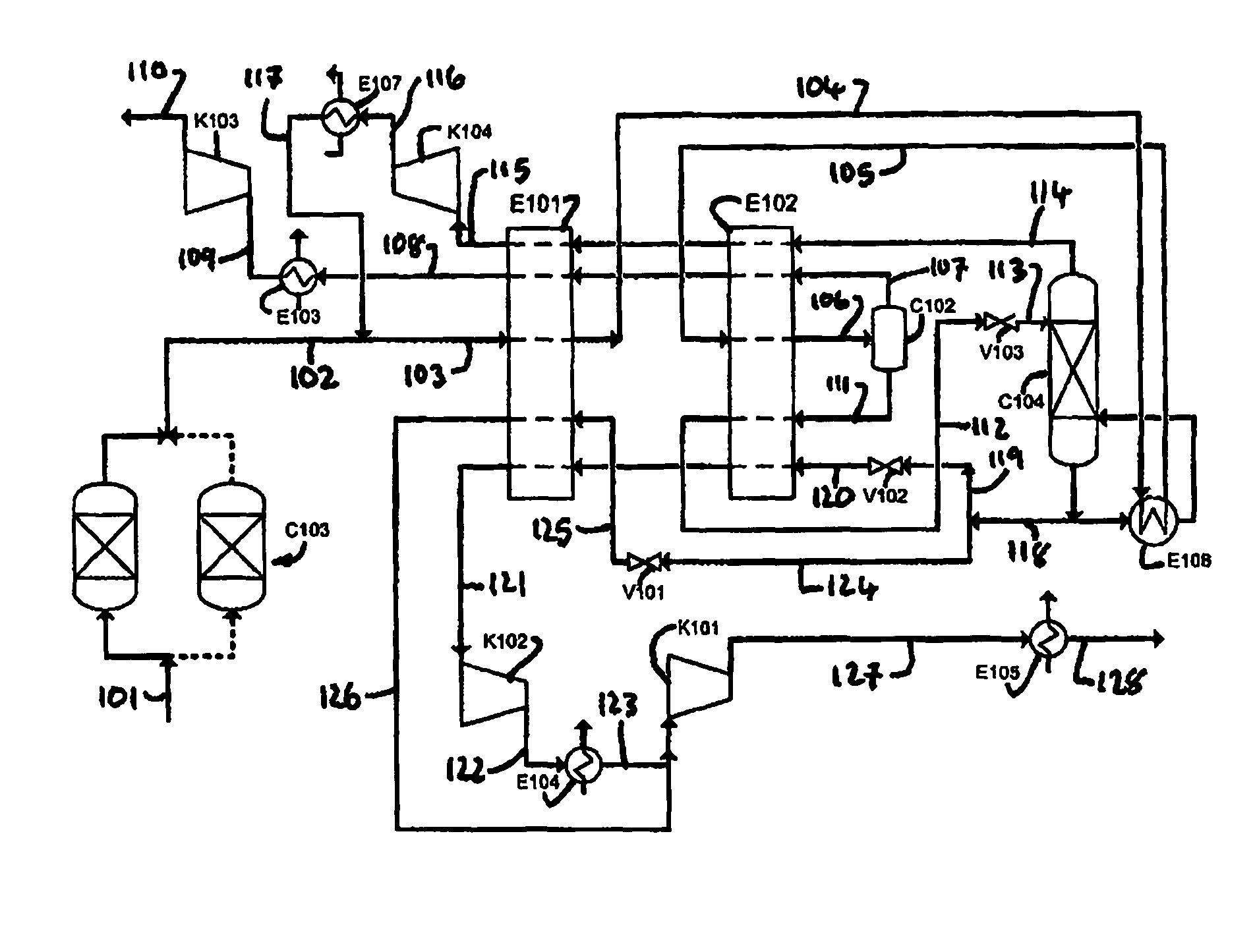
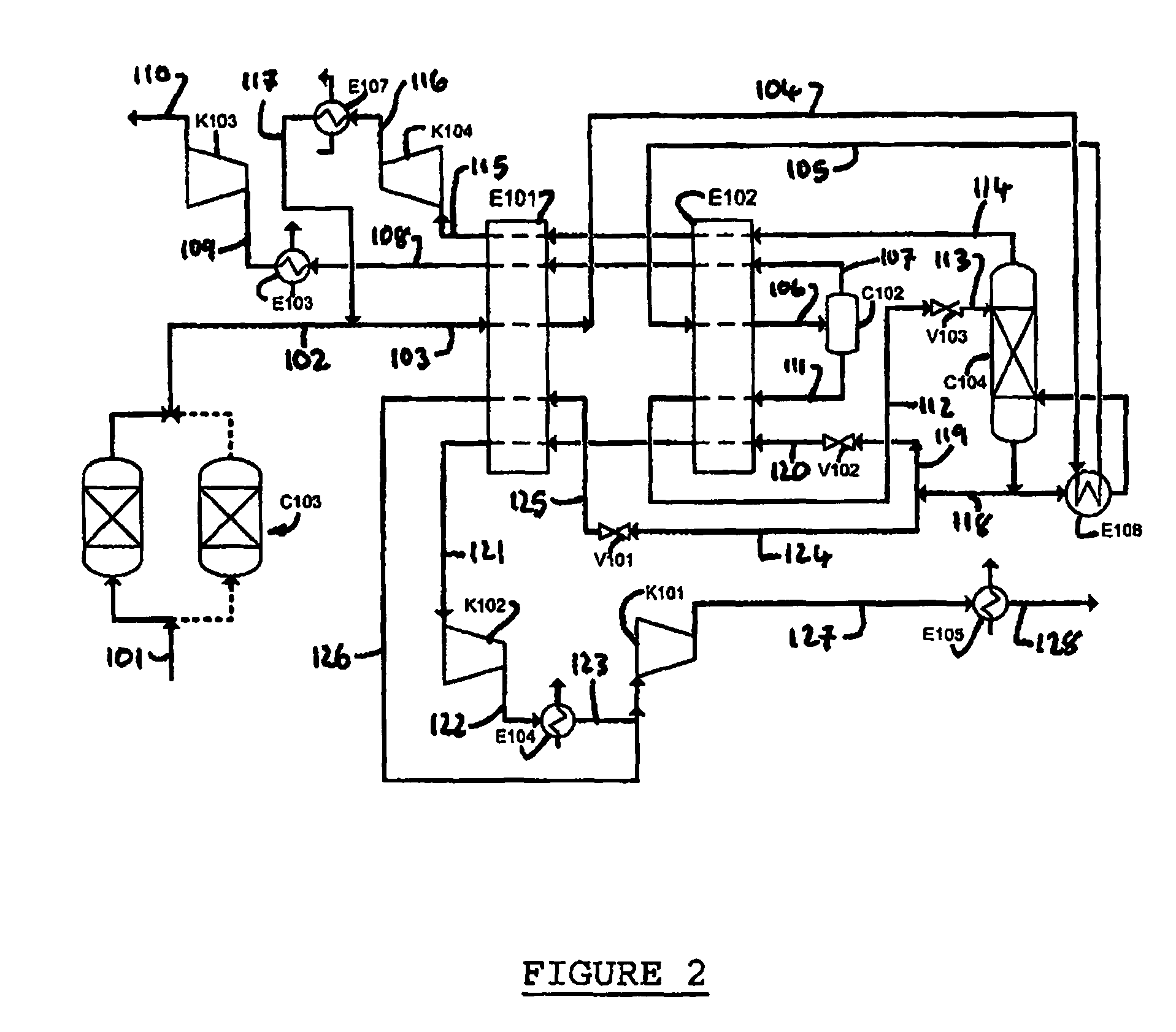
[0232]A computer simulation has been carried out using commercially available simulation software (Aspen Plus Version 2004.1) in which the process depicted in FIG. 2 is integrated with an oxyfuel combustion process in a power generation plant. A heat and mass balance table for the simulation is provided in Table 2.
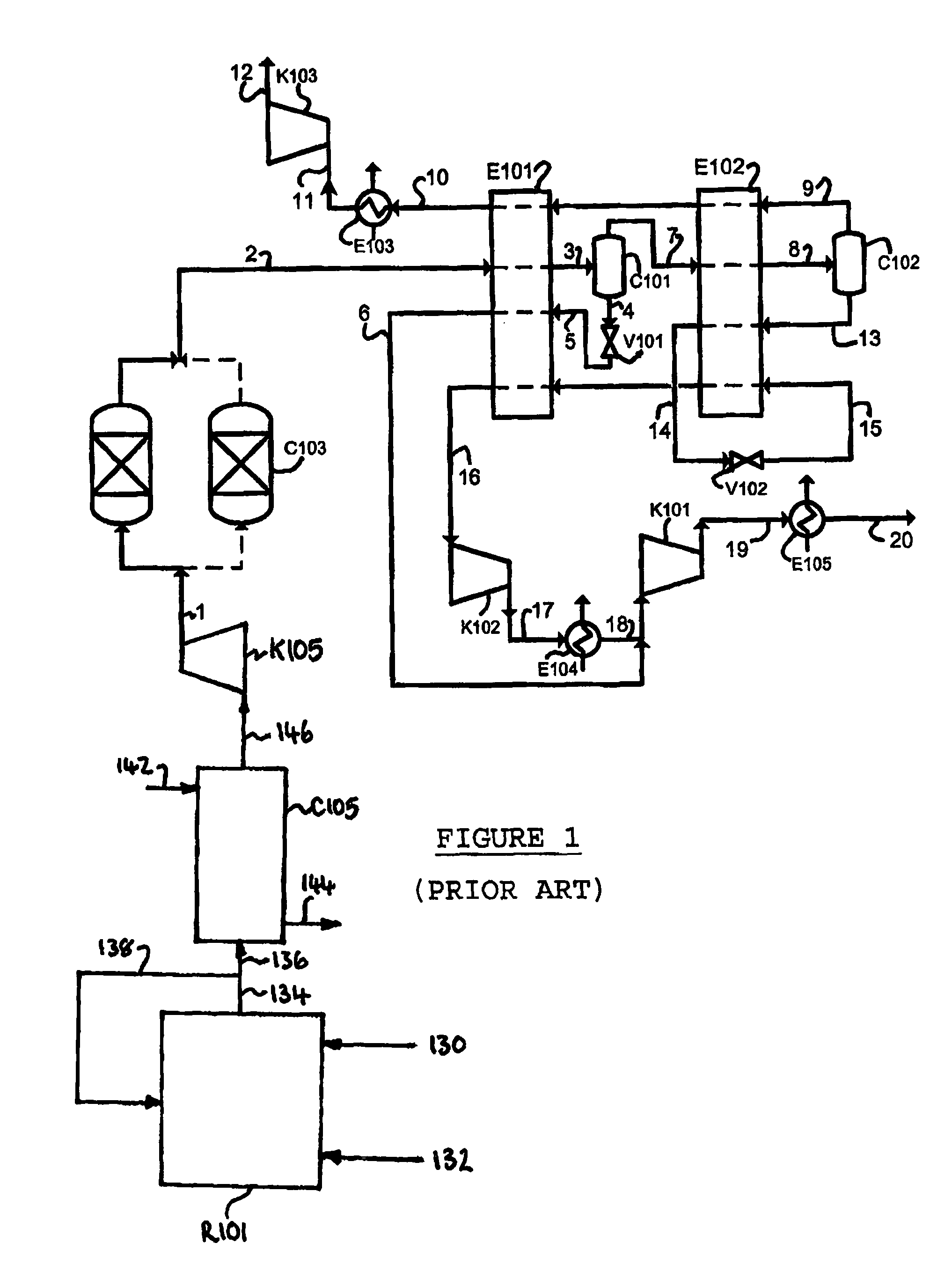
[0233]The simulation achieved the required level of carbon dioxide purity of over 97 mol % (actually about 99.9 mol %), with about 87.4% carbon dioxide recovery. However, the specific power consumption is increased by 3% and carbon dioxide recovery reduced by 1.6% compared to the prior art process shown in FIG. 1.
[0234]A computer simulation (Aspen Plus Version 2004.1) of the same process but vaporizing a third level of liquid carbon dioxide to provide further refrigeration (FIG. 3) indicates that overall power consumption can be reduced by about 13% compared to the process depicted in FIG. 1.
[0235]
TABLE 2Stream Number101102103104105106107108109110Temperature° C.24.8324.832...
example 2
[0236]A computer simulation (Aspen Plus Version 2004.1) has been carried out in which the process depicted in FIG. 2 is integrated with a hydrogen PSA system (not shown). The off gas from the PSA system is compressed to 30 bar to form a stream 101 of compressed off gas which is fed to the process. A heat and mass balance table for the simulation is provided in Table 3.
[0237]The simulation indicates that the carbon monoxide level can be reduced to about 100 ppm.
[0238]
TABLE 3Stream Number101102103104105106107108109110Temperature° C.20.0020.0020.30−3.21−16.35−53.65−53.658.40300.0065.90Pressurebar a3030.00303030303030301.1Flowkg / s54.5954.5659.0559.0559.0559.059.789.789.789.78CompositionCO2mol %71.601671.679972.476872.476872.476872.476823.748423.748423.748423.7484N2mol %0.99510.99621.01831.01831.01831.01832.68592.68592.68592.6859Armol %0.16820.16840.18360.18360.18360.18360.43880.43880.43880.4388H2mol %21.860921.884820.835520.835520.835520.835559.030359.030359.030359.0303H2Omol %0.10920.0...
PUM
| Property | Measurement | Unit |
|---|---|---|
| mol % | aaaaa | aaaaa |
| mol % | aaaaa | aaaaa |
| pressure | aaaaa | aaaaa |
Abstract
Description
Claims
Application Information
 Login to View More