Multi-processor control device and method
a control device and multi-processor technology, applied in multi-programming arrangements, liquid/fluent solid measurement, instruments, etc., can solve problems such as degrading energy efficiency, unable to perform any control, and affecting the performance of a program
- Summary
- Abstract
- Description
- Claims
- Application Information
AI Technical Summary
Problems solved by technology
Method used
Image



Examples
first embodiment
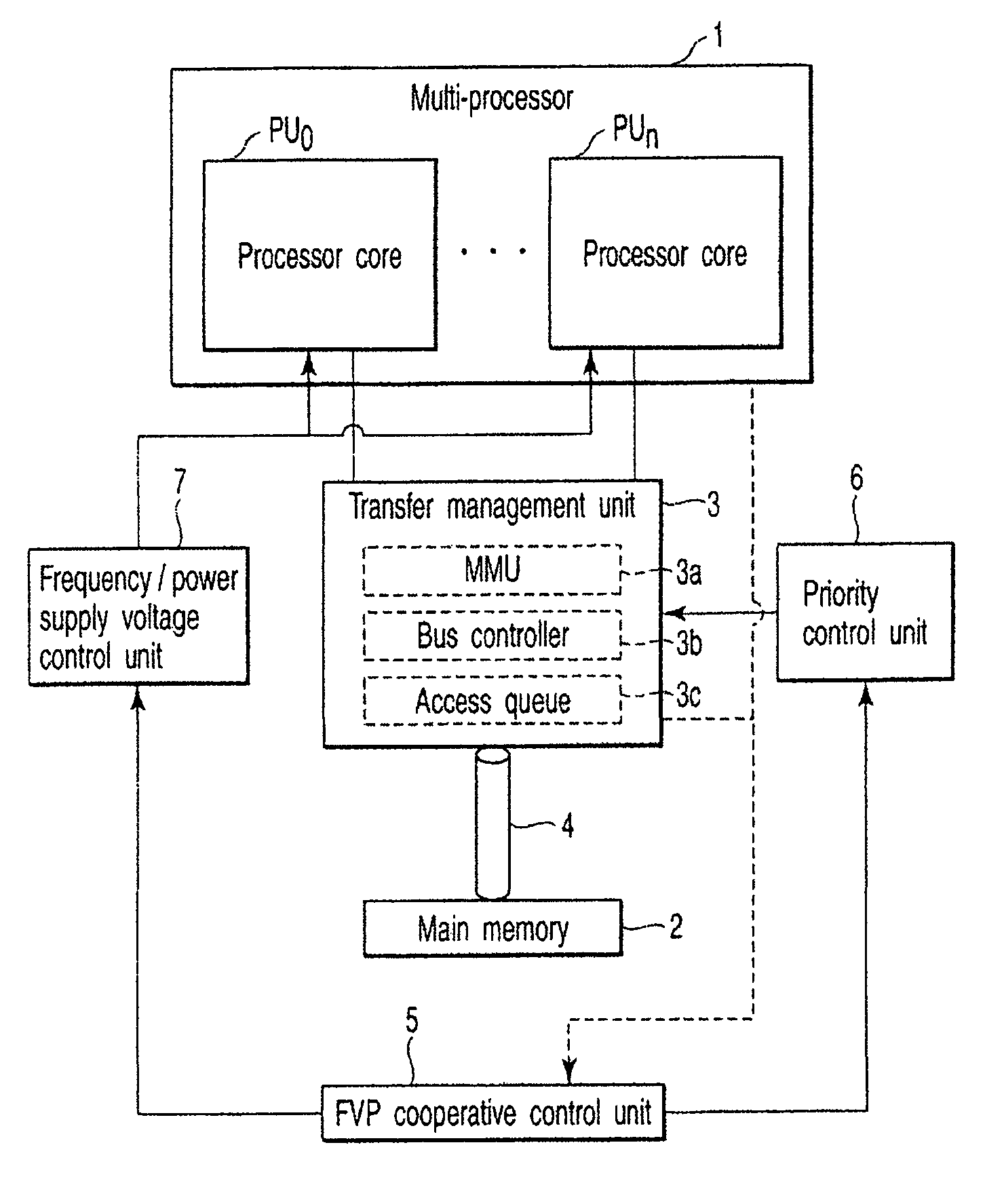
This embodiment exemplifies a device which controls a chip multi processor (CMP) having a plurality of processor cores mounted on one chip. However, a control target of this control device is not limited to a CMP. For example, a multi-processor system comprising a plurality of chips can be a control target.
This embodiment exemplifies a multi-processor control device which suppresses at least one of power consumption and energy consumption by modeling an influence of shared resource contention on performance in consideration of the influence of the shared resource contention between programs executed by the respective processor cores. The following description exemplifies a case in which power consumption is suppressed. It is, however, possible to suppress energy consumption by using a similar control technique.
This embodiment can improve a power consumption suppressing effect by adjusting the influence of shared resource contention on performance by priority control. For this purpos...
second embodiment
This embodiment exemplifies a control algorithm which controls priorities and frequencies / power supply voltages by a scheme different from that in the first embodiment.
According to a performance prediction model, when the frequencies of processor cores PU0 to PUn become equal to each other, the overall power consumption is minimized.
In this embodiment, therefore, an FVP cooperative control unit 5 controls priorities such that all the frequencies of the processor cores PU0 to PUn include within a target range (more preferably become equal to each other).
Consider, for example, the two processor cores PU0 and PU1. If the frequency of the processor core PU0 is higher than that of the processor core PU1, the FVP cooperative control unit 5 increases the priority of the processor core PU0.
In contrast, if the frequency of the processor core PU1 is higher than that of the processor core PU0, the FVP cooperative control unit 5 increases the priority of the processor core PU1.
Using such a cont...
third embodiment
This embodiment exemplifies the performance prediction model in the first and second embodiments.
For simplification, a multi-processor (chip multi processor) 1 on which two processor cores PU0 and PU1 are mounted as shown in FIG. 5 will be described.
The processor cores PU0 and PU1 respectively incorporate caches L1 and L2, and share a memory bus 4 and a main memory 2. The processor cores PU0 and PU1 respectively execute independent programs T0 and T1. The processor cores PU0 and PU1 have latency constraints as performance constraints.
Access contention for the memory bus 4 will be described below.
As shown in FIG. 6, a processor core which is executing a program takes two states, i.e., a state (operation state) in which an instruction is being executed and a state (stall state) in which access to the cache L2 fails, and the processor core is stalled to wait for the corresponding data.
When the frequency / power supply voltage of a processor core is changed, the operation time required to...
PUM
 Login to View More
 Abstract
Description
Claims
Application Information
 Login to View More
 - R&D
- Intellectual Property
- Life Sciences
- Materials
- Tech Scout
- Unparalleled Data Quality
- Higher Quality Content
- 60% Fewer Hallucinations
Browse by: Latest US Patents, China's latest patents, Technical Efficacy Thesaurus, Application Domain, Technology Topic, Popular Technical Reports.
© 2025 PatSnap. All rights reserved.Legal|Privacy policy|Modern Slavery Act Transparency Statement|Sitemap|About US| Contact US: help@patsnap.com