

Ureteral stent
a ureteral stent and ureteral tube technology, applied in the field of improved stents, can solve problems such as significant patient discomfort, and achieve the effects of significant hydrophilicity or hydrophobicity, reduced rigidity or stiffness, and more rigidity
- Summary
- Abstract
- Description
- Claims
- Application Information
AI Technical Summary
Problems solved by technology
Method used
Image

Examples
Embodiment Construction
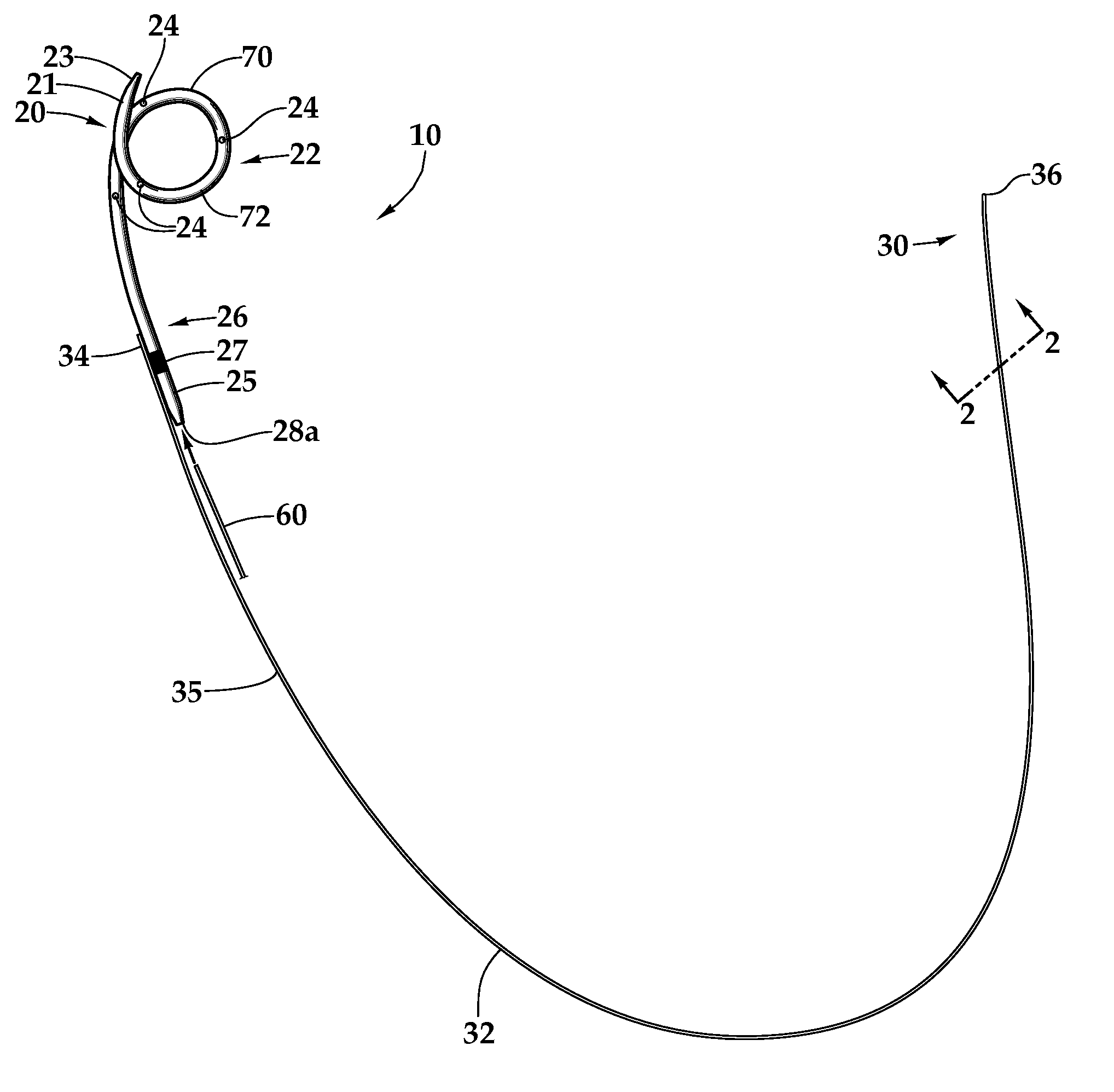
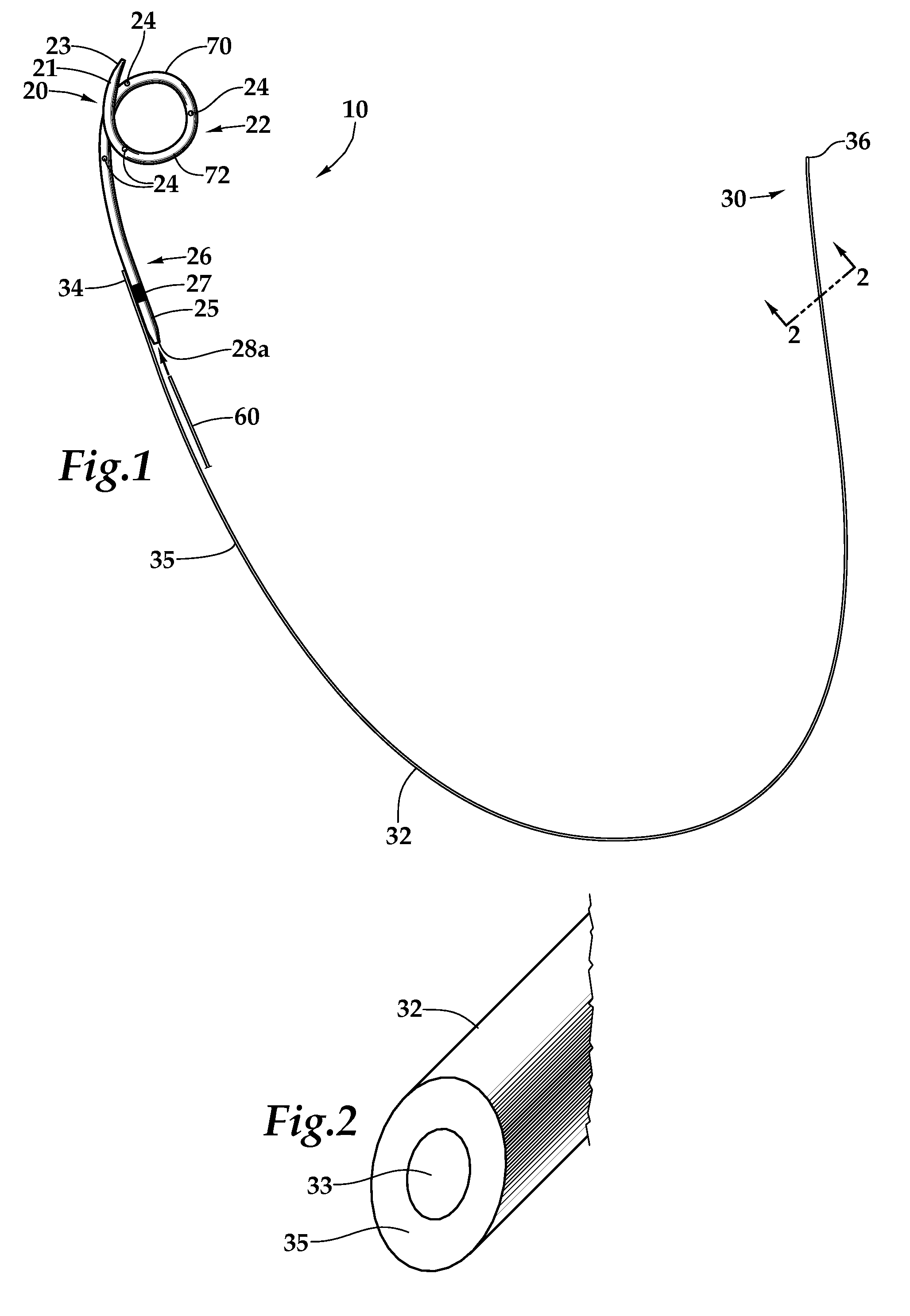
[0025]As seen in FIG. 1, a stent such as ureteral stent 10 comprising a renal coil 22 at a renal end 20 and wick portion 32 extending from renal coil 22 to a bladder end 30.
[0026]Renal coil 22 may comprise a flexible coiled material such as a rubberized or polymerized material. As its name implies, renal coil 22 may be coiled at renal end 20 of stent 10 for locating and maintaining renal end 20 inside kidney 2, preferably proximate renal pelvis 3. Renal coil 22 may be spiral shaped or generally J-shaped, or it may have other configurations that will keep renal end 20 from migrating out of kidney 2. Moreover, renal coil 22 may have a tapered end 23 at the proximal end of stent 10, which may facilitate insertion of stent 10. Furthermore, renal coil 22 may have a tapered end 25 for ease of stent 10 removal.
[0027]In addition, renal coil 22 may be a generally tubular material having an outer diameter of between about 3 Fr. and about 10 Fr., preferably between about 5 Fr. and about 7 Fr.,...
PUM
 Login to View More
 Abstract
Description
Claims
Application Information
 Login to View More