

Benzoxazolone derivatives as aldosterone synthase inhibitors
a technology of aldosterone and derivatives, which is applied in the direction of drug compositions, biocide, metabolic disorders, etc., can solve the problems of gynecomastia and impotence, and achieve the effect of suppressing aldosterone production and meliorating the deleterious effects of aldosteron
- Summary
- Abstract
- Description
- Claims
- Application Information
AI Technical Summary
Benefits of technology
Problems solved by technology
Method used
Image

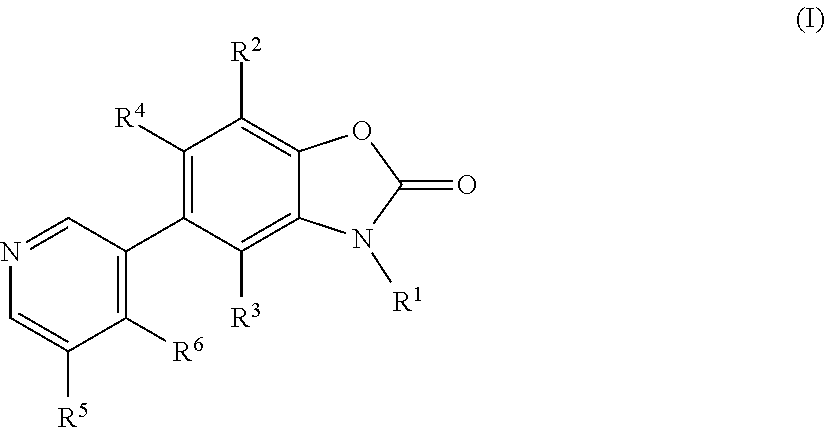
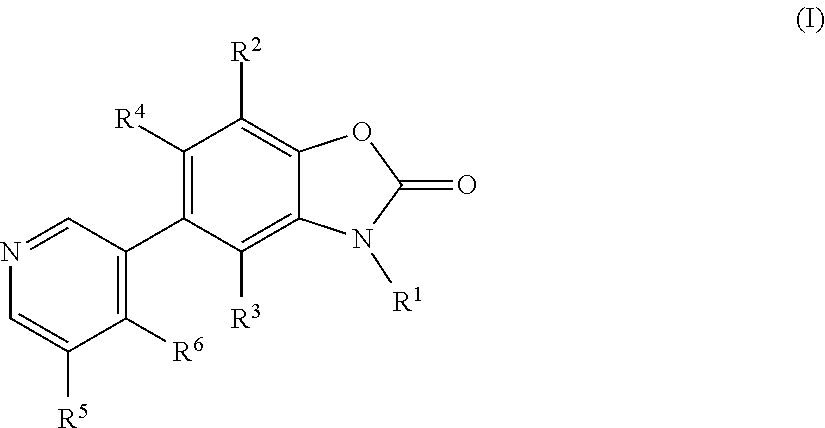
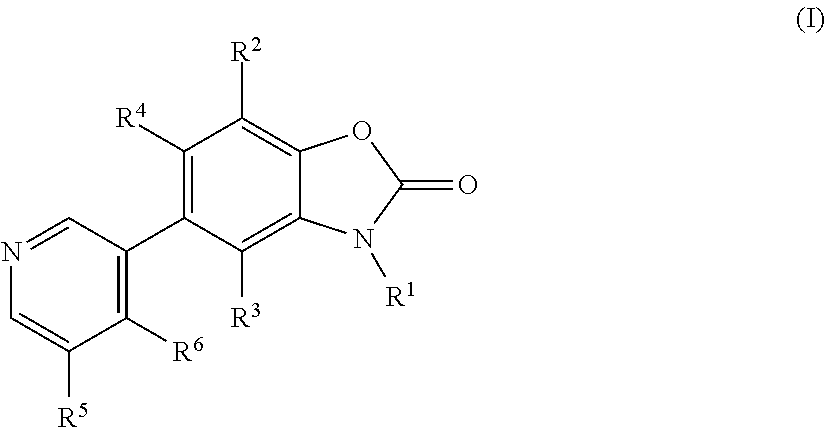
Examples
example 1
3-Methyl-5-pyridin-3-yl-3H-benzooxazol-2-one
[0251]
Step 1: Synthesis of 5-Bromo-3-methyl-3H-benzooxazol-2-one
[0252]
[0253]A mixture of 5-Bromo-3-hydro-3H-benzooxazol-2-one (500 mg, 2.3 mmol), iodomethane (291 uL, 663 mg, 4.67 mmol), K2CO3 (807 mg, 5.84 mmol) in DMSO (10 mL) was stirred at room temperature for overnight. After concentration under reduced pressure, the residue was purified by flash column and yielded colorless solid (440 mg). 1HNMR (CDCl3, 400.342 MHz): δ 3.38 (5, 3H), 7.07 (d, J=8 Hz, 1H), 7.10 (d, J=1.9 Hz, 1H), 7.24 (dd, J=8, 1.9 Hz, 1H).
Step 2: Synthesis of 3-Methyl-5-pyridin-3-yl-3H-benzooxazol-2-one
[0254]
[0255]A mixture of pyridin-3-ylboronic acid (61.5 mg, 0.5 mmol), 5-Bromo-3-methyl-3H-benzooxazol-2-one (114 mg, 0.5 mmol), polymer-supported Pd(PPh3)4 (0.11 mmol / g, 114 mg, 0.0125 mmol), Na2CO3 (2 M in water, 0.5 mL, 1 mmol) in DME (3 mL) was heated to reflux for 6 hrs. After filtration and concentration, the residue was purified by flash column (MeOH—CH2Cl2, v / v,...
example 2
3-Methyl-5-(4-methyl-pyridin-3-yl)-3H-benzooxazol-2-one
[0256]
[0257]The entitled compound was synthesized using the Suzuki coupling conditions described in example 1. 1HNMR (CDCl3, 400.342 MHz): δ 2.22 (s, 3H), 3.37 (s, 3H), 6.83 (d, J=1.6 Hz, 1H), 6.98 (dd, J=8.2, 1.68 Hz, 1H), 7.14 (d, J=6 Hz, 1H), 7.20 (d J=8.2 Hz, 1H), 8.36 (s, 1H), 8.40 (d, J=6.04 Hz, 1H).
example 3
5-(5-fluo pyridin-3-yl)-3-methylbenzo[d]oxazol-2(3H-one
[0258]
[0259]The entitled compound was synthesized using the Suzuki coupling conditions described in example 1, 1HNMR (CDCl3, 400.342 MHz): δ 3.41 (s, 3H), 7.06 (s, 1H), 7.24 (m, 2H), 7.51 (m, 1H), 841 (d, J=2.6 Hz, 1H), 8.58 (s, 1H).
PUM
| Property | Measurement | Unit |
|---|---|---|
| enantiomeric excess | aaaaa | aaaaa |
| enantiomeric excess | aaaaa | aaaaa |
| enantiomeric excess | aaaaa | aaaaa |
Abstract
Description
Claims
Application Information
 Login to View More