Predictive wakeup for push-to-talk-over-cellular (POC) call setup optimizations
What is AI technical title?
AI technical title is built by Patsnap AI team. It summarizes the technical point description of the patent document.
a technology of push-to-talk-over-cellular and call setup optimization, which is applied in the direction of connection management, broadcast service distribution, wireless commuication services, etc., can solve the problems of inability to achieve the set-up time in view of inherent network parameters, inability to set-up poc sessions for more than 2 seconds, and inability to meet the call setup time. , to achieve the effect of reducing the overall set-up time and less complexity
Active Publication Date: 2013-07-02
KODIAK NETWORKS
View PDF127 Cites 39 Cited by
Summary
Abstract
Description
Claims
Application Information
AI Technical Summary
This helps you quickly interpret patents by identifying the three key elements:
Problems solved by technology
Method used
Benefits of technology
Benefits of technology
[0040]The terminating mobiles of the predicted participants are identified by a predictive wakeup mechanism before the originating mobile sends a list of one or more terminating mobiles of actual participants to the real-time exchange. When the list of the terminating mobiles of the actual participants is received, the real-time exchange sets up PoC sessions to the terminating mobiles of the actual participants. Since the participants in the session have been transitioned from a dormant state to an active state by the prior wakeup messages that were sent by the real-time exchange, the overall set up time to establish PoC sessions is considerably reduced.
[0041]The predictive wakeup mechanism includes one or more algorithms performed by a processor that derive the list of predicted participants, wherein these algorithms can be client-based or server-based. Client-based algorithms derive the list of participants based on client actions on the mobile. Server-based algorithms may derive the same or a different list of predicted participants based on the same information or server-based information not available to a client-based algorithm. Also, a server-based algorithm eliminates the need for the client on the mobile to implement complex algorithms, resulting in less complexity and hence cost.
Problems solved by technology
In practice, these setup times are difficult to achieve in view of inherent network parameters.
This results in inherent delays of longer than 2 seconds in setting up of PoC sessions, which is unacceptably long.
Method used
the structure of the environmentally friendly knitted fabric provided by the present invention; figure 2 Flow chart of the yarn wrapping machine for environmentally friendly knitted fabrics and storage devices; image 3 Is the parameter map of the yarn covering machine
View more
Image
Smart Image Click on the blue labels to locate them in the text.
Viewing Examples
Smart Image
Click on the blue label to locate the original text in one second.
Reading with bidirectional positioning of images and text.
Smart Image
Examples
Experimental program
Comparison scheme
Effect test
Embodiment Construction
[0047]In the following description of the preferred embodiment, reference is made to the accompanying drawings which form a part hereof, and in which is shown by way of illustration the specific embodiment in which the invention may be practiced. It is to be understood that other embodiments may be utilized as structural changes may be made without departing from the scope of the present invention.
[0048]Overview
[0049]This invention relates in general to mobile phone networks, and more specifically, to predictive wakeup for call setup optimizations in a mobile phone network. In one embodiment, the predictive wakeup mechanism of the present invention is used with a Push-to-Talk-over-Cellular (PoC) call for wireless networks, although it may be used for other advanced voice services as well.
[0050]Network Architecture
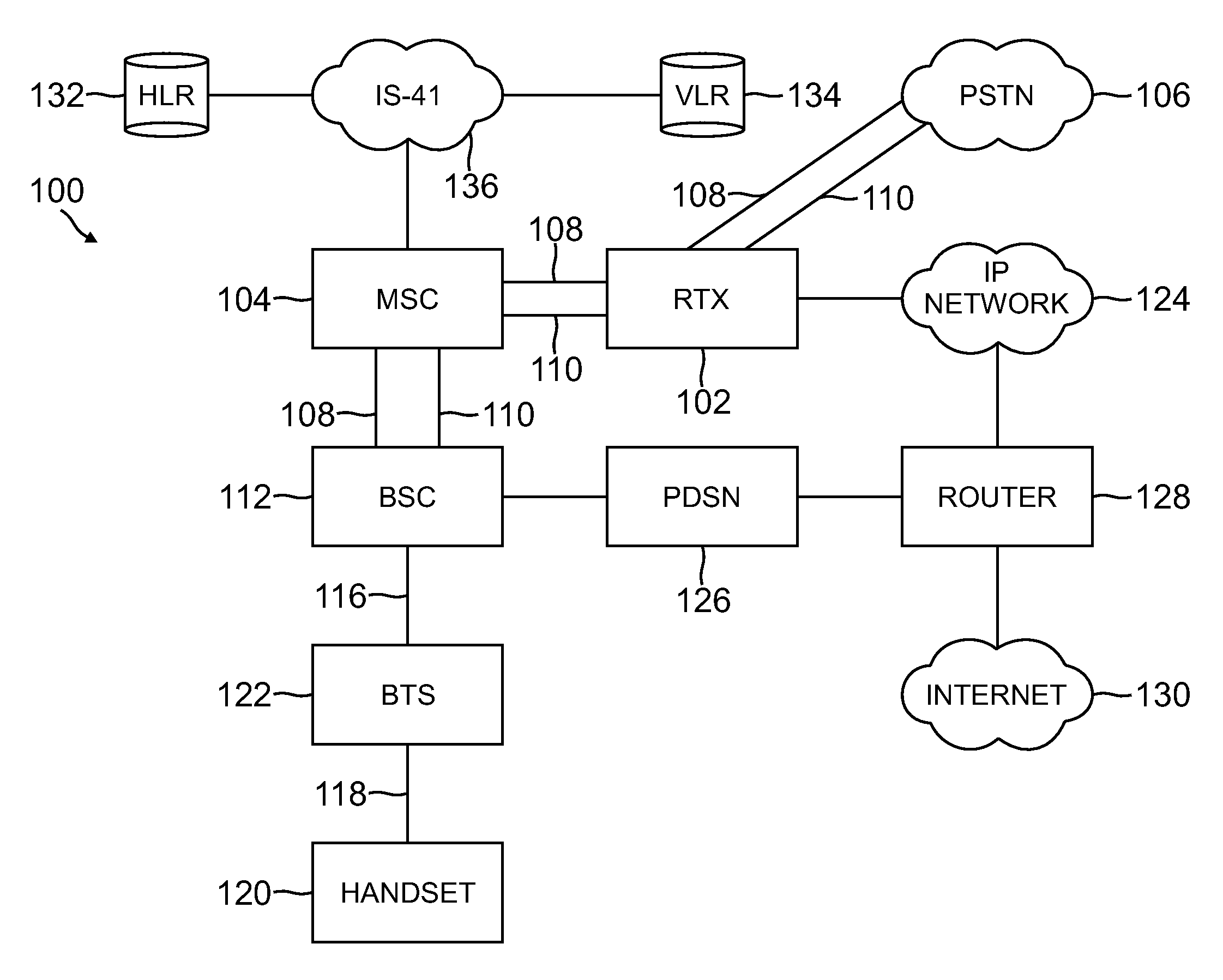
[0051]FIG. 1 is a block diagram that illustrates an exemplary embodiment of a wireless communications network (also known as a cellular phone network or mobile phone networ...
the structure of the environmentally friendly knitted fabric provided by the present invention; figure 2 Flow chart of the yarn wrapping machine for environmentally friendly knitted fabrics and storage devices; image 3 Is the parameter map of the yarn covering machine
Login to View More
PUM
Login to View More
Abstract
A predictive wakeup function for Push-to-Talk-over Cellular (PoC) call setup optimizations in a cellular mobile phone network. In performing the predictive wakeup for call setup optimizations, an originating mobile transmits an event trigger to a real-time exchange that interfaces to a mobile switching center in the cellular mobile phone network. The real-time exchange transmits a wakeup message to one or more terminating mobiles of predicted participants, in order to transition the terminating mobiles of the predicted participants from a dormant state to an active state prior to a call being setup with the terminating mobiles of the predicted participants. The terminating mobiles of the predicted participants are identified by a predictive wakeup mechanism before the originating mobile sends a list of one or more terminating mobiles of actual participants to the real-time exchange. The predicted participants may be determined based on static or dynamic information, including heuristics involving calling patterns.
Description
CROSS REFERENCE TO RELATED APPLICATIONS[0001]This application claims the benefit under 35 U.S.C. Section 119(e) of the following and commonly-assigned patent application:[0002]U.S. Provisional Application Ser. No. 61 / 347,217, filed May 21, 2010, by Brahmananda R. Vempati, Krishnakant M. Patel, Pratap Chandana, Anand Narayanan, and Ravi Ayyasamy, entitled “PREDICTIVE WAKEUP FOR PUSH-TO-TALK-OVER-CELLULAR (POC) CALL SETUP OPTIMIZATIONS,”;[0003]which application is incorporated by reference herein.[0004]This application is related to the following commonly-assigned patent applications:[0005]U.S. Utility application Ser. No. 10 / 515,556, filed Nov. 23, 2004, by Gorachand Kundu, Ravi Ayyasamy and Krishnakant Patel, entitled “DISPATCH SERVICE ARCHITECTURE FRAMEWORK,”, now U.S. Pat. No. 7,787,896, issued Aug. 31, 2010, which application claims the benefit under 35 U.S.C. Section 365 of P.C.T. International Application Serial Number PCT / US03 / 16386, which application claims the benefit under ...
Claims
the structure of the environmentally friendly knitted fabric provided by the present invention; figure 2 Flow chart of the yarn wrapping machine for environmentally friendly knitted fabrics and storage devices; image 3 Is the parameter map of the yarn covering machine
Login to View More
Application Information
Patent Timeline
Application Date:The date an application was filed.
Publication Date:The date a patent or application was officially published.
First Publication Date:The earliest publication date of a patent with the same application number.
Issue Date:Publication date of the patent grant document.
PCT Entry Date:The Entry date of PCT National Phase.
Estimated Expiry Date:The statutory expiry date of a patent right according to the Patent Law, and it is the longest term of protection that the patent right can achieve without the termination of the patent right due to other reasons(Term extension factor has been taken into account ).
Invalid Date:Actual expiry date is based on effective date or publication date of legal transaction data of invalid patent.



 Login to View More
  Login to View More