Check patentability & draft patents in minutes with Patsnap Eureka AI!

Infinite complexity deep-framebuffer rendering

a deepframebuffer and infinite complexity technology, applied in the field of computer graphics, can solve the problems of large amount of redundant computation, and high cost of redundant computation

Active Publication Date: 2013-07-30
PACIFIC DATA IMAGES LLC
View PDF0 Cites 2 Cited by
  • Summary
  • Abstract
  • Description
  • Claims
  • Application Information

AI Technical Summary

Benefits of technology

This approach enables fast, high-quality rendering of complex scenes by reducing memory usage and eliminating redundant computations, allowing for continuous processing and efficient reconstruction of the scene without system crashes, even with limited memory resources.

Problems solved by technology

However, the Reyes rendering architecture generally requires the entire framebuffer (a buffer that stores the contents of an image pixel by pixel) to be stored in memory since the final image cannot be outputted until all geometric primitives have been processed.
However, using bucket rendering in a Reyes rendering architecture has a number of drawbacks.
One drawback is the redundant computations required in processing geometric primitives when the full list of primitives does not fit entirely in memory and when primitives span multiple buckets, as is the case in most complex scenes.
As a result, re-processing / regeneration of the same geometric primitives that span subsequent buckets results in a significant amount of redundant computation.
However, when the list of accumulated geometric primitives has filled up the memory devoted to that purpose, some of these geometric primitives are discarded anyways and re-processing / regeneration of these geometric primitives still results in expensive redundant computations.
However, the geometry shaders become much more difficult to write.
However, saving the deep-framebuffer into a single file at the end of a rendering process may limit the complexity or the richness of the scenes and the productivity of the artists who are generating the scenes.
As scenes become more complex, the deep-framebuffer may grow well beyond the amount of memory available on the processing machine.
An artist may be forced to choose between limiting the complexity or richness of the scenes, or implementing tedious workarounds, such as manual level-of-detail (LOD) techniques (i.e., techniques that decrease the complexity of 3D object representation based on object importance, eye-space speed, or position) when overly complex or large scenes must be generated by the rendering tools.
However, similar to bucket rendering, one significant drawback of tiling is the redundant computations required in processing geometric primitives when the primitives span multiple tiles.
Because the data from a previously rendered tile is discarded before the next tile is processed, re-processing of the same geometric primitives for subsequent tiles results in redundant computations.
These redundant computations may be substantial, especially for geometries with long geometry generation, tessellation, and rasterization times or geometries that appear extensively over a scene, such as fur, hair, grass, trees, foliage, and the like.

Method used

the structure of the environmentally friendly knitted fabric provided by the present invention; figure 2 Flow chart of the yarn wrapping machine for environmentally friendly knitted fabrics and storage devices; image 3 Is the parameter map of the yarn covering machine
View more

Image

Smart Image Click on the blue labels to locate them in the text.
Viewing Examples
Smart Image
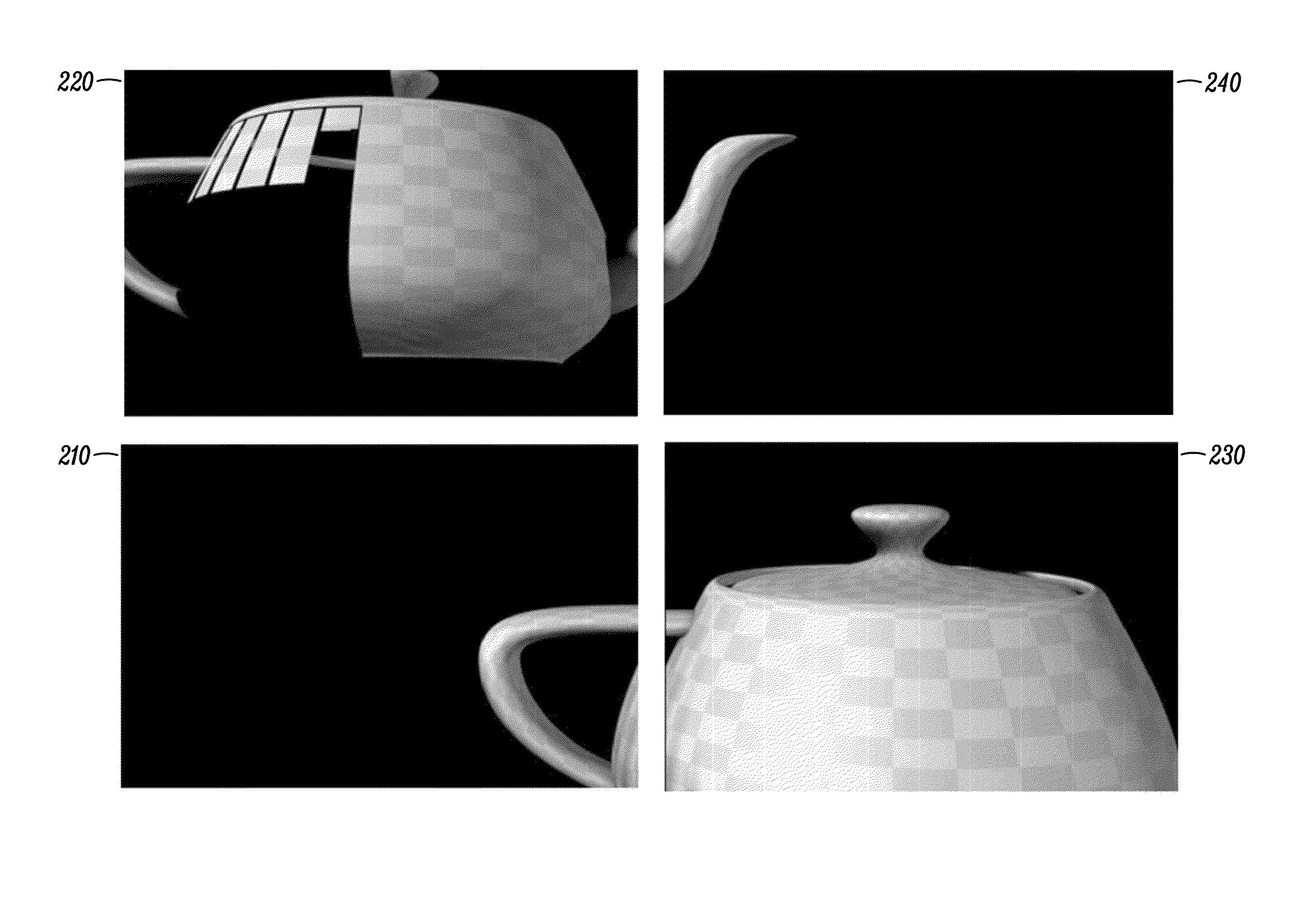
  • Infinite complexity deep-framebuffer rendering
  • Infinite complexity deep-framebuffer rendering
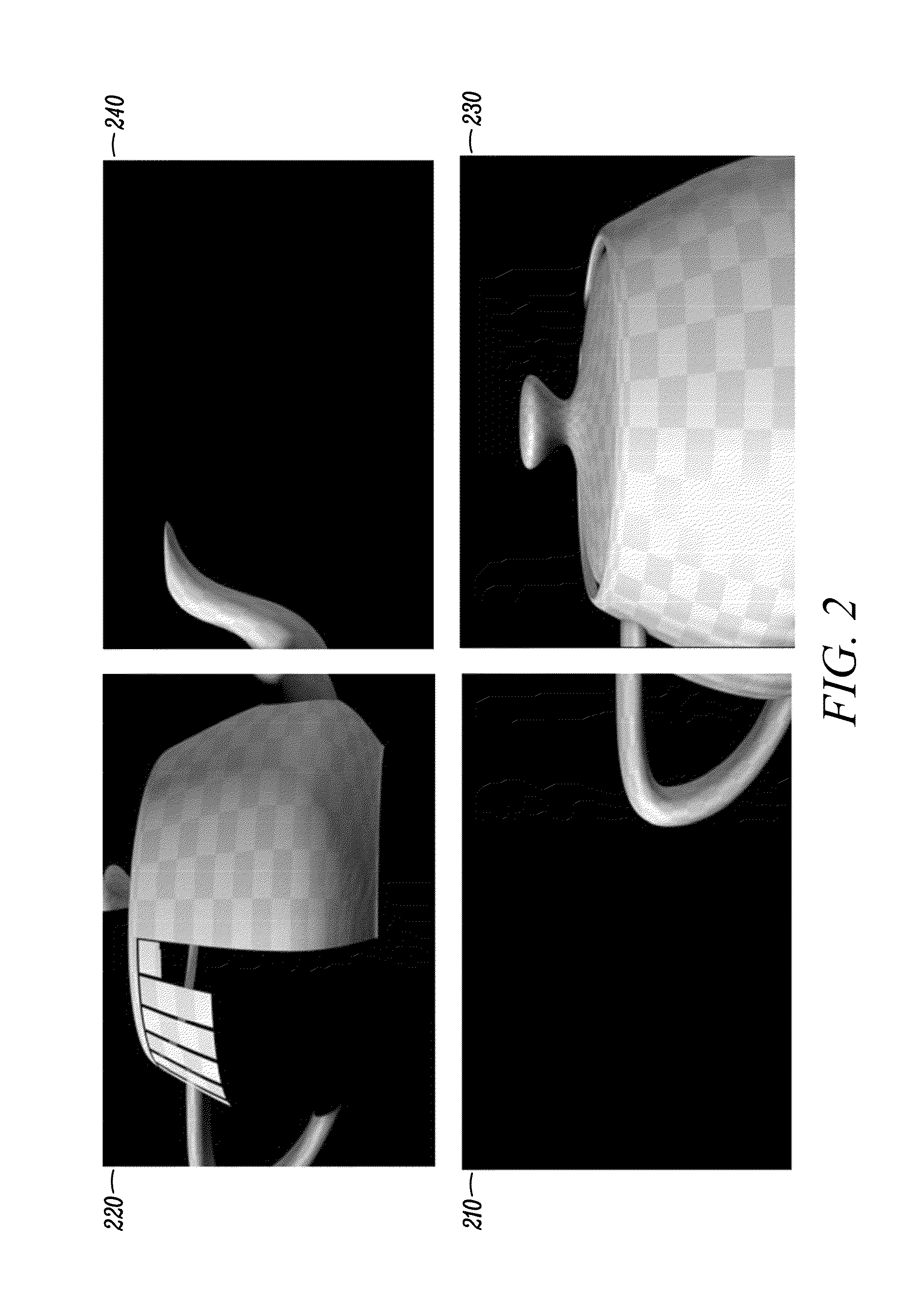
  • Infinite complexity deep-framebuffer rendering

Examples

Experimental program
Comparison scheme
Effect test

Embodiment Construction

[0026]The following description sets forth numerous specific configurations, parameters, and the like. It should be recognized, however, that such description is not intended as a limitation on the scope of the present invention, but is instead provided as a description of exemplary embodiments.

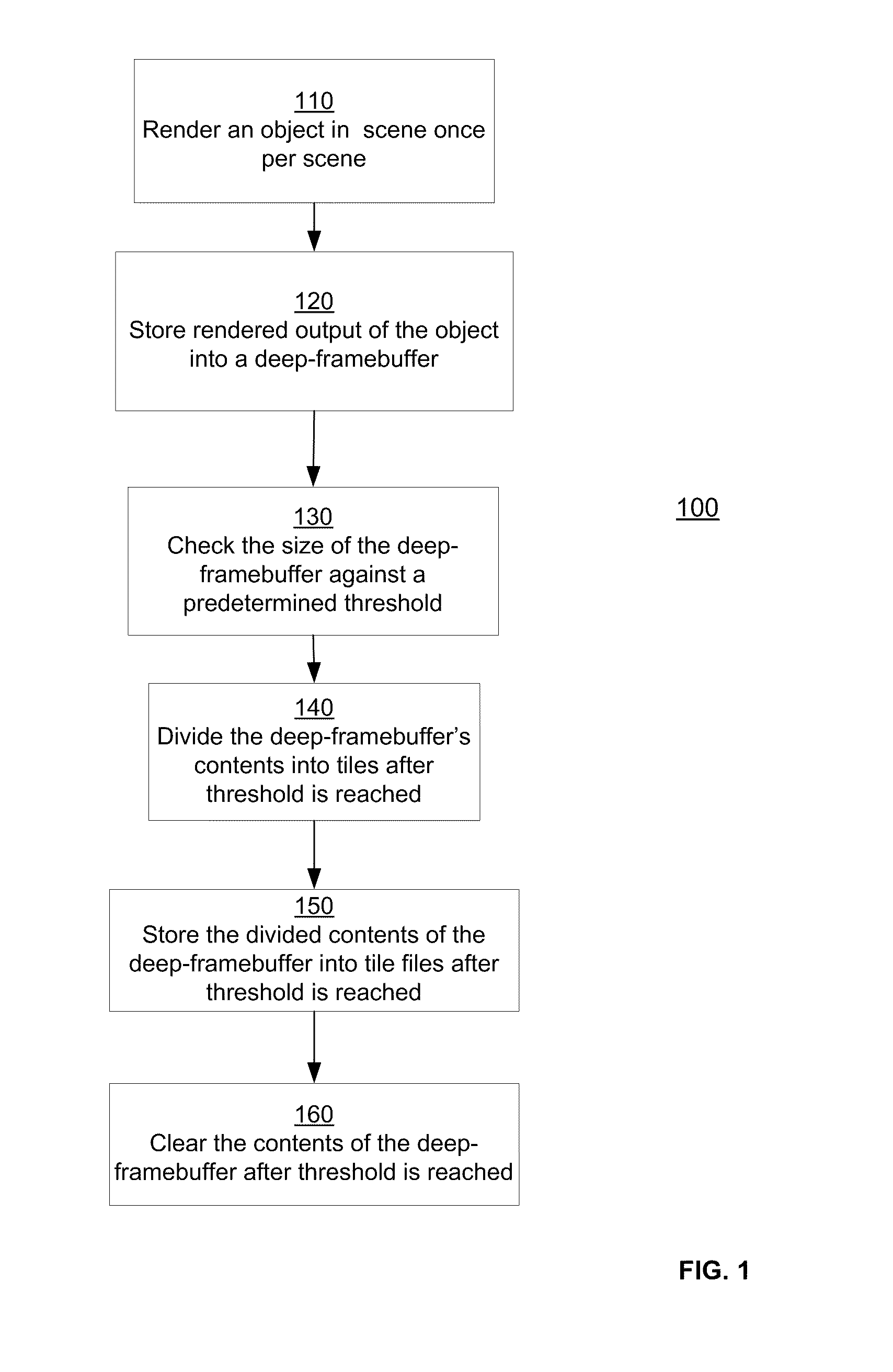
[0027]In the present application, improved deep-framebuffer rendering techniques are employed for fast, high-quality rendering of complex scenes of motion pictures when memory resources may be limited. Instead of saving the deep-framebuffer into a single deep file at the end of the rendering process, which may cause memory problems, the rendering process is temporarily paused whenever the size of the deep-framebuffer reaches a predetermined memory threshold. After the rendering process is paused, the contents of the deep-framebuffer are divided into non-overlapping tiles that subdivide a scene. The divided contents of the deep-framebuffer are then stored into a plurality of tile files as part...

the structure of the environmentally friendly knitted fabric provided by the present invention; figure 2 Flow chart of the yarn wrapping machine for environmentally friendly knitted fabrics and storage devices; image 3 Is the parameter map of the yarn covering machine
Login to View More

PUM

No PUM Login to View More

Abstract

A method of rendering a scene with a plurality of objects includes rendering an object in a scene, wherein a portion of the object spans at least two of a plurality of non-overlapping tiles that subdivide the scene, and wherein the portion of the object is rendered only once in rendering the scene. The process further includes storing the rendered output of the object into a deep-framebuffer. While rendering the object and storing the rendered output of the object, in response to the size of the deep-framebuffer reaching a predetermined threshold, the steps that are performed include dividing the deep-framebuffer's contents based on the plurality of non-overlapping tiles, storing the divided contents of the deep-framebuffer in a plurality of tile files, and clearing the contents of the deep-framebuffer.

Description

BACKGROUND[0001]1. Field[0002]This application relates generally to computer graphics, and more specifically to computer systems and processes for rendering scenes using deep-framebuffer rendering techniques.[0003]2. Related Art[0004]Images used in high-quality motion pictures need to be photorealistic. Since the mid-1980s, algorithms utilizing the Reyes rendering architecture have been used for fast, high-quality rendering of complex scenes of motion pictures. The Reyes rendering architecture was developed in the mid-1980s with the specific goal of creating a rendering algorithm that would be applicable to creating special effects for motion pictures. The architecture efficiently achieves several important effects: smooth curved surfaces, surface texturing, motion blur, and depth of field.[0005]However, the Reyes rendering architecture generally requires the entire framebuffer (a buffer that stores the contents of an image pixel by pixel) to be stored in memory since the final imag...

Claims

the structure of the environmentally friendly knitted fabric provided by the present invention; figure 2 Flow chart of the yarn wrapping machine for environmentally friendly knitted fabrics and storage devices; image 3 Is the parameter map of the yarn covering machine
Login to View More

Application Information

Patent Timeline
no application Login to View More
Patent Type & Authority Patents(United States)
IPC IPC(8): G09G5/00
CPCG06T15/005
Inventor YUEN, STEPHENTABELLION, ERIC
Owner PACIFIC DATA IMAGES LLC
Features
  • R&D
  • Intellectual Property
  • Life Sciences
  • Materials
  • Tech Scout
Why Patsnap Eureka
  • Unparalleled Data Quality
  • Higher Quality Content
  • 60% Fewer Hallucinations
Social media
Patsnap Eureka Blog
Learn More