
Paint, retardation element, display device, method for manufacturing retardation element
a retardation element and display device technology, applied in the direction of optical elements, instruments, coatings, etc., can solve the problems of reducing yield advantageously, affecting the appearance of the alignment film, and the restraining force of the alignment film is not likely to work, so as to reduce the black luminance in the black area, the number of bright points, and the effect of reducing the number of slight alignment defects
- Summary
- Abstract
- Description
- Claims
- Application Information
AI Technical Summary
Benefits of technology
Problems solved by technology
Method used
Image

Examples
first embodiment
1. First Embodiment
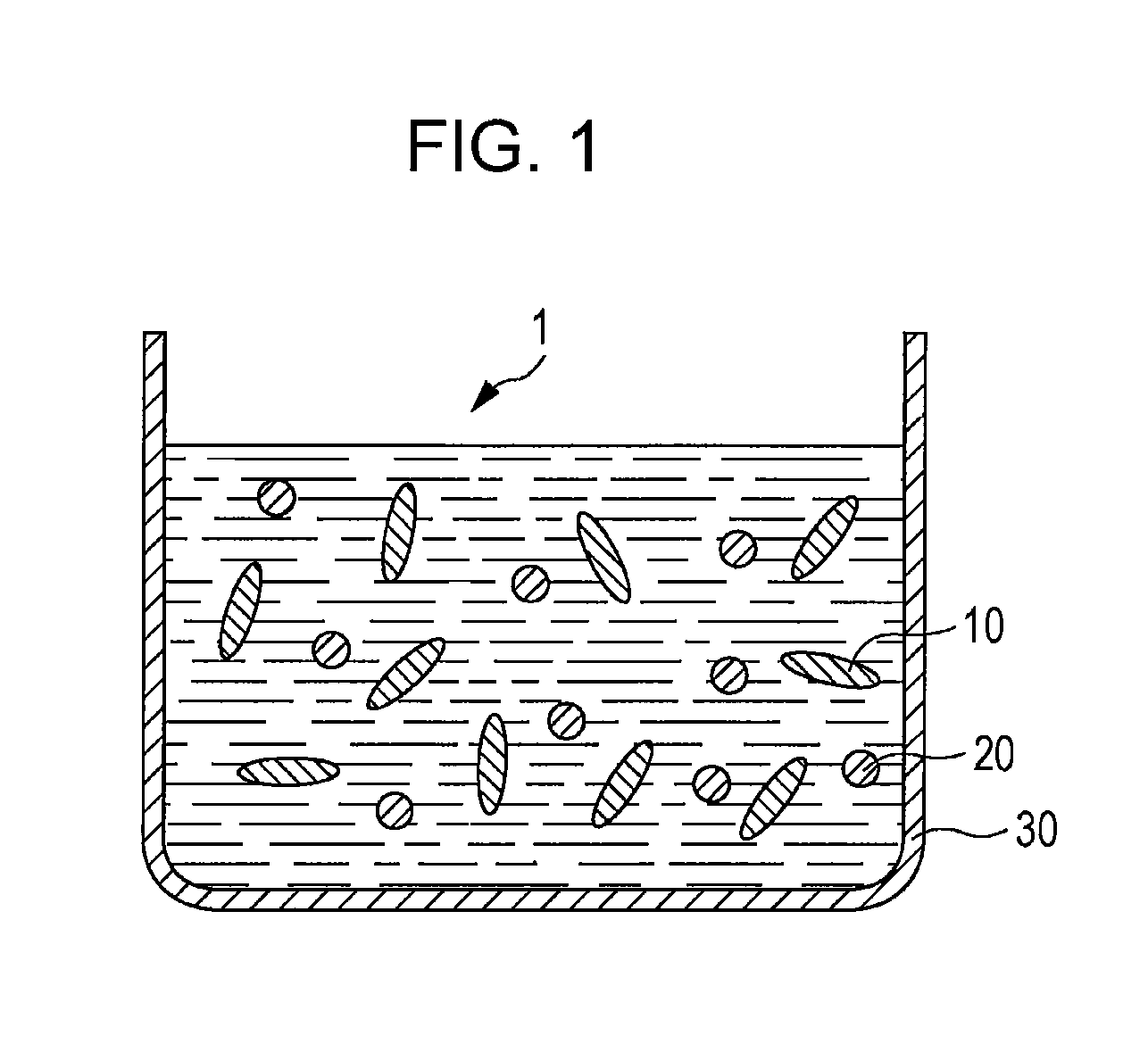
[0054]First, a paint 1 according to a first embodiment of the present disclosure will be described. As shown in FIG. 1, the paint 1 is, for example, a liquid material which can be accommodated in a container 30 and contains a liquid crystal monomer 10 and a non-liquid crystal monomer 20. In addition, the paint 1 may also contain materials other than the liquid crystal monomer 10 and the non-liquid crystal monomer 20 and, for example, may contain an initiator, a surfactant, a polymerization inhibitor, a plasticizer, and / or a viscosity modifier.
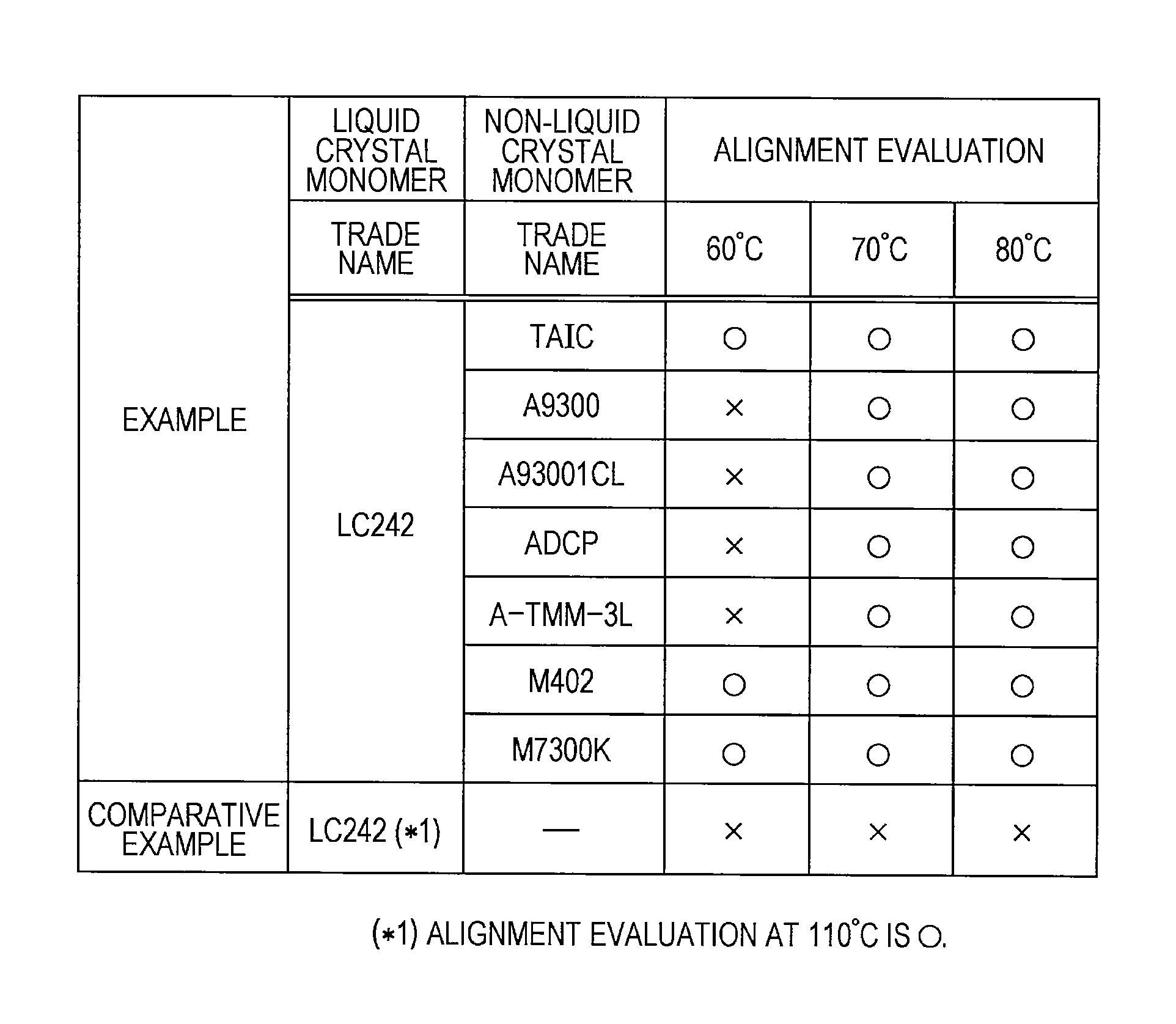
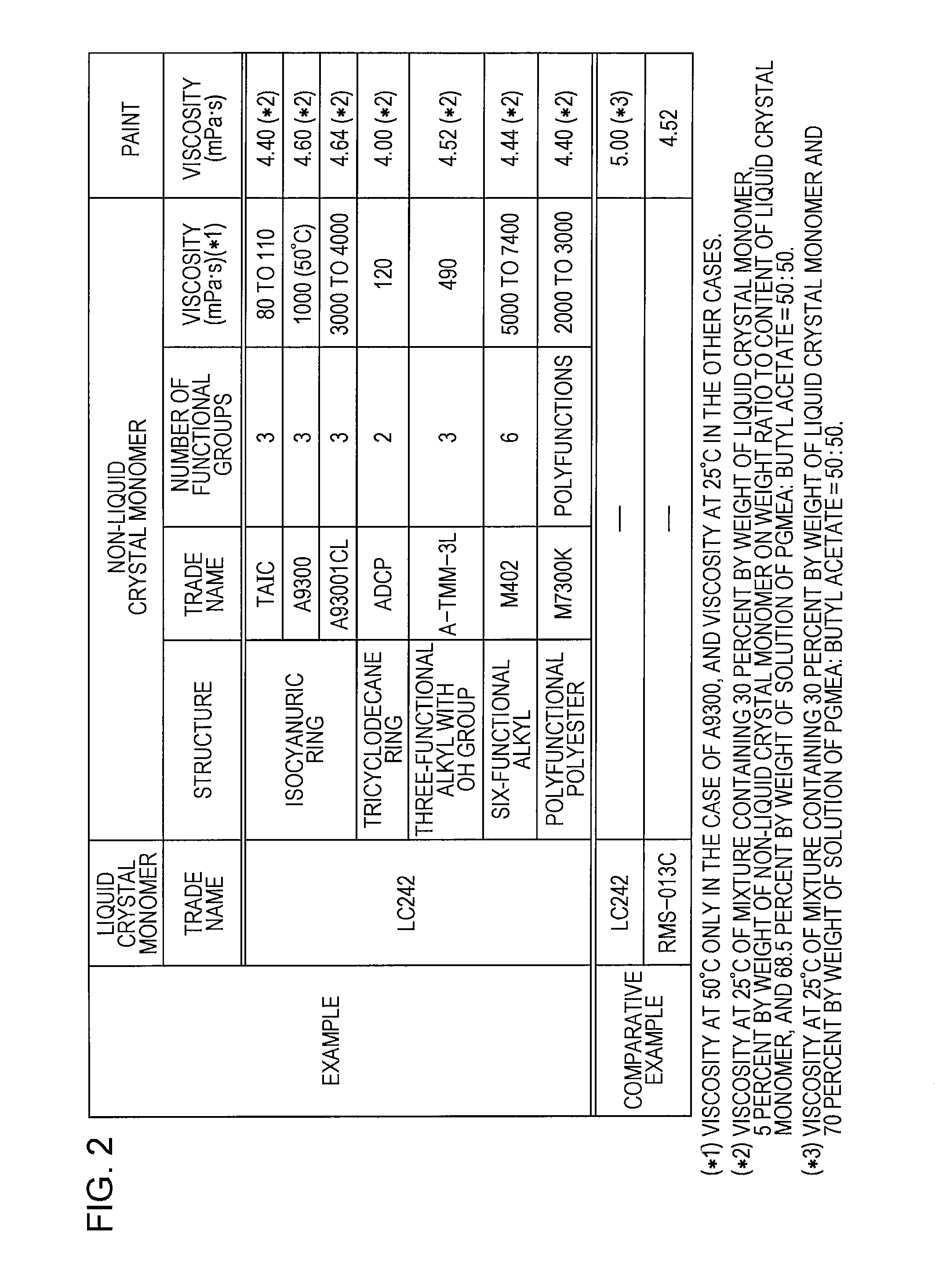
[0055]Columns of an example of FIG. 2 show materials used as the liquid crystal monomer 10 and the non-liquid crystal monomer 20 by way of example. Columns of a comparative example of FIG. 2 show liquid crystal paints which are now commercially available. Although the columns of the example of FIG. 2 show the materials which can be used as the liquid crystal monomer 10 and the non-liquid crystal monomer 20 by way of example, ...
second embodiment
Modification of Second Embodiment
[0106]In addition, in the retardation element 2 of this embodiment, the alignment film 22 may be formed of a plurality of types of alignment regions in which the extending directions of the fine grooves are different from each other. In this case, the retardation layer 23 is formed of a plurality of types of retardation regions having lagging axes in the directions corresponding to the extending directions of the fine grooves included in the alignment regions.
3. Third Embodiment
[0107]Next, the display device 3 according to a third embodiment of the present disclosure will be described. FIG. 17 is a perspective view showing one example of a cross-sectional structure of the display device 3. The display device 3 is a polarized glass type display device which displays a stereoscopic image to a viewer (not shown) wearing a pair of polarized glasses 6, which will be described later, in front of the eyeballs of the viewer. This display device 3 is formed b...
third embodiment
Modification of Third Embodiment
[0142]Although the two types of retardation regions (right-eye region 23A and left-eye region 23B) in which the directions of the lagging axes are different from each other are provided in the retardation element 2 according to the above third embodiment, at least three types of retardation regions in which the directions of the lagging axes are different from each other may also be provided.
[0143]In addition, although the case in which the retardation regions (right-eye regions 23A and left-eye regions 23B) of the retardation element 2 extend horizontally is described in the third embodiment by way of example, the retardation regions may also extend in another direction.
[0144]In addition, although the case in which the retardation element 2 is applied to the display device 3 is described in the third embodiment and the modification thereof by way of example, of course, the retardation element 2 may also be applied to other devices.
[0145]Furthermore, ...
PUM
| Property | Measurement | Unit |
|---|---|---|
| temperature | aaaaa | aaaaa |
| area | aaaaa | aaaaa |
| temperature | aaaaa | aaaaa |
Abstract
Description
Claims
Application Information
 Login to View More