System and method for limiting usage of a wireless communication device
What is AI technical title?
AI technical title is built by PatSnap AI team. It summarizes the technical point description of the patent document.
a wireless communication and wireless technology, applied in the field of wireless communication devices, can solve the problems of limiting (or disabling) the way in which the driver of the vehicle can use their cell phone, not allowing the driver to make a telephone call, not allowing the driver to receive (or view) a text message, and/or a telephone call
Active Publication Date: 2014-07-08
ARTIFEX SOFTWARE
View PDF2 Cites 62 Cited by
Summary
Abstract
Description
Claims
Application Information
AI Technical Summary
This helps you quickly interpret patents by identifying the three key elements:
Problems solved by technology
Method used
Benefits of technology
Benefits of technology
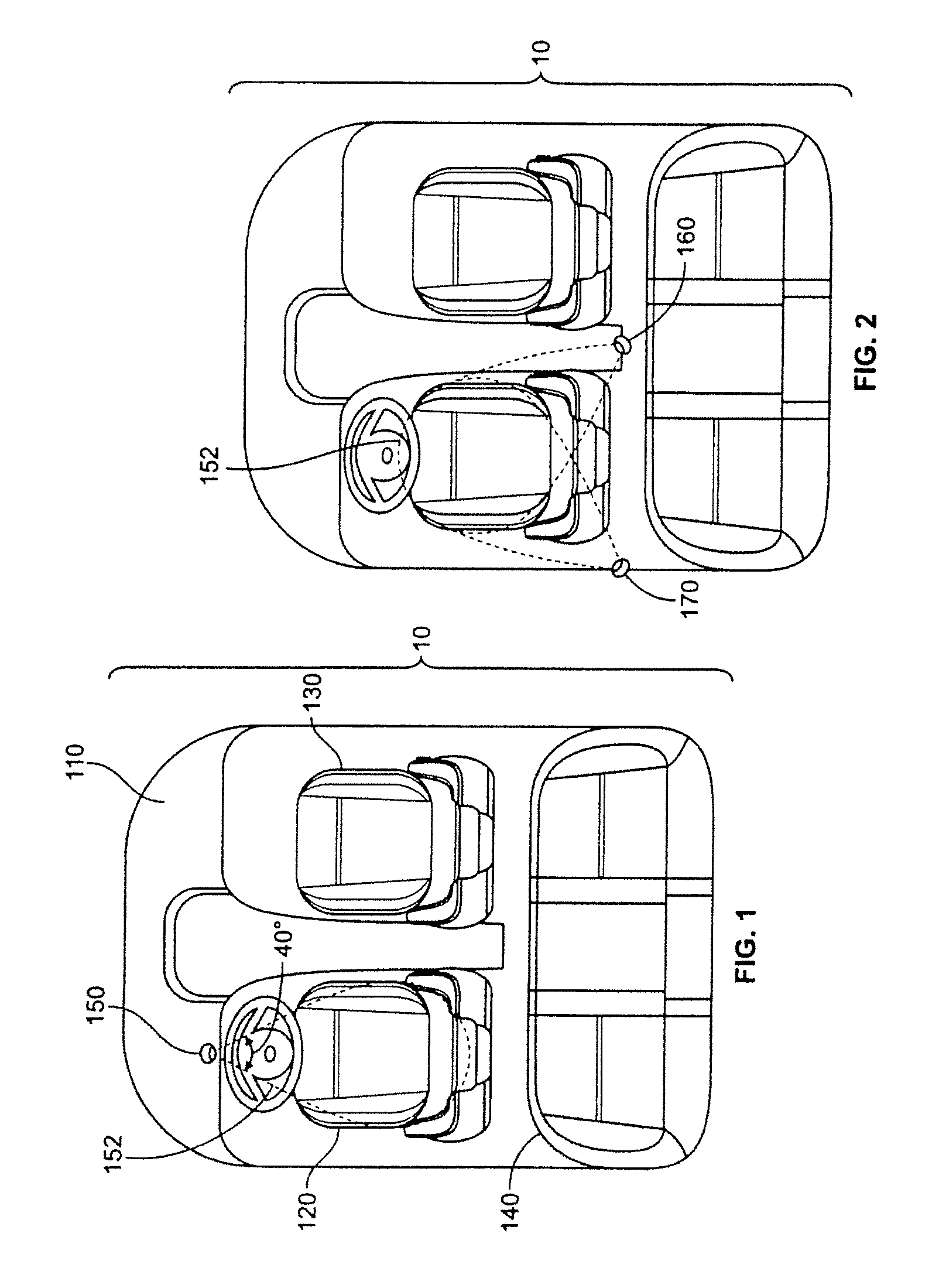
[0008]In a second embodiment of the present invention, at least two IR LEDs are used to direct wireless signals toward a driver of a vehicle. This embodiment differs from the first embodiment in that the wireless signals are transmitted in a forward direction, away from the passengers of the vehicle. This embodiment is advantageous over the first embodiment in that the detection zone can be (at least more easily) tailored so that it does not extend (at least substantially) beyond the driver's front seat. In accordance with this embodiment, the IR LEDs can be mounted, for example, in the driver's seat, center console, door panel, and / or headliner.
Problems solved by technology
In doing so, it may limit (or disable) the way in which the driver of the vehicle can use their cell phone.
For example, it may not allow the driver to make a telephone call, send (or compose) a text message, and / or send (or compose) an email.
It also may not allow the driver to receive a telephone call, receive (or view) a text message, and / or receive (or view) an email.
Method used
the structure of the environmentally friendly knitted fabric provided by the present invention; figure 2 Flow chart of the yarn wrapping machine for environmentally friendly knitted fabrics and storage devices; image 3 Is the parameter map of the yarn covering machine
View more
Image
Smart Image Click on the blue labels to locate them in the text.
Viewing Examples
Smart Image
Click on the blue label to locate the original text in one second.
Reading with bidirectional positioning of images and text.
Smart Image
Examples
Experimental program
Comparison scheme
Effect test
Embodiment Construction
[0020]The present invention provides a system and method for limiting cell phone usage during operation of a motor vehicle. It should be appreciated, however, that while the invention is described herein in terms of a cell phone in a vehicle environment, the invention is not so limited, and can be used to limit or disable any electronic wireless or wired device (e.g., PDA, portable computer, IPAD™, IPOD™, navigation device, Bluetooth™earpiece, etc.) in any environment. In the detailed description that follows, like element numerals are used to describe like elements illustrated in one or more figures.
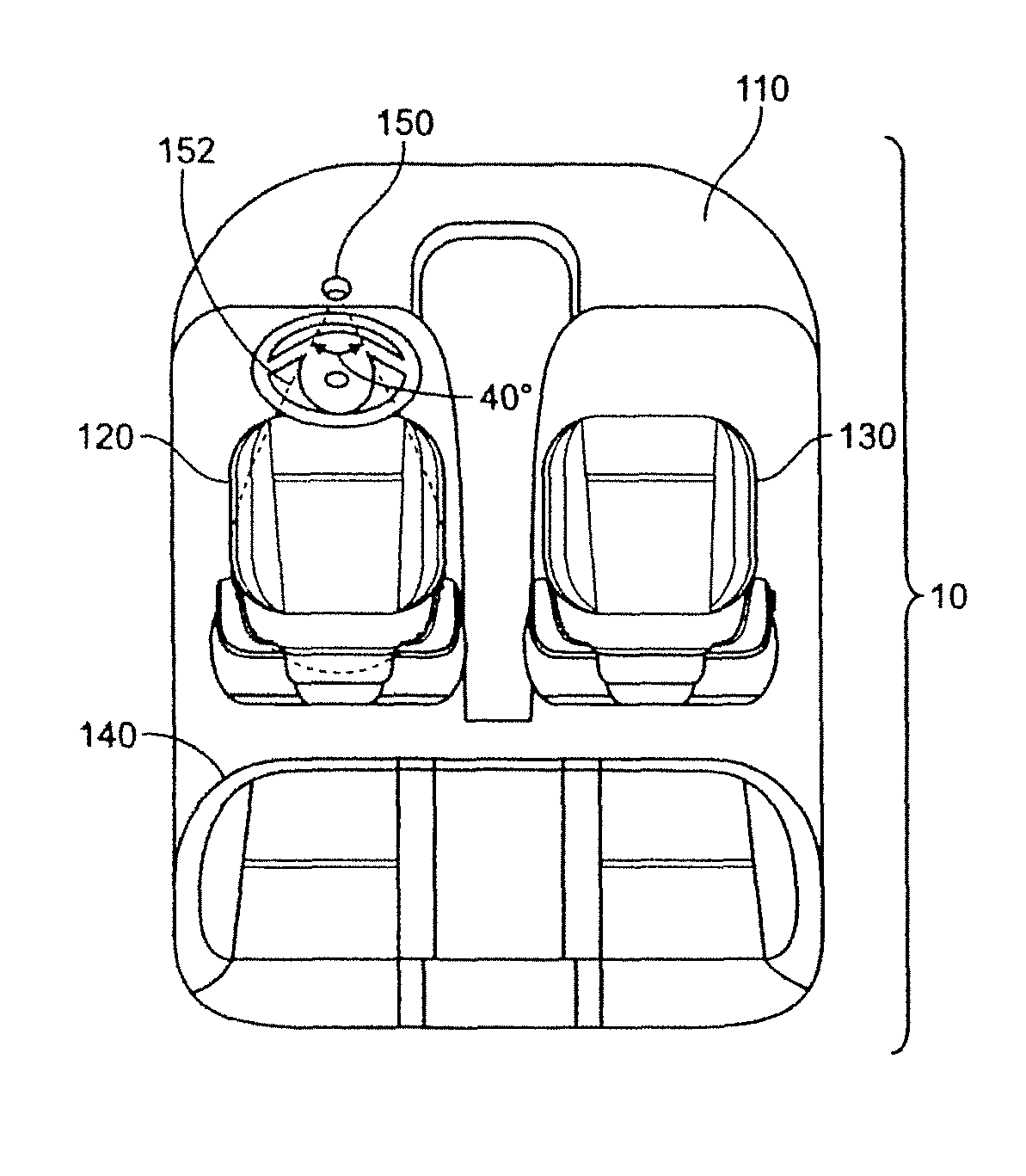
[0021]As shown in FIG. 1, at least one infrared (“IR”) light emitting diode (“LED”) 150, which may be mounted in a dashboard 110 of a vehicle 10, is used to direct a wireless signal toward a driver of the vehicle 120. In one embodiment of the present invention, the wireless signal is configured to limit usage of a cell phone that is located in a detection zone 152 that is substantially ...
the structure of the environmentally friendly knitted fabric provided by the present invention; figure 2 Flow chart of the yarn wrapping machine for environmentally friendly knitted fabrics and storage devices; image 3 Is the parameter map of the yarn covering machine
Login to View More
PUM
Login to View More
Abstract
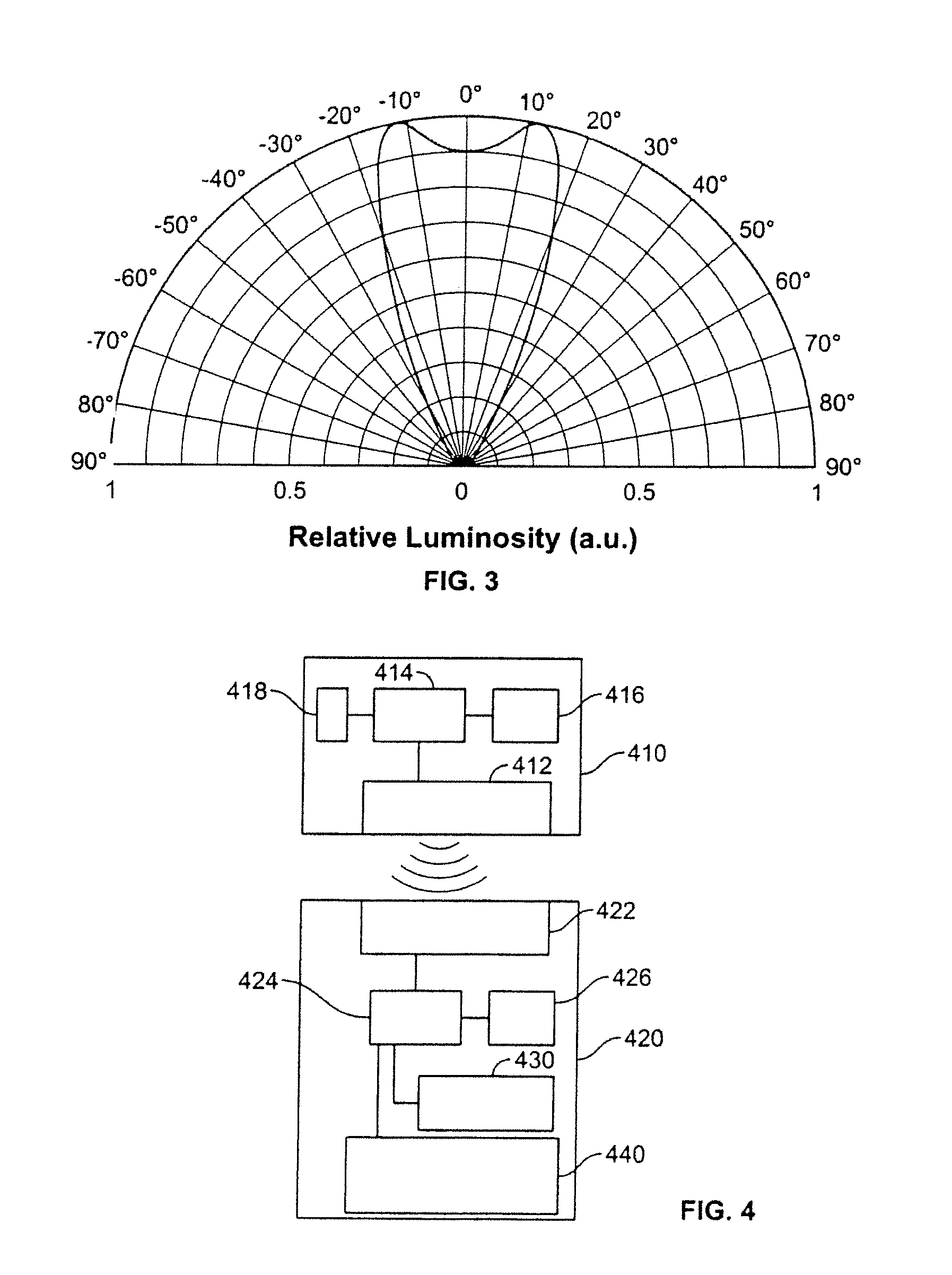
A system and method is provided for limiting or disabling cellular telephone usage during operation of a motor vehicle. In one embodiment of the present invention, the system includes a wireless transmission device and a cell phone. The wireless transmission device, which includes at least an IR modulation circuit, a processor, and a memory device, is configured to transmit a wireless signal toward a driver of the motor vehicle. The cell phone, which includes at least an IR modulation detection circuit, a processor, a memory device, a keypad, and a display, is configured to receive the wireless signal and, in response thereto, limit or disable certain features of the cell phone. This can be done by disabling certain features (e.g., cellular service, Bluetooth™, telephone calls, text messaging, emailing, its antenna, its keyboard, and / or its display) or disabling (e.g., powering down, etc.) the entire cell phone.
Description
CROSS-REFERENCE TO RELATED APPLICATION[0001]This application claims priority pursuant to 35 U.S.C. §119(e) to U.S. provisional patent application Ser. No. 61 / 585,524, filed Jan. 11, 2012, the subject matter of which is incorporated by reference herein in its entirety.BACKGROUND OF THE INVENTION[0002]1. Field of the Invention[0003]The present invention relates to a wireless communication device, and more particularly, to a system and method for limiting or disabling usage of a wireless communication device during operation of a motor vehicle.[0004]2. Description of Related Art There have been a number of studies that have shown that it is dangerous to operate a motor vehicle while using a wireless communication device, such as a cellular telephone (“cell phone”) or a personal digital assistance (“PDA”). In fact, recently the National Traffic Safety Board (“NTSB”) has released a recommendation that the States disallow the use of cell phones by drivers of motor vehicles. The recommenda...
Claims
the structure of the environmentally friendly knitted fabric provided by the present invention; figure 2 Flow chart of the yarn wrapping machine for environmentally friendly knitted fabrics and storage devices; image 3 Is the parameter map of the yarn covering machine
Login to View More
Application Information
Patent Timeline
Application Date:The date an application was filed.
Publication Date:The date a patent or application was officially published.
First Publication Date:The earliest publication date of a patent with the same application number.
Issue Date:Publication date of the patent grant document.
PCT Entry Date:The Entry date of PCT National Phase.
Estimated Expiry Date:The statutory expiry date of a patent right according to the Patent Law, and it is the longest term of protection that the patent right can achieve without the termination of the patent right due to other reasons(Term extension factor has been taken into account ).
Invalid Date:Actual expiry date is based on effective date or publication date of legal transaction data of invalid patent.



 Login to View More
  Login to View More