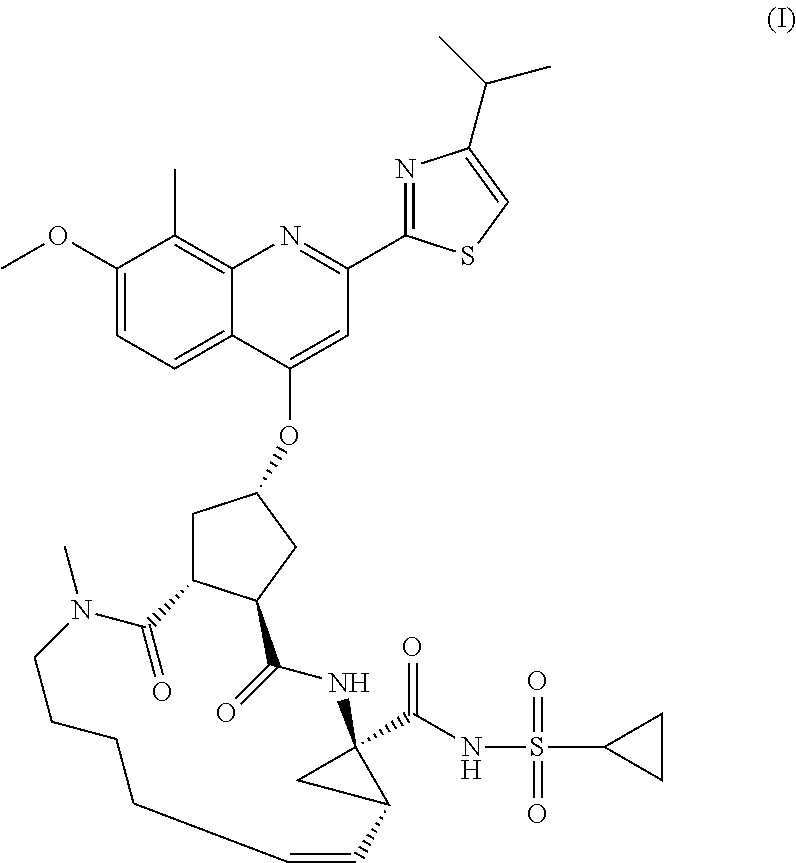
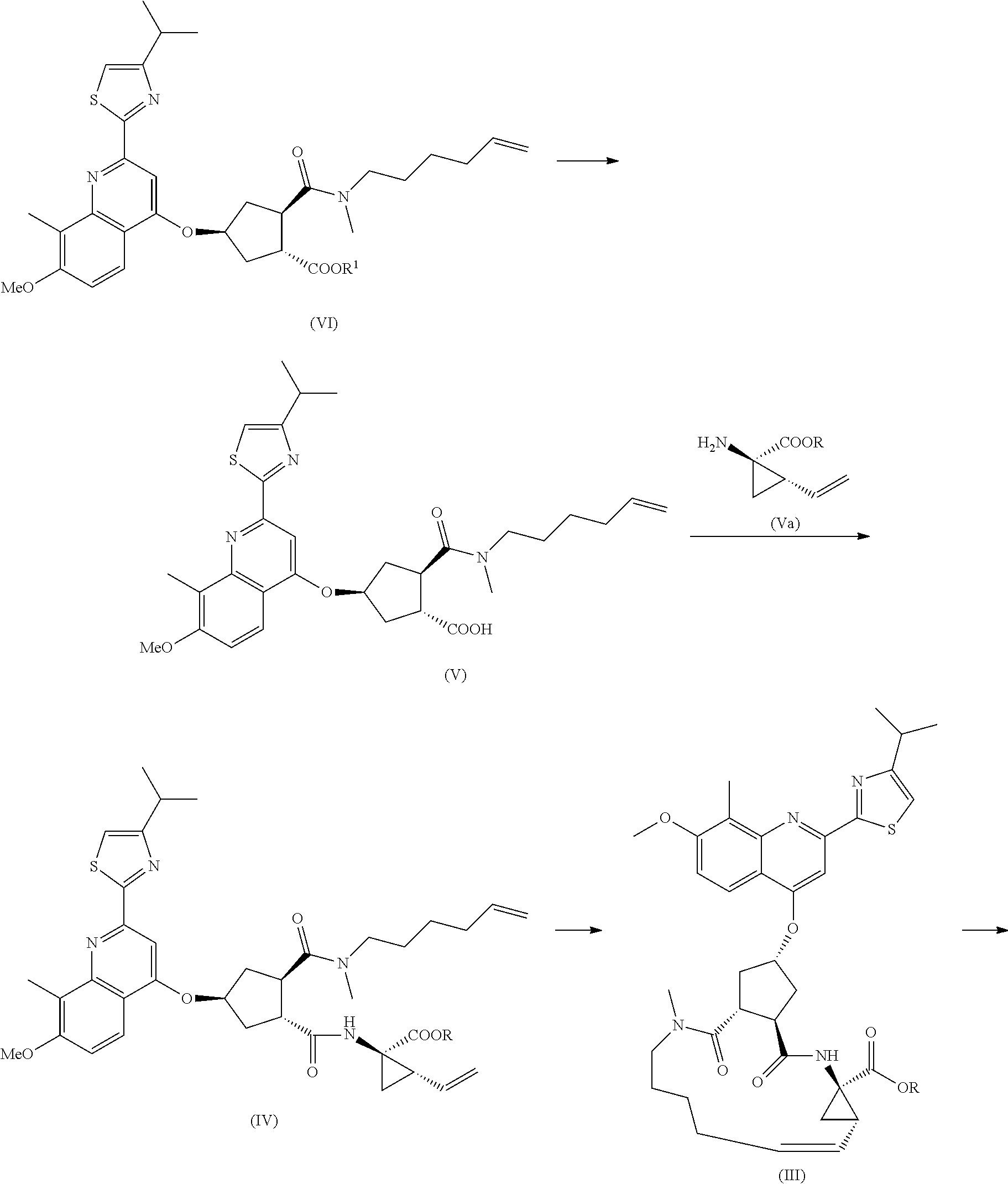
Processes and intermediates for preparing a macrocyclic protease inhibitor of HCV
a macrocyclic protease and inhibitor technology, applied in the preparation of carboxylic acid amides, chemistry apparatus and processes, organic chemistry, etc., can solve the problems of limited efficacy, significant side effects, and poor treatment effect in many patients
- Summary
- Abstract
- Description
- Claims
- Application Information
AI Technical Summary
Benefits of technology
Problems solved by technology
Method used
Image

Examples
example 1
[0062]
[0063]To a suspension of 32.7 g (0.19 mol) of intermediate (XVII) (racemic) in 237.5 ml water under an atmosphere of nitrogen was added 1.0 ml (0.019 mol) 50% wt / wt aqueous NaOH. Warm the mixture to 60° C. and add 2.5 g Rh / C (5% wt / wt). The reaction flask was purged with hydrogen and stirred under an atmosphere of hydrogen until complete conversion was reached. The warm reaction mixture was filtered over Celite. The filter cake was washed twice with 10 ml water. Triethylamine (55.61 ml, 0.40 mol) was added and 80% of the solvent volume was distilled off under a pressure of 30 mbar. The reaction flask was fitted with a Dean-Stark trap filled with 2-methyl-tetrahydrofuran. 2-Methyltetrahydrofuran (100 ml) was added to the reaction mixture, which was refluxed for 4 hours to remove the remaining water. 80% of the solvent volume was distilled off under ambient pressure. The mixture was cooled to 50° C. and acetone (380 ml) added. The mixture was cooled further to 22° C. and again a...
example 2
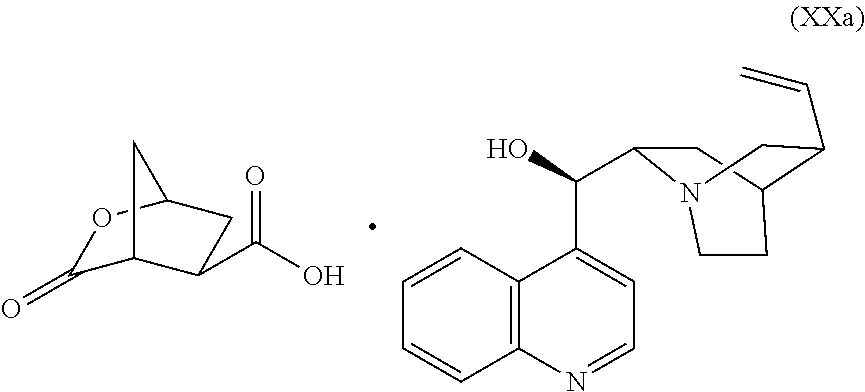
Preparation of Cinchonidine Salt (XXa)
[0064]
[0065]Method 1
[0066]Approximately 80% of the solvent volume was distilled off under atmospheric pressure. Ethyl acetate (190 ml) was added and the organic solution was washed with aqueous HCl (2M, 114 ml), yielding a solution of (XV) in ethyl acetate. The solution of (XV) in ethyl acetate was added to a suspension of cinchonidine (55.94 g, 0.19 mol) in acetonitrile (760 ml) at 60° C. The resulting mixture was stirred at 60° C. for 10 minutes and then cooled to 22° C. and filtered. The solids were recrystallized from isopropanol (1500 ml) to yield after drying 24.8 g (29% yield) of a white solid. Chiral purity: e.r.: 89 / 11
[0067]H-NMR (DMSO-d6-400 MHz), δ ppm 1.45-1.86 (m, 6 H), 1.93-2.19 (m, 3H), 2.32 (br s, 1H), 2.56-2.80 (m, 2H), 2.90-3.07 (m, 2H), 3.12-3.29 (m, 1H), 3.30-3.52 (m, 1H), 4.93-5.03 (m, 3H), 5.52 (d, J=5.6 Hz, 1H), 5.80-5.89 (m, 1H), 7.5 (d, J=4.2 Hz, 1H), 7.6 (t, J=5.6 Hz, 1H), 8.0 (d, J=9.3 Hz, 1H), 8.3 (d, J=8.1 Hz, 1H), 8...
example 3
Preparation of (XVI) and its Triethylamine Salts (XVIa)
[0076]
[0077](a) 344 mg (2 mmol) (XVII) and 725 mg (4 mmol) tetramethylammonium hydroxide pentahydrate were dissolved in a mixture of 2.5 ml methanol and 2.5 ml MeTHF. The solution was stirred overnight at room temperature under hydrogen atmosphere in the presence of 82 mg wet 5% rhodium on charcoal as a catalyst. The catalyst was filtered off and the filtrate was diluted to a final volume of 100 ml with methanol. LC analysis showed that 46.% (XVI) was formed as its bis(tetramethylammonium) salt while 41% (XVII) was still present as its bis(tetramethylammonium) salt.
[0078](b) To 400 g of a 6.6 wt / wt % (XVI) solution in water was added 44.4 ml triethylamine 330 g solvent was distilled off under vacuum, then the oily residue was allowed to cool to 50° C. and 51.5 ml acetone was added thus obtaining a suspension. This suspension was cooled to room temperature and 155 ml more acetone was added. The suspension was cooled to 5° C. and ...
PUM
| Property | Measurement | Unit |
|---|---|---|
| temperature | aaaaa | aaaaa |
| temperature | aaaaa | aaaaa |
| temperature | aaaaa | aaaaa |
Abstract
Description
Claims
Application Information
 Login to View More
 - R&D
- Intellectual Property
- Life Sciences
- Materials
- Tech Scout
- Unparalleled Data Quality
- Higher Quality Content
- 60% Fewer Hallucinations
Browse by: Latest US Patents, China's latest patents, Technical Efficacy Thesaurus, Application Domain, Technology Topic, Popular Technical Reports.
© 2025 PatSnap. All rights reserved.Legal|Privacy policy|Modern Slavery Act Transparency Statement|Sitemap|About US| Contact US: help@patsnap.com