
Microstructure manufacturing method
a manufacturing method and microstructure technology, applied in the direction of liquid/solution decomposition chemical coating, instruments, imaging devices, etc., can solve the problems of difficult to obtain a desirable phase image, difficult to obtain an image of soft material or soft tissue using these techniques, and more places of sticking of periodic structur
- Summary
- Abstract
- Description
- Claims
- Application Information
AI Technical Summary
Benefits of technology
Problems solved by technology
Method used
Image

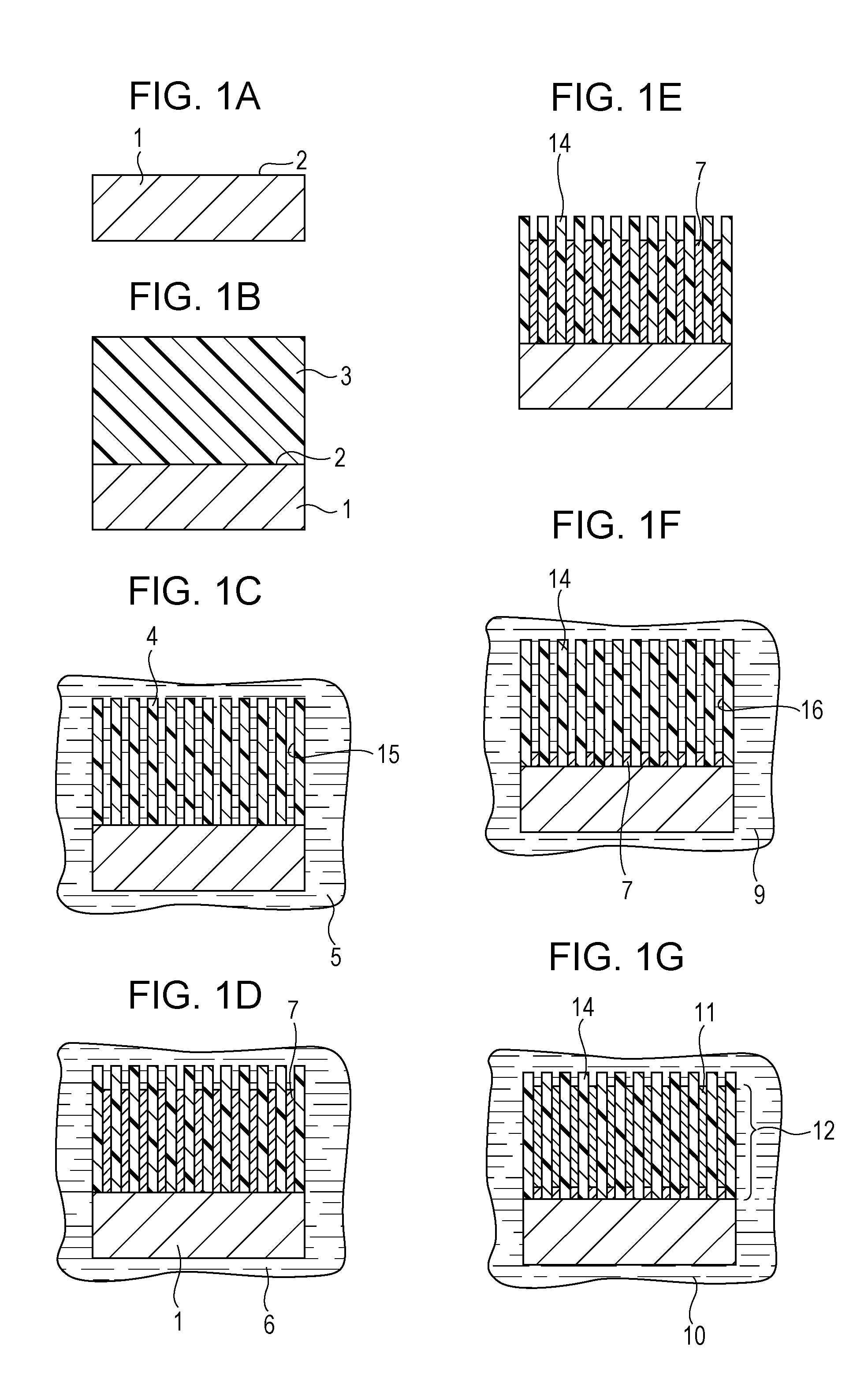
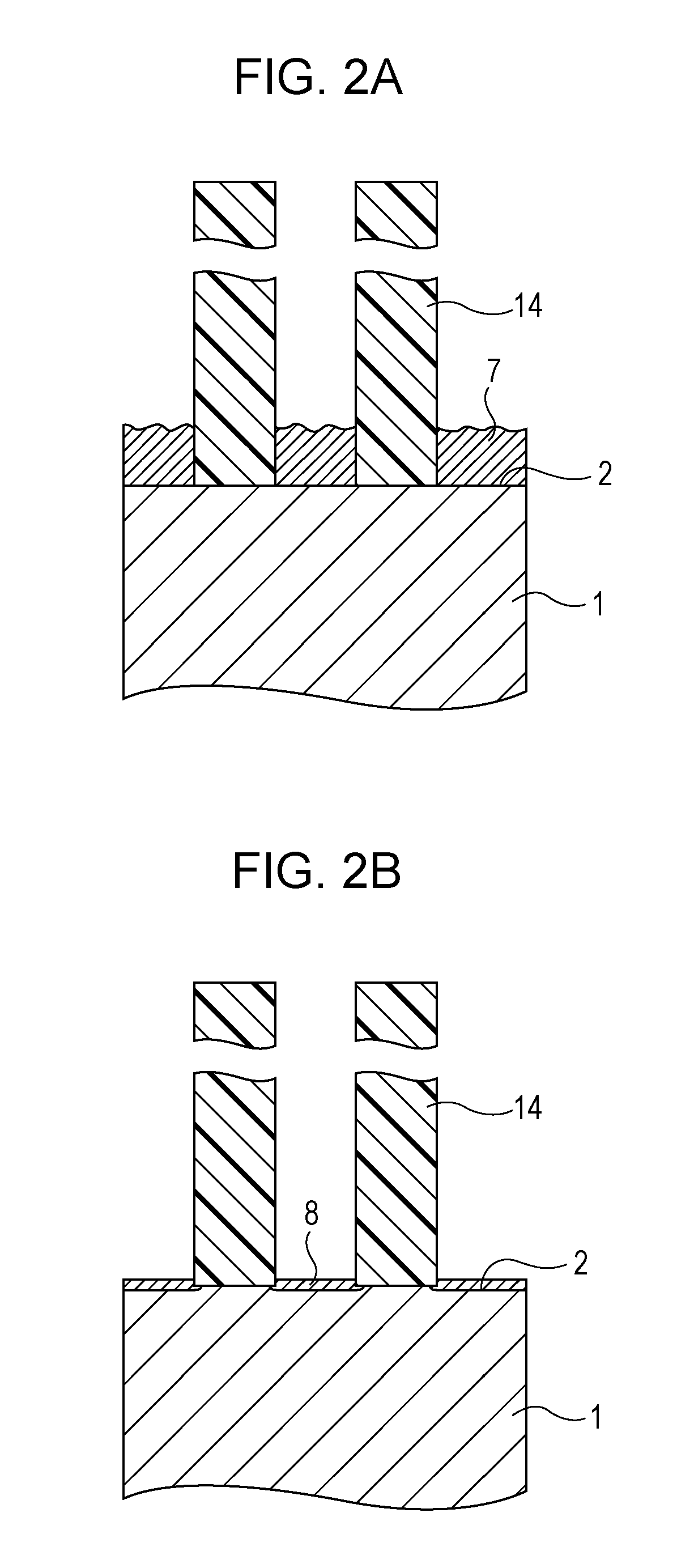
Examples
first example
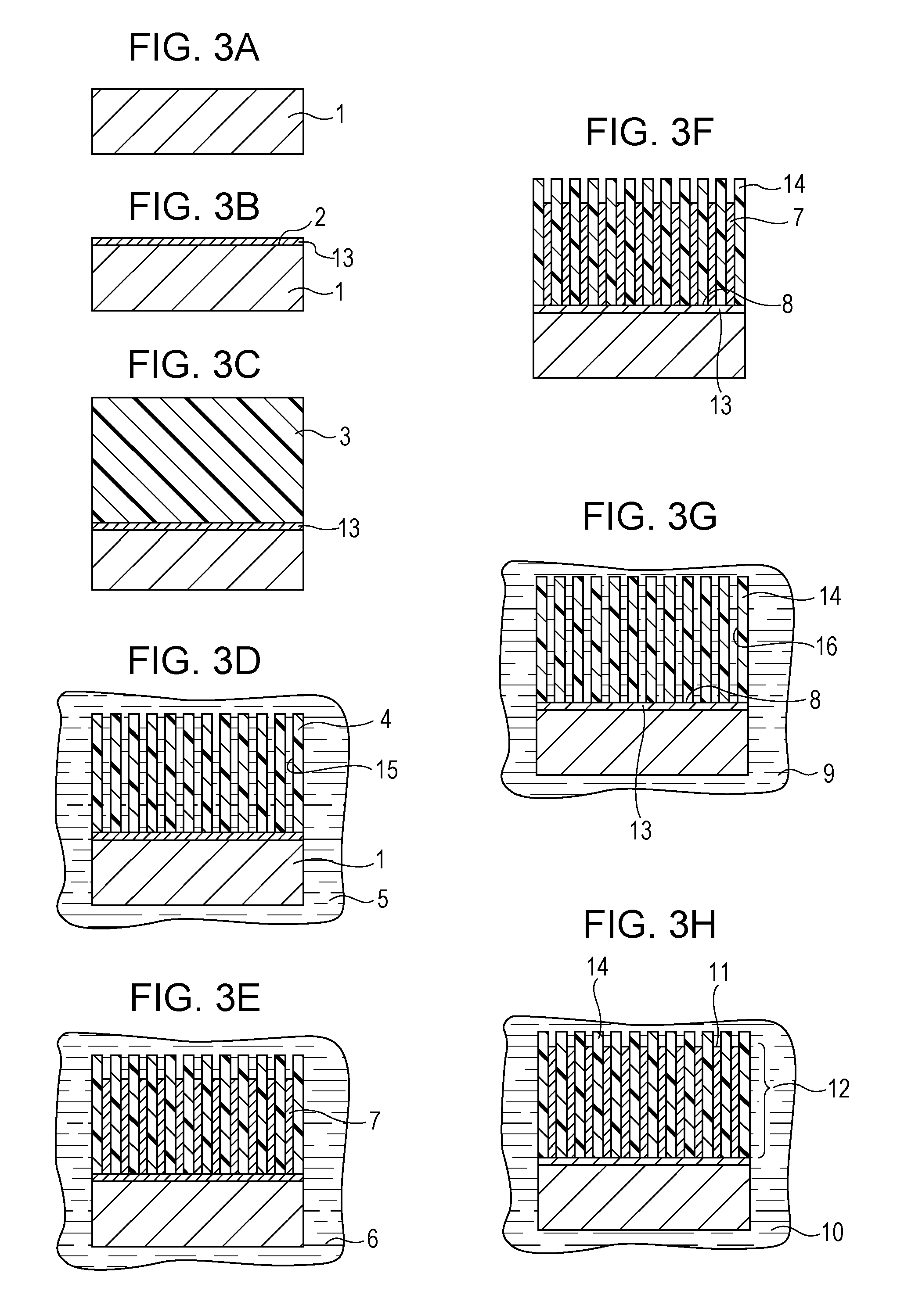
[0050]FIGS. 3A to 3h illustrate a first example according to the microstructure manufacturing method of the present invention.
[0051]In the present example, a silicon wafer is used as the substrate 1 (FIG. 3A). The wafer is double sided, and its diameter is 4 inches and its thickness is 525 μm. A titanium film with a thickness of 5 nm and a gold film with a thickness of 100 nm are formed sequentially in this order on the substrate 1 as the electrically conductive layer 13 by an electron beam deposition apparatus (FIG. 3B).
[0052]The negative resist of SU-8 (manufactured by KAYAKU Micro Chemical Co., Ltd) is used as the photosensitive resin. The SU-8 is applied on the electrically conductive layer 13, and a photosensitive resin layer 3 with a thickness of 40 μm is formed, the photosensitive resin layer 3 is soft-baked at 95° C. for ten minutes (FIG. 3C). Next, the photosensitive resin layer 3 is exposed to ultraviolet light by MPA600 (manufactured by Canon), and the exposed photosensit...
second example
[0060]FIGS. 4A to 4H illustrate a second example according to the microstructure manufacturing method of the present invention.
[0061]In the present example, a silicon wafer is used as the substrate 1 (FIG. 4A). The wafer is double sided, and its diameter is 4 inches and its thickness is 525 μm. A chromium film with a thickness of 5 nm and a platinum film with a thickness of 100 nm are formed sequentially in this order on the substrate 1 as the electrically conductive layer 13 by a vacuum sputtering apparatus (FIG. 4B).
[0062]The negative resist of SU-8 (manufactured by KAYAKU Micro Chemical Co., Ltd) is used as the photosensitive resin. The SU-8 is applied on the electrically conductive layer 13, and a photosensitive resin layer 3 with a thickness of 60 μm is formed, the photosensitive resin layer 3 is soft-baked at 95° C. for ten minutes (FIG. 4C). Next, the photosensitive resin layer 3 is exposed to synchrotron radiation light by X-ray exposure apparatus, and the exposed photosensi...
third example
[0068]FIGS. 5A to 5g illustrate a third example according to the microstructure manufacturing method of the present invention.
[0069]In the present example, a stainless plate is used as the substrate 1 (FIG. 5A). The substrate 1 includes the substrate surface 2 which has electrical conductivity. The negative resist of SU-8 (manufactured by KAYAKU Micro Chemical Co., Ltd) is used as the photosensitive resin. The SU-8 is applied on the stainless plate, and a photosensitive resin layer 3 with a thickness of 60 μm is formed, the photosensitive resin layer 3 is soft-baked at 95° C. for ten minutes (FIG. 5B). Next, the photosensitive resin layer 3 is exposed to synchrotron radiation light by X-ray exposure apparatus, and the exposed photosensitive resin layer 3 is baked at 65° C. for five minutes. A latent image is formed in the photosensitive resin layer 3 in such a manner that a square pole pattern 2 μm on a side is two-dimensionally arranged at the 4 μm pitch. The latent image is develo...
PUM
| Property | Measurement | Unit |
|---|---|---|
| aspect ratio | aaaaa | aaaaa |
| aspect ratio | aaaaa | aaaaa |
| aspect ratio | aaaaa | aaaaa |
Abstract
Description
Claims
Application Information
 Login to View More