
Foams made of amorphous hollow spheres and methods of manufacture thereof
a hollow sphere and foam technology, applied in the field of foams, can solve the problems of difficult individual methods, time-consuming manner, limited success of foams made of metallic glasses,
- Summary
- Abstract
- Description
- Claims
- Application Information
AI Technical Summary
Benefits of technology
Problems solved by technology
Method used
Image

Examples
example 1
Study of Theoretical Foam Properties
[0142]Foam properties naturally depend on the material used, the geometry of the foam, the strain rate, and temperature, among other characteristics. However, equations derived for open and closed cell foams with struts arranged like a cube that describe the basic properties have some similarities and can be used to provide some theoretical limits on the properties of the foams of the instant invention. (See, LG Gibson (1997) cited above.) First, the Young's modulus of foams is most generally described by EQ 2 below:
[0143]E*Es≈φ2(ρ*ρs)2+(1-φ)ρ*ρs+pinternal(1-2v*)Es(1-ρ*ρs)[EQ.2]
All terms are used for closed cell foams, but the internal pressure variable is not used for open cell foams. The final term accounts for internal cell pressure (notice that the stiffness of the foam will increase as the internal bubble pressure increases). With regard to the other terms, E* and Es are the Young's modulus of the foam and the bulk solid respectively, ...
example 2
Exemplary Hollow Sphere Cellular Solid
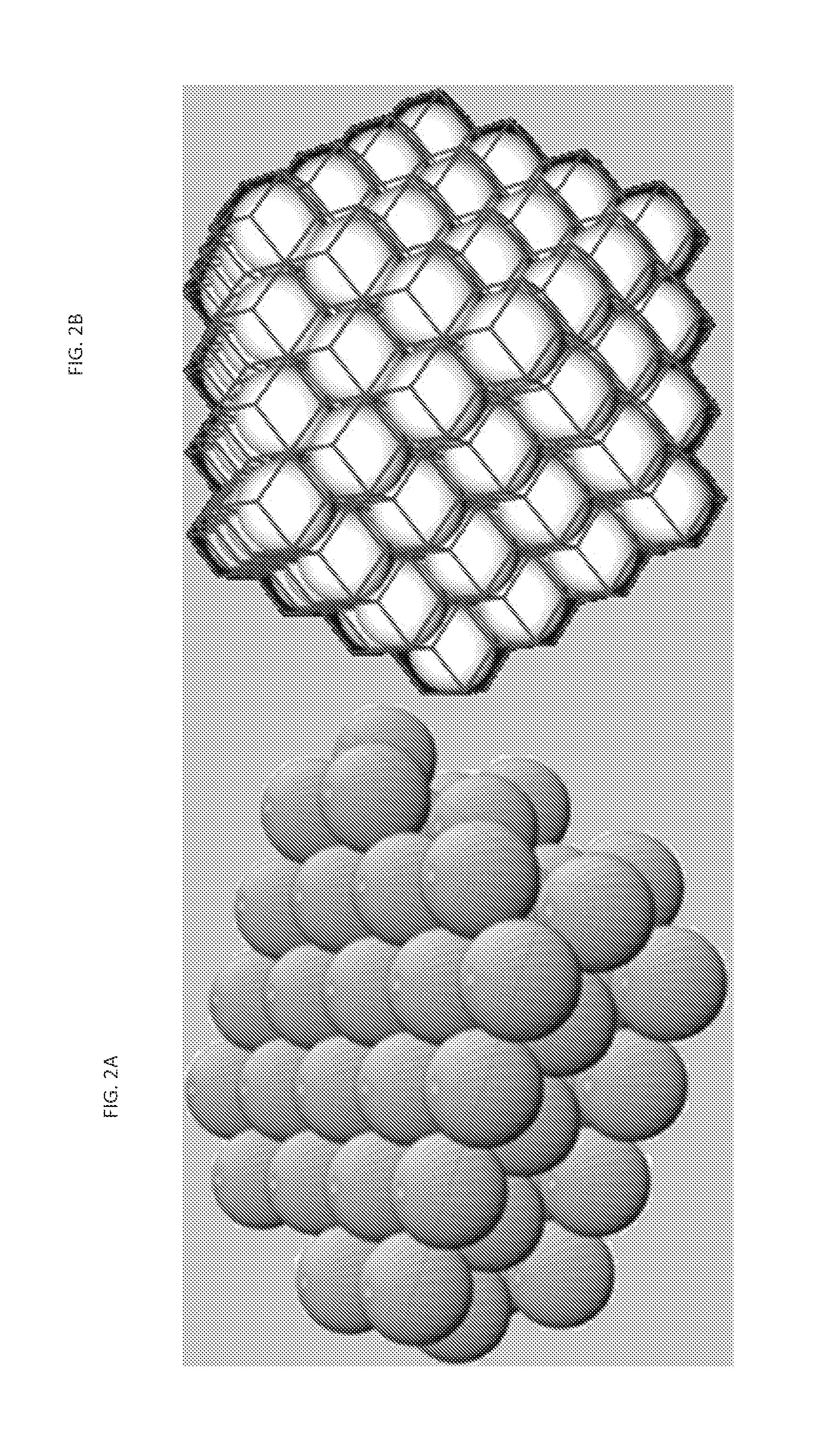
[0157]To prove the efficacy of the technique, hollow spheres of silicate glass were placed in a sealed quartz tube and heated to 1100C for 1hour to create the foam seen in FIGS. 10a-10d. The foam dimensions are 4 mm diameter by 25 mm long.
Conclusion
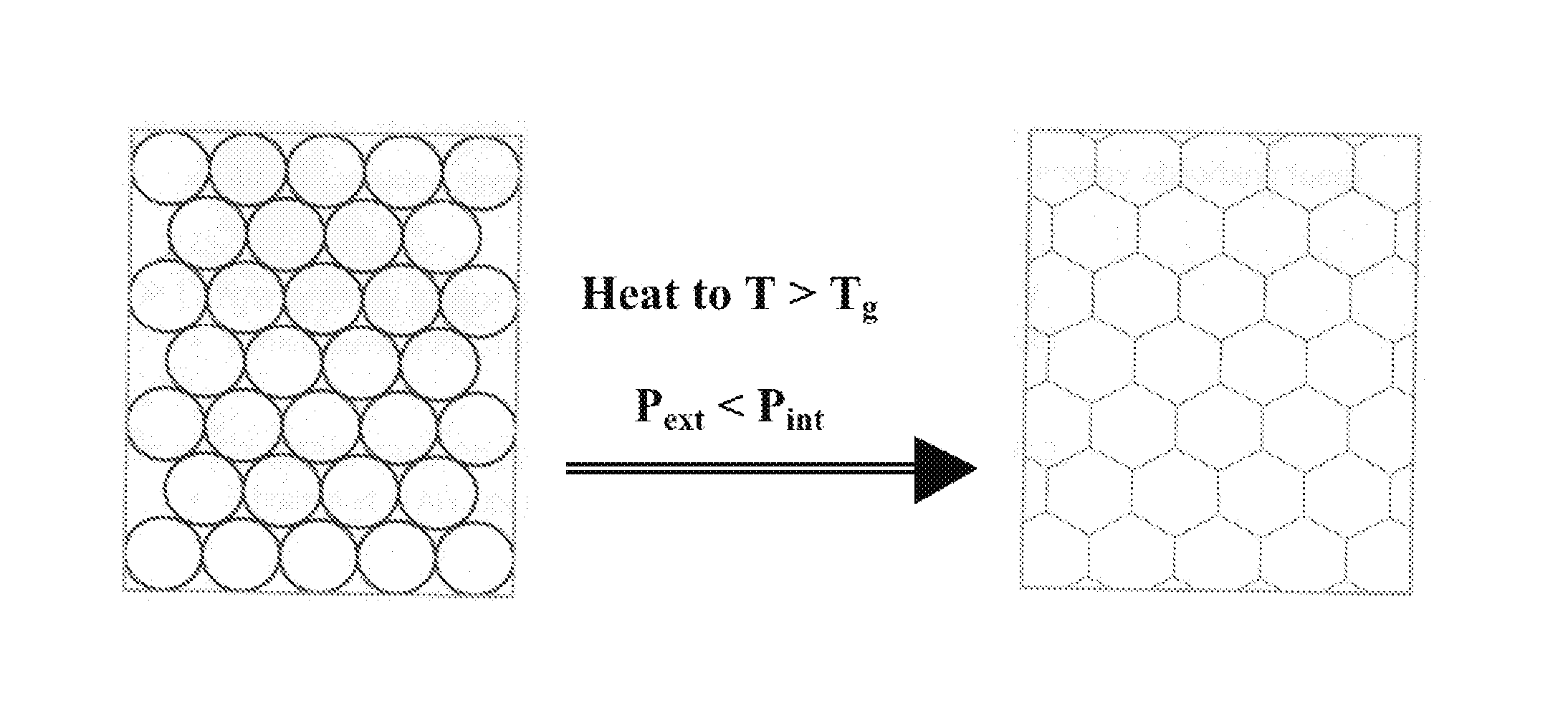
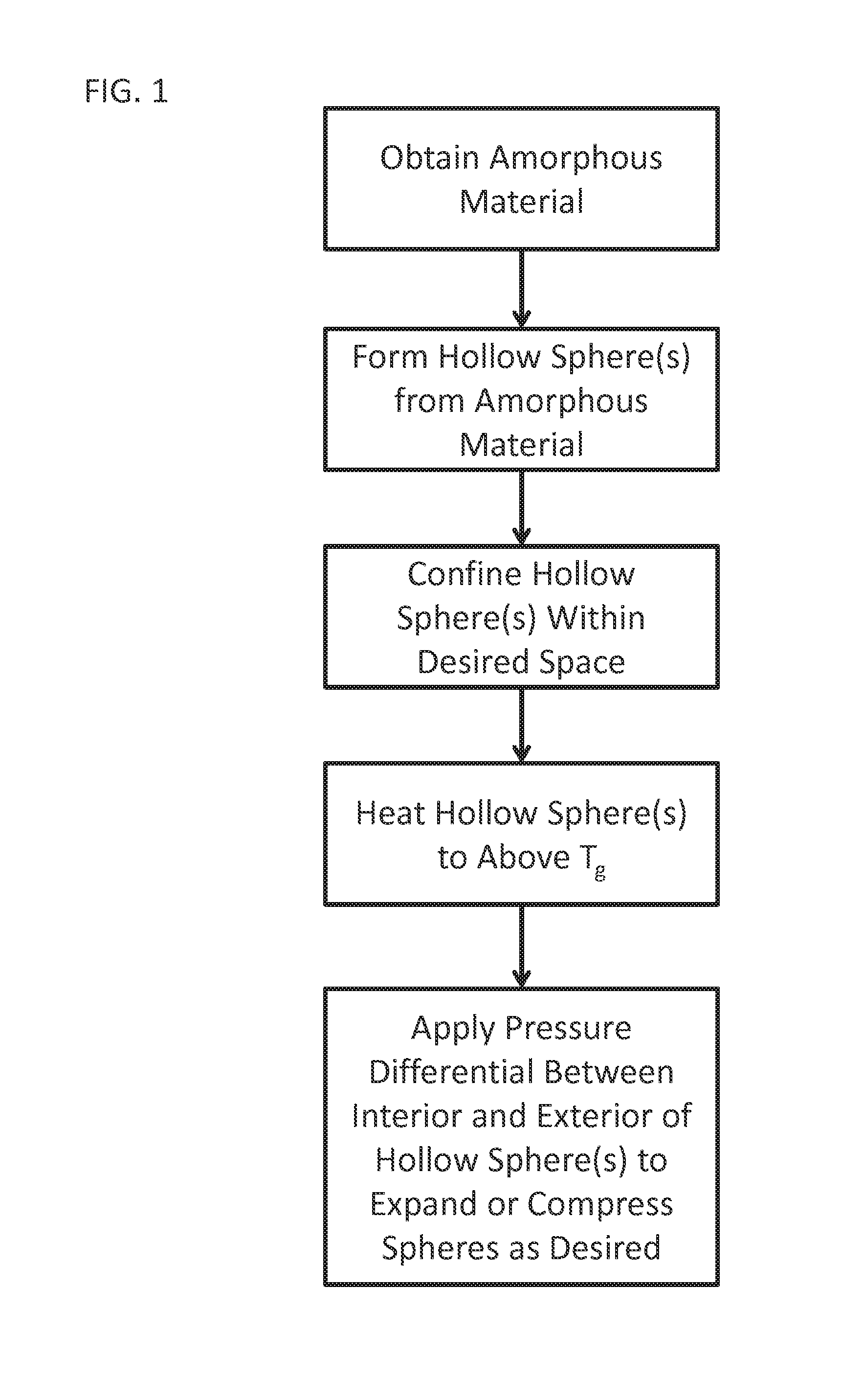
[0158]Many foam making methods are highly specialized and applicable to only a small class of materials such as use of titanium hydride (TiH2) or calcium carbonate (CaCO3) to foam aluminum alloys. The versatility of the method proposed herein arises from the many variables that can be altered, such as for example,[0159]by altering the material (with Tg) from which the hollow spheres are made from,[0160]by altering the fabrication of the hollow spheres to vary their wall thickness or diameter,[0161]by altering to control the amount of compression or expansion of the spheres at Tg,[0162]by altering the packing geometry of the spheres, and[0163]by altering the composition of the sphere's internal void.
[0...
PUM
| Property | Measurement | Unit |
|---|---|---|
| yield strength | aaaaa | aaaaa |
| yield strength | aaaaa | aaaaa |
| yield strength | aaaaa | aaaaa |
Abstract
Description
Claims
Application Information
 Login to View More