Check patentability & draft patents in minutes with Patsnap Eureka AI!

Methods and apparatus for capacitively detecting key motion and finger presence on a magnetic keyboard key

a capacitively sensing and key motion technology, applied in the field of methods and apparatus, can solve the problems that the capacitively sensing keyboard system using a transmitter/receiver electrode pair underneath the key cap is limited in its ability to ability, and achieve the effect of accurately detecting initial keystroke movement, enhancing the ability of the transmitter/receiver electrode pair, and accurate detection

Active Publication Date: 2016-08-02
SYNAPTICS INC
View PDF13 Cites 0 Cited by
  • Summary
  • Abstract
  • Description
  • Claims
  • Application Information

AI Technical Summary

Benefits of technology

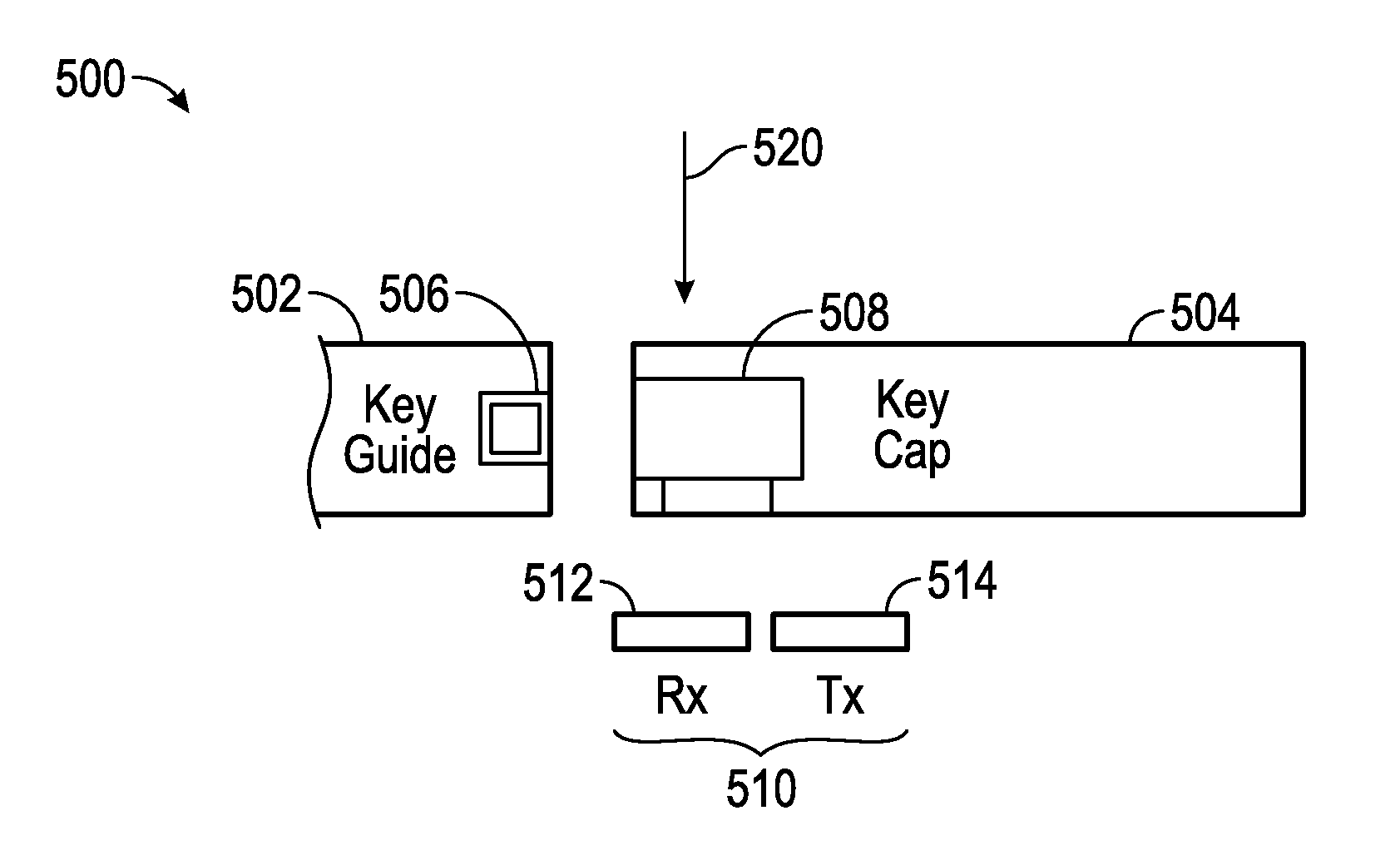
[0008]Methods and apparatus are provided for capacitively sensing initial and latter stage keystroke position of a key cap. In an embodiment, a key assembly includes a stationary key guide magnet, a movable key cap magnet, and a transmitter / receiver electrode pair wherein one of the electrodes underlies the key cap and the other electrode underlies the key guide. In this way, the measured change in capacitance between the transmitter and receiver electrode in response to a downward keystroke includes both the change in capacitance between the key cap and the electrode pair, and the change in capacitance between the key cap and the key guide. Consequently, key cap position may be accurately detected in the early portion of the keystroke due to the change in capacitance between the key cap and the key guide, as well as in the latter portion of the keystroke due to the change in capacitance between the key cap and the electrode pair.
[0009]In an alternate embodiment of a key assembly, the transmitter / receiver electrode pair is disposed underneath the key cap, and the conductive element of the key guide (e.g., a magnet) is grounded or otherwise maintained at a constant voltage potential. Grounding the key guide inverts the capacitive response between the key cap and key guide responsive to a downward keystroke, further enhancing the ability of the transmitter / receiver electrode pair to accurately detect initial keystroke movement.

Problems solved by technology

Presently known keyboard systems for capacitively sensing keystroke position using a transmitter / receiver electrode pair underneath the key cap are limited in their ability to ability to accurately detect initial keystroke movement, inasmuch as the capacitive response is an inverse function of the square of the distance between the key cap and the electrode pair.

Method used

the structure of the environmentally friendly knitted fabric provided by the present invention; figure 2 Flow chart of the yarn wrapping machine for environmentally friendly knitted fabrics and storage devices; image 3 Is the parameter map of the yarn covering machine
View more

Image

Smart Image Click on the blue labels to locate them in the text.
Viewing Examples
Smart Image
  • Methods and apparatus for capacitively detecting key motion and finger presence on a magnetic keyboard key
  • Methods and apparatus for capacitively detecting key motion and finger presence on a magnetic keyboard key
  • Methods and apparatus for capacitively detecting key motion and finger presence on a magnetic keyboard key

Examples

Experimental program
Comparison scheme
Effect test

Embodiment Construction

[0022]The following detailed description is merely exemplary in nature and is not intended to limit the invention or the application and uses of the invention.

[0023]Various embodiments of the present invention provide input devices and methods that facilitate improved usability, thinner devices, easier assembly, lower cost, more flexible industrial design, or a combination thereof. These input devices and methods involve pressable touchsurfaces that may be incorporated in any number of devices. As some examples, pressable touchsurfaces may be implemented as surfaces of touchpads, touchscreens, keys, buttons, and the surfaces of any other appropriate input device. Thus, some non-limiting examples of devices that may incorporate pressable touchsurfaces include personal computers of all sizes and shapes, such as desktop computers, laptop computers, netbooks, ultrabooks, tablets, e-book readers, personal digital assistants (PDAs), and cellular phones including smart phones. Additional e...

the structure of the environmentally friendly knitted fabric provided by the present invention; figure 2 Flow chart of the yarn wrapping machine for environmentally friendly knitted fabrics and storage devices; image 3 Is the parameter map of the yarn covering machine
Login to View More

PUM

No PUM Login to View More

Abstract

Devices and methods for capacitively sensing key cap position during the initial and latter stages of a keystroke. A key assembly includes a stationary key guide magnet, a movable key cap magnet, and a transmitter / receiver electrode pair. One or both of the electrodes underlies the key cap. The capacitance change between the electrodes during a keystroke includes the capacitance change between the key cap and the electrode pair, and the change in capacitance between the key cap and the key guide. Key cap position may thus be accurately detected throughout the entire keystroke.

Description

CROSS-REFERENCE TO RELATED APPLICATIONS[0001]This application claims the benefit of U.S. Provisional Application No. 61 / 748,923 filed Jan. 4, 2013.FIELD OF THE INVENTION[0002]This invention generally relates to electronic devices.BACKGROUND OF THE INVENTION[0003]Pressable touchsurfaces (touch surfaces which can be pressed) are widely used in a variety of input devices, including as the surfaces of keys or buttons for keypads or keyboards, and as the surfaces of touch pads or touch screens. It is desirable to improve the usability of these input systems.[0004]FIG. 2 shows a graph 200 of an example tactile response curve associated with the “snapover” haptic response found in many keys enabled with metal snap domes or rubber domes. Specifically, graph 200 relates force applied to the user by a touchsurface of the key and the amount of key displacement (movement relative to its unpressed position). The force applied to the user may be a total force or the portion of the total force alo...

Claims

the structure of the environmentally friendly knitted fabric provided by the present invention; figure 2 Flow chart of the yarn wrapping machine for environmentally friendly knitted fabrics and storage devices; image 3 Is the parameter map of the yarn covering machine
Login to View More

Application Information

Patent Timeline
no application Login to View More
Patent Type & Authority Patents(United States)
IPC IPC(8): G01R27/26G06F3/02H01H13/7065H01H3/12H03K17/96H03K17/98
CPCG01R27/2605G06F3/0202H01H3/122H01H13/7065H03K17/9622H03K17/98H03K2217/96079H01H2217/01H01H2221/04
Inventor BOLENDER, ROBERT J.REYNOLDS, JOSEPH KURTH
Owner SYNAPTICS INC
Features
  • R&D
  • Intellectual Property
  • Life Sciences
  • Materials
  • Tech Scout
Why Patsnap Eureka
  • Unparalleled Data Quality
  • Higher Quality Content
  • 60% Fewer Hallucinations
Social media
Patsnap Eureka Blog
Learn More