
Beam position monitor for energy recovered linac beams
a technology of beam position and beam beam, which is applied in the field of beam position monitors, can solve the problems of high cost of signal processing and high cost of time domain processing, and achieve the effects of accurate, reliable, and low cos
- Summary
- Abstract
- Description
- Claims
- Application Information
AI Technical Summary
Benefits of technology
Problems solved by technology
Method used
Image


Examples
Embodiment Construction
[0009]This invention is for a novel technique which makes use of in phase and quadrature (I / Q) demodulation techniques to separate out first and second pass beam in an energy recovered linac. The system will make use of either analog or digital based I / Q demodulation techniques in order to measure the relative amplitude of the signals from a position sensitive beam pickup such as a button, strip line or microstripline beam position monitor.
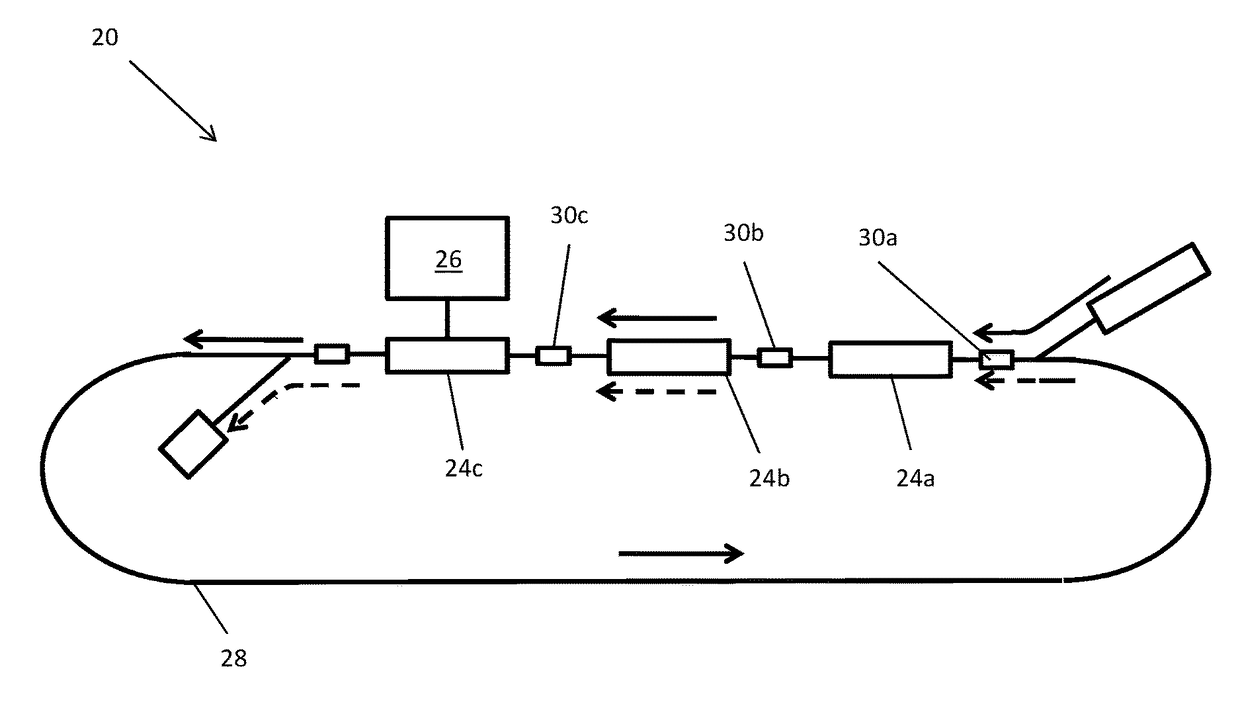
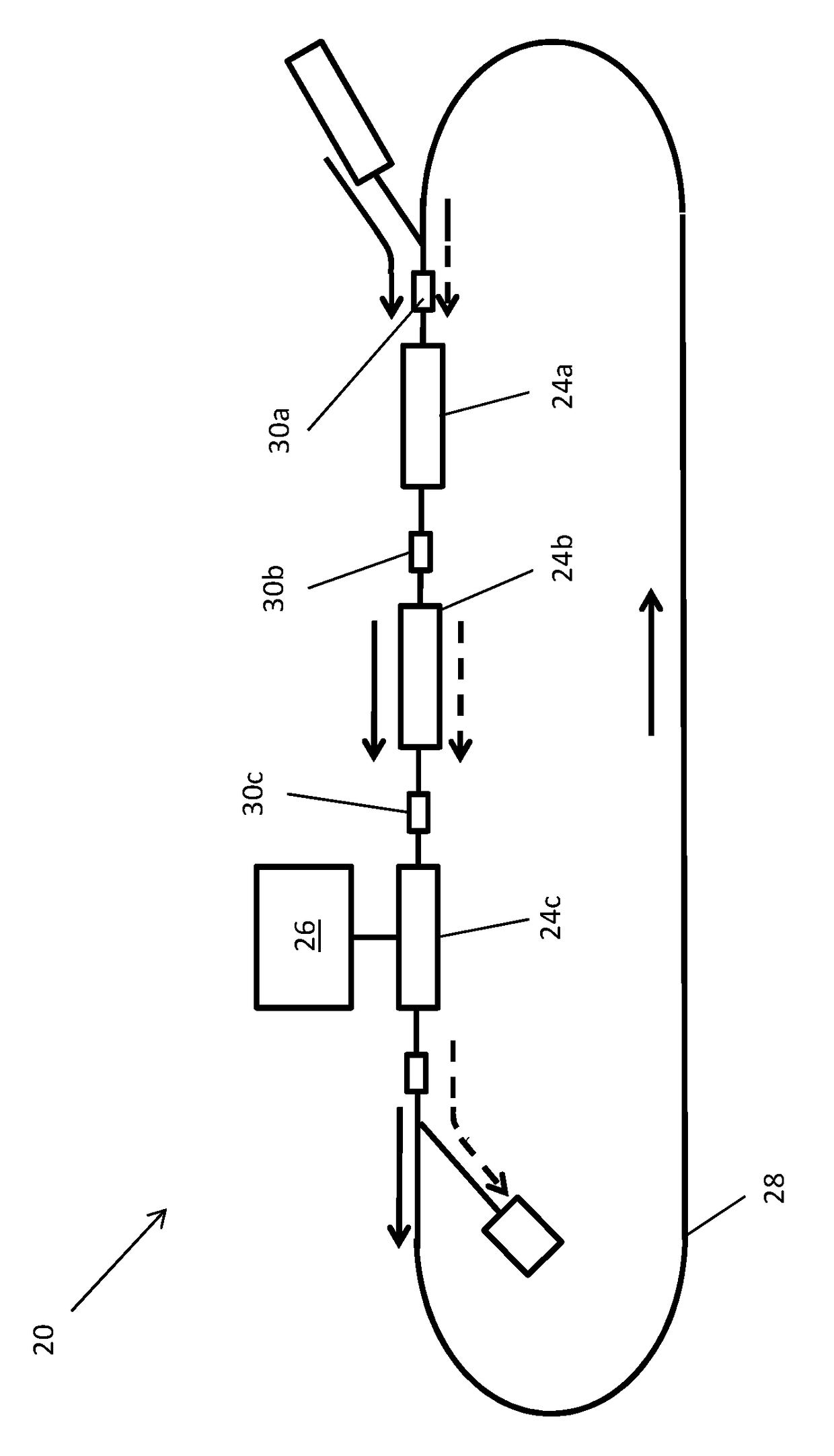
[0010]With reference to FIG. 1 there is shown an energy recovered linac 20 with a a plurality of RF cavities 24a, 24b, and 24c supplied by RF energy from an RF system 26 that accelerates particles around a path 28. The energy recovery linac 20 is an accelerator topology where the first pass beam extracts energy from the RF cavities 24a, 24b, and 24c and the second pass beam deposits an approximately equal amount of energy into the RF cavities. Thus the net energy from the RF system 26 that is deposited in the vector sum of the beams is very small ...
PUM
 Login to View More
 Abstract
Description
Claims
Application Information
 Login to View More