Method for extending wireless sensor network life cycle based on redundant node-tree
A wireless sensor and redundant node technology, applied in the field of wireless communication, can solve the problems that the life cycle cannot be improved, and the performance improvement has not been improved.
- Summary
- Abstract
- Description
- Claims
- Application Information
AI Technical Summary
Problems solved by technology
Method used
Image

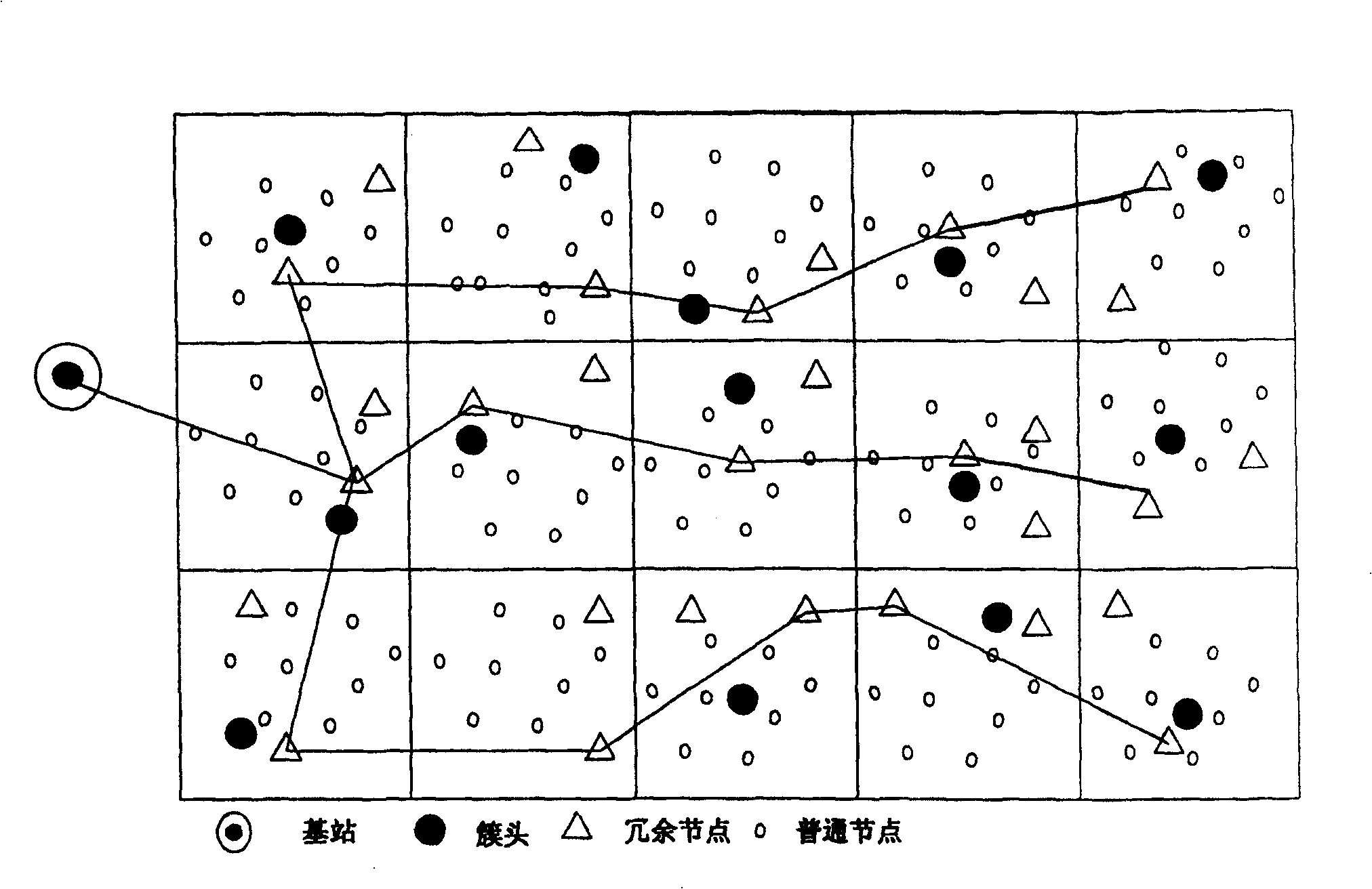


Examples
Embodiment 1
[0053] according to figure 1 , the basic flow of the general EERNT algorithm is as follows figure 2 As shown, the basic steps are as follows:
[0054] (1) Obtain the geographic location and coverage of each node, so as to find and identify each redundant node;
[0055] (2) After the redundant node identification is completed, select a redundant node in a relatively "uniform" position in the cluster (determined according to the density deviation and sparsity deviation of the redundant node) from each cluster, and establish a redundant node. Node tree EERNT, thus ensuring that each redundant node can know its own superior node or base station;
[0056] (3) After the redundant node identification is completed and EERNT is built, each node cluster head and cluster members are notified of the redundant nodes on the redundant node tree in the cluster;
[0057] (4) After the current cluster head node receives the sensor sensing information of other cluster members, it uses the da...
Embodiment 2
[0061] There is a wireless sensor network, the structure is relatively simple as image 3 As shown, that is, the entire network is divided into three clusters 1, 2, and 3. Each cluster is directly connected to the base station, but there are multiple redundant nodes in the cluster. In this case, the basic steps of the EERNT algorithm are as follows:
[0062] (1) The base station node or the management node obtains the geographic location and coverage of each node, thereby finding and identifying the redundant nodes of clusters 1, 2, and 3;
[0063] (2) After the redundant nodes of clusters 1, 2, and 3 are marked, notify the cluster heads and cluster members of clusters 1, 2, and 3 respectively;
[0064] (3) After the current cluster head node receives the sensor sensing information of other cluster members, it uses the method of data aggregation to converge the sensing information;
[0065] (4) After the current cluster head node completes data convergence, it sends the data ...
Embodiment 3
[0069] There is a wireless sensor network with a relatively complex structure such as Figure 5 As shown, that is, the entire network is divided into twelve clusters, each cluster is quite different from the base station. Clusters 1, 5, and 9 are relatively close and are directly connected to the base station; , 10, 11, 12 are far away from the base station, and the multi-hop form is used to transmit information to the base station, but there is at least one redundant node in each cluster. The basic steps of the EERNT algorithm in this case are as follows:
[0070] (1) The base station node or the management node obtains the geographical location and coverage of each node, thereby finding and identifying each redundant node;
[0071] (2) Judging the uniformity of redundant nodes in the cluster, selecting the node with the highest uniformity, and constructing an optimized redundant node tree EERNT;
[0072] (2) After the redundant node identification is completed, notify the c...
PUM
 Login to View More
 Abstract
Description
Claims
Application Information
 Login to View More