Check patentability & draft patents in minutes with Patsnap Eureka AI!

Method for the relative measurement of the fluorescence quantum efficiency of dyes in solution

A technology of quantum yield and dyes, which is applied in the direction of measuring devices, fluorescence/phosphorescence, and analytical materials, can solve the problems of measurement result error, poor result reproducibility, difficult measurement reproducibility, etc., to reduce time and measure precise effect

Inactive Publication Date: 2007-12-05
COMMISSARIAT A LENERGIE ATOMIQUE ET AUX ENERGIES ALTERNATIVES
View PDF0 Cites 7 Cited by
  • Summary
  • Abstract
  • Description
  • Claims
  • Application Information

AI Technical Summary

Problems solved by technology

[0010] However, the methods used by most laboratories or manufacturers are controversial on two points:
[0011] 1) First, in order to be able to compare the photoluminescence intensities of two solutions, they must have the same absorbance, which cannot always be guaranteed for comparing samples and references at a single concentration
Using this method may require post-measurement corrections, but correction factors are not always known exactly and thus constitute a major source of error in fluorescence quantum yield values
[0012] 2) Another difficulty is related to the reproducibility of the measurements
However, since photoluminescence is isotropic, the yield measured by the detector represents only a fraction of the emitted flux
Precise knowledge of the geometry of the device is therefore essential, since any variation (even small) in the path of the laser beam or in the positioning of the chamber can lead to large errors and poor measurement results. reproducibility of results
[0013] In conclusion, relative measurements of fluorescence quantum yields, such as those routinely performed, have been found to be highly unreliable, difficult to reproduce and cannot be automated

Method used

the structure of the environmentally friendly knitted fabric provided by the present invention; figure 2 Flow chart of the yarn wrapping machine for environmentally friendly knitted fabrics and storage devices; image 3 Is the parameter map of the yarn covering machine
View more

Image

Smart Image Click on the blue labels to locate them in the text.
Viewing Examples
Smart Image
  • Method for the relative measurement of the fluorescence quantum efficiency of dyes in solution
  • Method for the relative measurement of the fluorescence quantum efficiency of dyes in solution
  • Method for the relative measurement of the fluorescence quantum efficiency of dyes in solution

Examples

Experimental program
Comparison scheme
Effect test

Embodiment 1

[0190] Embodiment 1: Relative measurement of the fluorescence quantum yield of organic dye quinine sulfate

[0191] Quinine sulfate, similar to rhodamine 6G, is one of the most widely studied dyes, and its fluorescence quantum yield is therefore the best known. Calorimetric measurements have shown that the yield of quinine in 0.1N sulfuric acid is 56% ± 7% (B. Gelemt et al, J. Chem. Soc., Faraday Trans. 2, 70, p939-940, (1974)) .

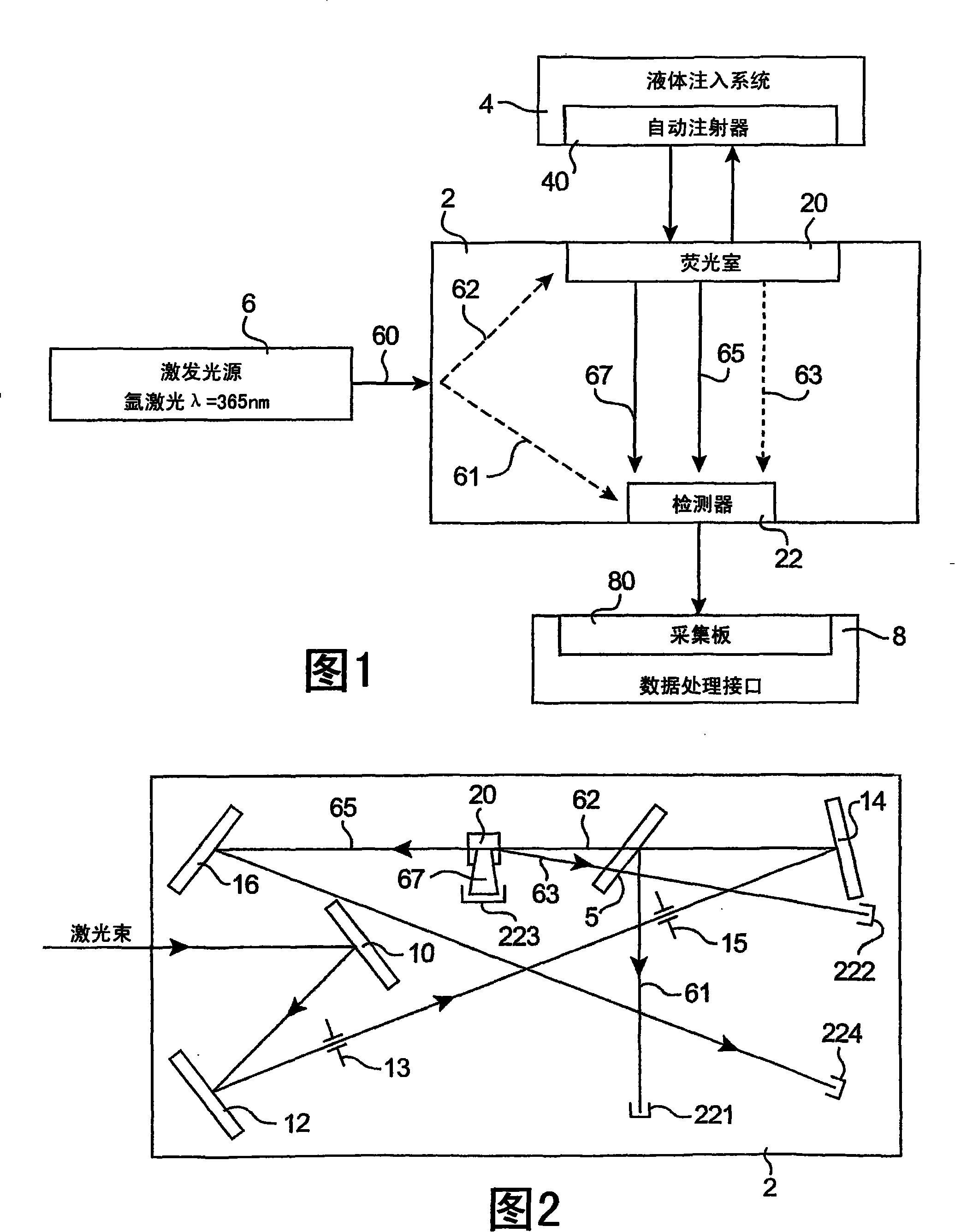
[0192] After some optical adjustments to bring the laser beam parallel to the reference directions given by the two apertures (Fig. 2), the measurement on the standard dye (rhodamine in this case) is ready.

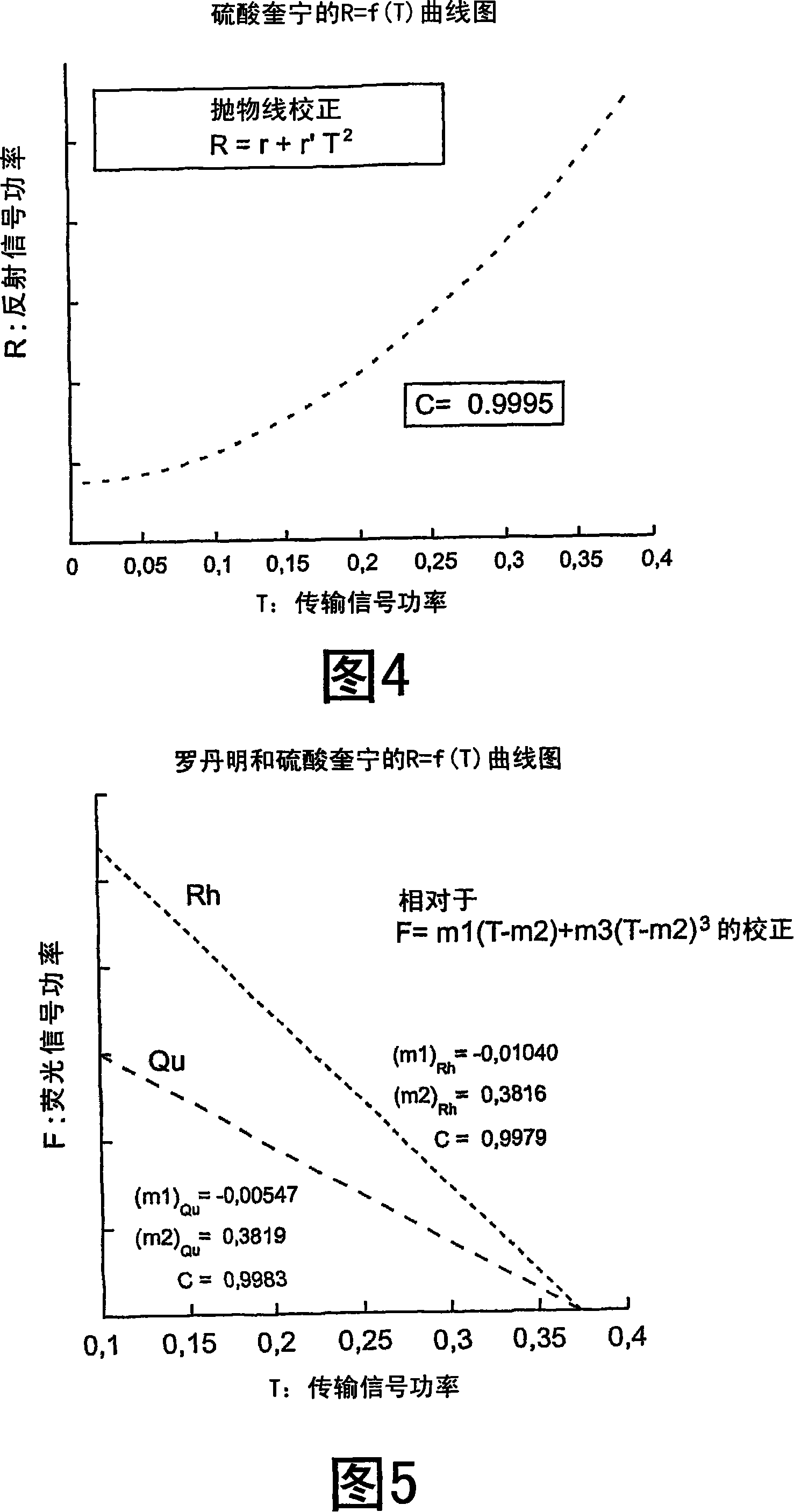
[0193] Inject 1 mL of rhodamine solution at a concentration of C = 1 mg / mL in ethanol into the fluorescence chamber. Ideally, the concentration of the solution is chosen such that the transmission is zero at the beginning of the experiment (all light from the laser beam is absorbed) and then rapidly becomes non-zero (ie not too concentrated) ...

Embodiment 2

[0216] Example 2: Relative Measurement of the Fluorescent Quantum Yield of CdSe(ZnS) Nanocrystals

[0217] Semiconductor II-VI nanocrystals are inorganic particles 2-10 nm in diameter that emit light upon excitation with light.

[0218] One of the potential applications of semiconducting II-VI nanocrystals lies in the substitution of organic dyes in chemistry and biology.

[0219] Therefore, it is interesting to compare them with organic dyes in terms of their fluorescence quantum yield.

[0220] The nanocrystals tested were purchased commercially. They are the inner core (outer shell): CdSe(ZnS) dispersed in toluene.

[0221] To obtain less viscous solutions, they were dispersed in chloroform. The lasing wavelength of these particles is λ=626nm.

[0222] The procedure used was the same as in Example 1, first obtaining a collection of rhodamine as a standard, and then obtaining a collection for the solution of the nanocrystals. The result obtained was processed in the sam...

the structure of the environmentally friendly knitted fabric provided by the present invention; figure 2 Flow chart of the yarn wrapping machine for environmentally friendly knitted fabrics and storage devices; image 3 Is the parameter map of the yarn covering machine
Login to View More

PUM

PropertyMeasurementUnit
concentrationaaaaaaaaaa
diameteraaaaaaaaaa
Login to View More

Abstract

The invention relates to a method for the measurement of the relative fluorescence quantum efficiency of a dye, comprising the following steps, namely: a) for at least two different concentrations of the dye in solution in a solvent, the excitation of the dye with electromagnetic radiation (6) and the measurement of the photoluminescence (67) of the dye that has been excited by said radiation and of the signal transmitted (65) through the cell containing the dye; b) a comparison of the data measured with the photoluminescence and transmission data of a reference dye; and c) the calculation of the relative fluorescence quantum efficiency of the dye.

Description

technical field [0001] The present invention relates to a new method for the relative measurement of the fluorescence quantum yield of dyes in solution. This method is applicable to various organic or inorganic dyes, such as semiconductor nanocrystals. Background technique [0002] A large number of applications of organic and inorganic dyes are based on their ability to emit light, for example using them as fluorescent markers. [0003] Fluorescence quantum yield quantifies the luminous efficiency of these dyes and is equal to the ratio of the number of photons emitted by the solution to the number of photons absorbed. Fluorescence quantum yield becomes an important parameter for manufacturers and users of such products, and a systematic and reliable measurement of this quantum yield is therefore required. [0004] Fluorescence quantum yield measurements for organic dyes are known so that reference dyes can be identified and their fluorescence quantum yields known and use...

Claims

the structure of the environmentally friendly knitted fabric provided by the present invention; figure 2 Flow chart of the yarn wrapping machine for environmentally friendly knitted fabrics and storage devices; image 3 Is the parameter map of the yarn covering machine
Login to View More

Application Information

Patent Timeline
no application Login to View More
Patent Type & Authority Applications(China)
IPC IPC(8): G01N21/64
CPCG01N21/643
Inventor J·布勒兹S·卡拉永E·德拉马德莱娜
Owner COMMISSARIAT A LENERGIE ATOMIQUE ET AUX ENERGIES ALTERNATIVES
Features
  • R&D
  • Intellectual Property
  • Life Sciences
  • Materials
  • Tech Scout
Why Patsnap Eureka
  • Unparalleled Data Quality
  • Higher Quality Content
  • 60% Fewer Hallucinations
Social media
Patsnap Eureka Blog
Learn More