Check patentability & draft patents in minutes with Patsnap Eureka AI!

Method for IPv6 repeating vector IPv4/6 through inverse path

A technology of reverse path forwarding and vectoring, applied in digital transmission systems, electrical components, transmission systems, etc., to achieve the effects of improving transmission quality, optimizing multicast functions, and wide applicability

Inactive Publication Date: 2011-01-26
TSINGHUA UNIV
View PDF3 Cites 0 Cited by
  • Summary
  • Abstract
  • Description
  • Claims
  • Application Information

AI Technical Summary

Problems solved by technology

Among them, the scheme based on dual protocol stack, tunnel and application layer multicast does not make full use of the multicast support function of the core network, and does not realize the optimization of multicast
The NAT-PT-based solution continues the same limitations as the NAT-PT protocol
In addition, there are other multicast solutions, which mainly rely on manual configuration of multicast mapping relationships, resulting in poor customer scalability and manageability, and cannot support a large number of multicast groups at all.

Method used

the structure of the environmentally friendly knitted fabric provided by the present invention; figure 2 Flow chart of the yarn wrapping machine for environmentally friendly knitted fabrics and storage devices; image 3 Is the parameter map of the yarn covering machine
View more

Image

Smart Image Click on the blue labels to locate them in the text.
Viewing Examples
Smart Image
  • Method for IPv6 repeating vector IPv4/6 through inverse path
  • Method for IPv6 repeating vector IPv4/6 through inverse path

Examples

Experimental program
Comparison scheme
Effect test

Embodiment Construction

[0031] The present invention will be further described below in conjunction with the accompanying drawings and embodiments.

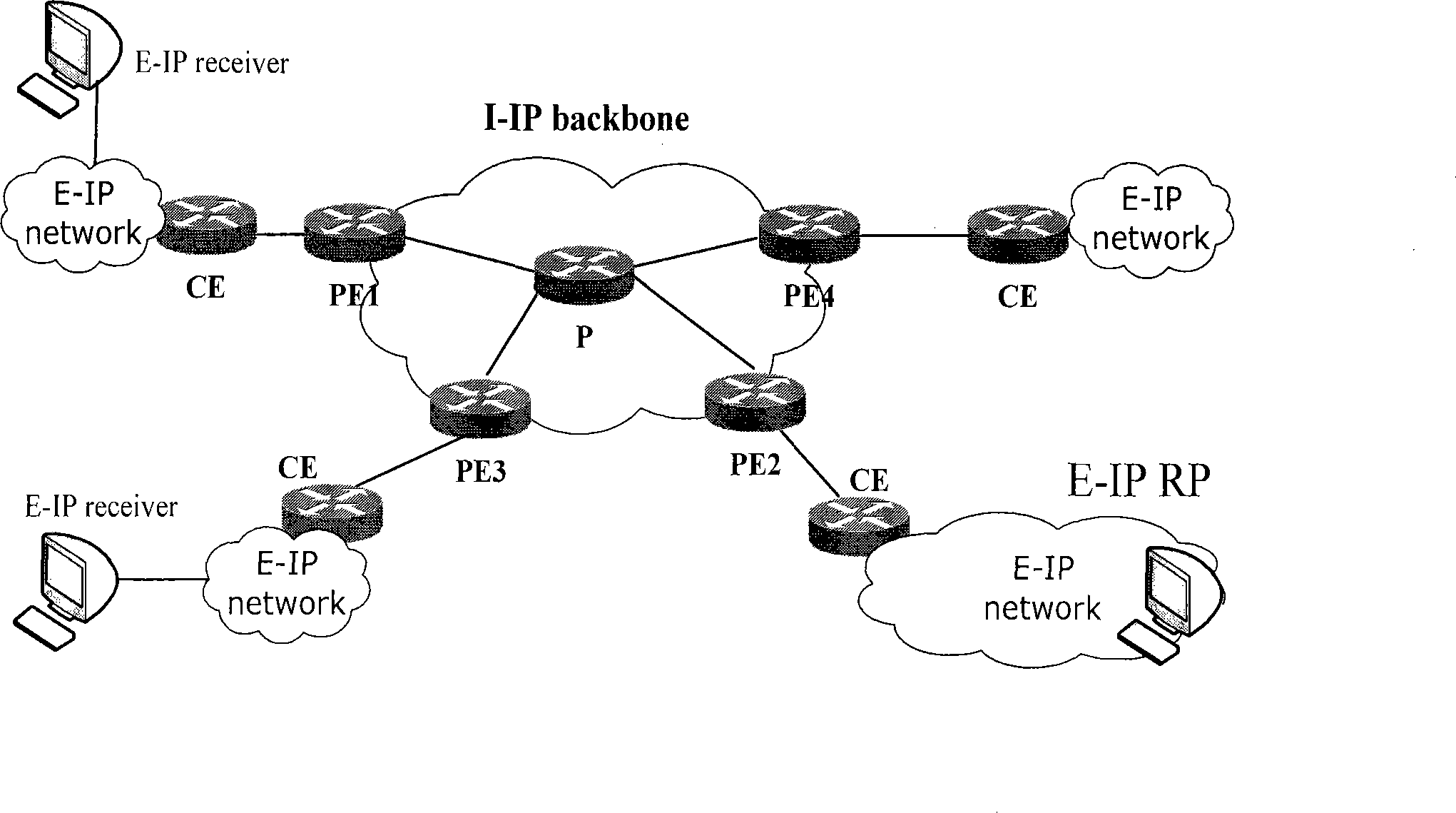
[0032] In softwire, the most basic components are several E-IP networks and an I-IP core network. This solution is suitable for IPv4 over IPv6, that is, E-IP and I-IP can use IPv4 and IPv6 respectively. The network connection mode is described in Figure 1.

[0033] From the perspective of the establishment of the multicast tree, when a host receiver in an E-IP network wants to join a multicast group with a host in another E-IP network as the source (RP address is 11.1.1.2, group The broadcast group address is 216.0.0.1), the Join message Join(11.1.1.2; 216.0.0.1) sent by the host first arrives at the PE1 router of the I-IP network, and the edge router PE1 router first transfers the message to the IPv4 / 6 address RPF Vector is added after conversion, and the Vector attribute value is the address EA::22 of the egress PE2, that is, Join(EF::11.1.1.2; FF::2...

the structure of the environmentally friendly knitted fabric provided by the present invention; figure 2 Flow chart of the yarn wrapping machine for environmentally friendly knitted fabrics and storage devices; image 3 Is the parameter map of the yarn covering machine
Login to View More

PUM

No PUM Login to View More

Abstract

The invention relates to an IPv4 / 6 multicast transition method which uses an RPF Vector in an IPv6 network and can improve the transport quality of IPv4 multicast by an IPv6 high speed backbone multicast network as well as map an isolated IPv4 network multicast tree into an IPv6 multicast network. The method adopts the technical proposal that: multicast trees in an IPv4 border network correspond to the multicast trees in an IPv6 core network one to one; when receiving a Join message, an edge router PE converts a source address and a multicast address pair (s, g) or (*, g) in the Join / Prune message into an IPv4-mapped IPv6 address (s', g') or (*, g'); and then the address of an egress edge router PE is put into a new Join message by the RPF Vector according to iBGP route so as to route in a core network; a P router in the core network supports the RPF Vector, routes and establishes or deletes a multicast routing table of (s', g') or (*, g') by the address of the Vector; when a multicast data packet reaches the PE, only the conversion of an IP address is needed.

Description

technical field [0001] The invention belongs to the field of IPv4 / 6 transition multicast technology, in particular to a method for IPv6 using reverse path forwarding vector IPv4 / 6. Background technique [0002] Due to the severe shortage of IPv4 address space, the next generation Internet based on IPv6 will develop rapidly. However, because the IPv4 Internet already has a considerable scale and wide application, the IPv4 network will inevitably exist for a long time in the future, forming a process of gradual integration with the next-generation IPv6 network. With the establishment of the IPv6 backbone network, a new technology needs to be introduced to connect IPv4 end users through the fast and efficient IPv6 backbone network to improve the service quality of the network. In addition, with the gradual abandonment of the IPv4 network, there will be a transitional stage where the IPv4 network is disconnected. In this stage, the IPv6 network serves as a bridge connecting mu...

Claims

the structure of the environmentally friendly knitted fabric provided by the present invention; figure 2 Flow chart of the yarn wrapping machine for environmentally friendly knitted fabrics and storage devices; image 3 Is the parameter map of the yarn covering machine
Login to View More

Application Information

Patent Timeline
no application Login to View More
Patent Type & Authority Patents(China)
IPC IPC(8): H04L12/56H04L29/06H04L45/16H04L45/52
Inventor 崔勇吴建平徐明伟宋林健
Owner TSINGHUA UNIV
Features
  • R&D
  • Intellectual Property
  • Life Sciences
  • Materials
  • Tech Scout
Why Patsnap Eureka
  • Unparalleled Data Quality
  • Higher Quality Content
  • 60% Fewer Hallucinations
Social media
Patsnap Eureka Blog
Learn More