Randomness detecting method based on pseudo-random sequence of sample
What is AI technical title?
AI technical title is built by PatSnap AI team. It summarizes the technical point description of the patent document.
A technology of randomness detection and pseudo-random sequence, applied in the field of randomness detection of pseudo-random sequence, can solve problems such as affecting the detection accuracy rate, limited one-sidedness, etc., to solve the limitations and one-sidedness, improve the accuracy rate, and avoid misjudgment Effect
Inactive Publication Date: 2010-03-17
XIDIAN UNIV
View PDF0 Cites 5 Cited by
Summary
Abstract
Description
Claims
Application Information
AI Technical Summary
This helps you quickly interpret patents by identifying the three key elements:
Problems solved by technology
Method used
Benefits of technology
Problems solved by technology
[0007] 5) The complexity of the sequence, such as linear complexity;
[0010] There are more than 60 kinds of corresponding tests, such as frequency test, cumulative sum test, run test, etc., they can only test some properties of randomness, that is to say, the passing of each test can only show that the sequence satisfies a certain A random characteristic, but it does not ensure that it also meets other characteristics, that is, there are limitations and one-sidedness, which affect the accuracy of detection.
Method used
the structure of the environmentally friendly knitted fabric provided by the present invention; figure 2 Flow chart of the yarn wrapping machine for environmentally friendly knitted fabrics and storage devices; image 3 Is the parameter map of the yarn covering machine
View more
Image
Smart Image Click on the blue labels to locate them in the text.
Viewing Examples
Smart Image
Click on the blue label to locate the original text in one second.
Reading with bidirectional positioning of images and text.
Smart Image
Examples
Experimental program
Comparison scheme
Effect test
Embodiment 1
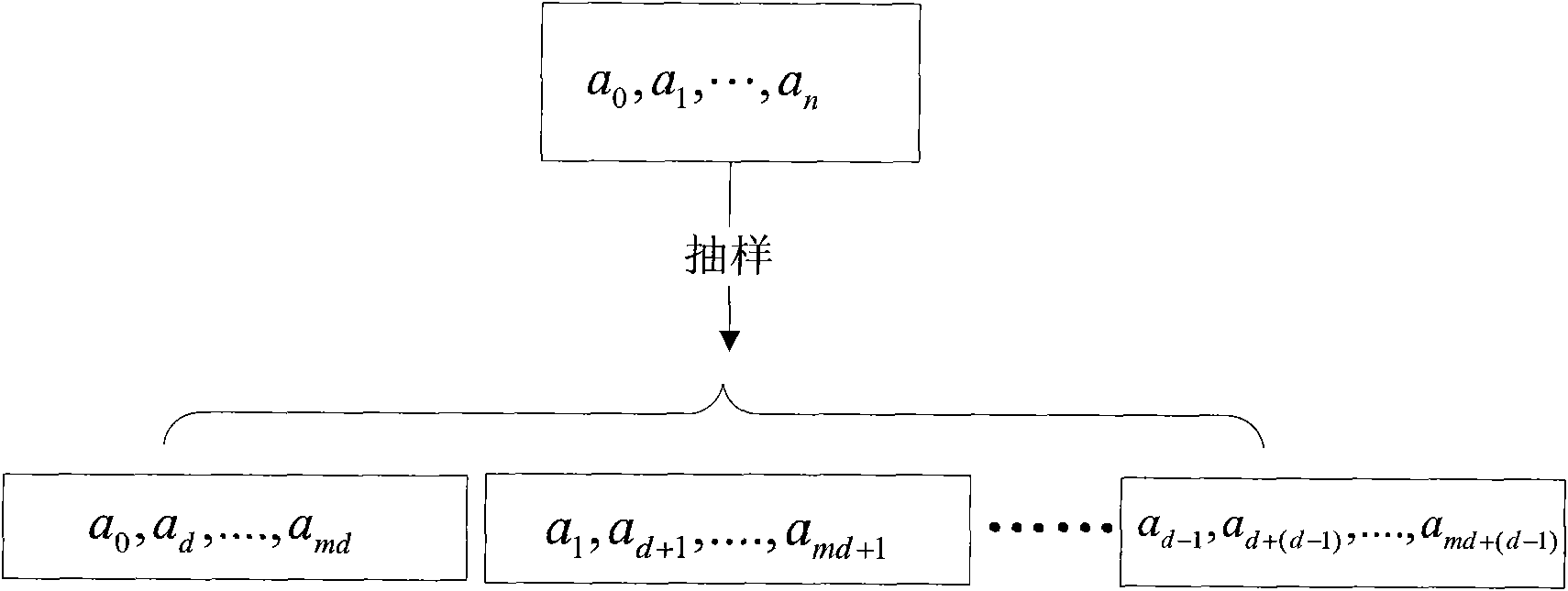
[0032] Embodiment 1, by sampling the sequence to be tested, the randomness detection of the pseudo-random sequence is realized,
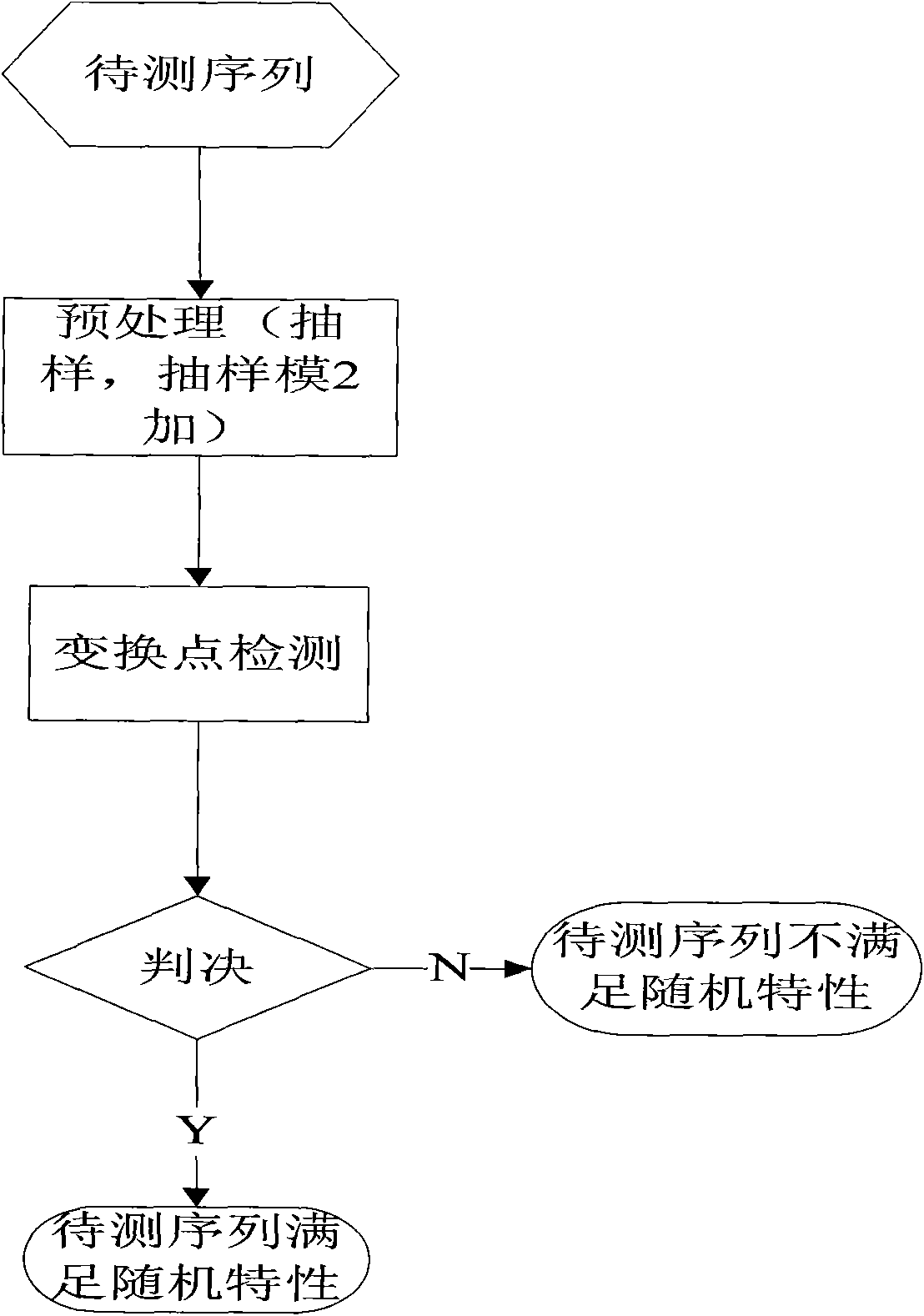
[0033] refer to figure 1 and figure 2 , the specific implementation steps of this example are as follows:
[0034] Step 1, input the sequence to be tested a 0 , a 1 ,...,a n , n=10 6 .
[0035] Step 2: Sampling the sequence to be tested, set the sampling interval as a positive integer d, and obtain the sampling sequence as a 0 ,...,a md , a 1 ,...,a md+1 ,...,a d-1 ,...,a md+(d-1) , m=(n+1) / (d-1).
[0036] Step 3, for the sampling sequence a 0 ,...,a md , a 1 ,...,a md+1 ,...,a d-1 ,...,a md+(d-1) Use the transformed point test method for statistics:
[0037] (3a) Take a sequence s that has been proven to be pseudo-random 0 ,s 1 ,...,s l(l=10 6 ) as a standard sequence, placed in a 0 ,...,a md , a 1 ,...,a md+1 ,...,a d-1 ,...,a md+(d-1) Before, form a new sequence s 0 ,s 1 ,...,s l , a 0 ,...,a md , a 1 ,...,a m...
Embodiment 2
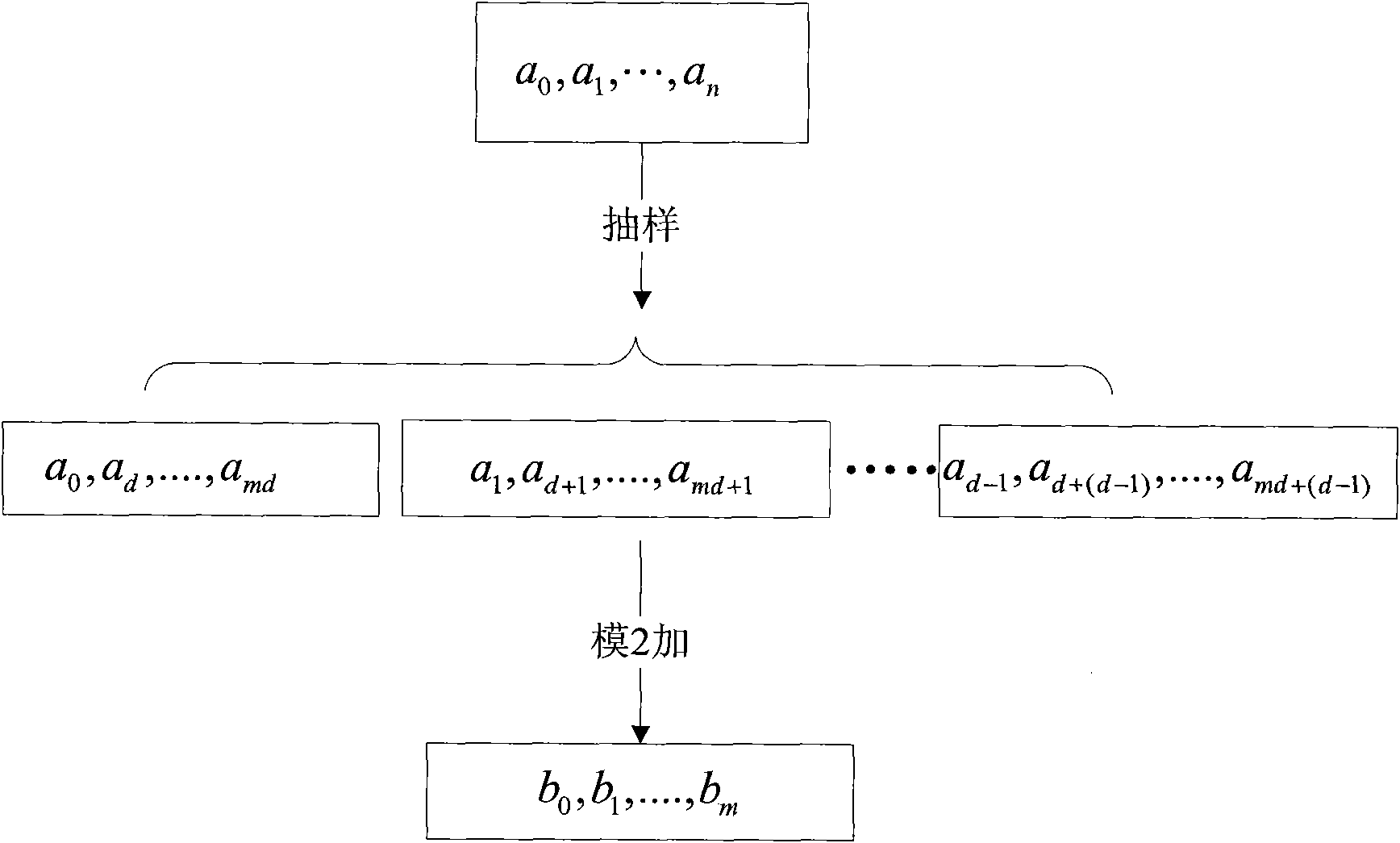
[0046] Embodiment two, realize the randomness detection of the pseudo-random sequence by adding the sampling modulo 2 of the sequence to be tested,
[0047] refer to figure 1 and image 3 , the specific implementation steps of this example are as follows:
[0048] Step 1, input the sequence to be tested a 0 , a 1 ,...,a n , n=10 6 .
[0049] Step 2: Sampling the sequence to be tested, setting the sampling interval as a positive integer d, and obtaining the sampling sequence as a 0 ,...,a md , a 1 ,...,a md+1 ,...,a d-1 ,...,a md+(d-1) , m=(n+1) / (d-1).
[0050] Step 3, for the above sampling sequence a 0 ,...,a md , a 1 ,...,a md+1 ,...,a d-1 ,...,a md+(d-1) Modulo 2 addition bit by bit: b i = a id ⊕ a id + 1 · · · ⊕ a ...
the structure of the environmentally friendly knitted fabric provided by the present invention; figure 2 Flow chart of the yarn wrapping machine for environmentally friendly knitted fabrics and storage devices; image 3 Is the parameter map of the yarn covering machine
Login to View More
PUM
Login to View More
Abstract
The invention discloses a random detecting method based on a pseudo-random sequence, belonging to the technical field of signal detection and mainly solving the problems of limitation and one-sidedness existing in the prior randomness detecting method. The method comprises the following detecting steps: carrying out pretreatment of sampling or sampling modulo 2 addition on sequences to be detected, and carrying out transformation point detection on the sequences obtained after the pretreatment; selecting a standard pseudo-random sequence, and arranging the standard pseudo-random sequence in front of the pretreated sequences to form new sequences; grouping the new sequences, and calculating the accumulative sum of bits in the groups to obtain the difference values of the accumulative sums of the adjacent groups; selecting fractiles and determining critical values; comparing all the difference values with the critical values, if all the difference values are less than or equal to the critical values, confirming that the sequences satisfy the random characteristic, otherwise, confirming that the sequences do not satisfy the random characteristic. The method has the advantages of overall detection result, high reliability and good effectiveness, and can be used in the fields of random simulation, spreading code generation in a CDMA system and key stream generation in a streamciphersystem.
Description
technical field [0001] The invention belongs to the technical field of signal detection, in particular to a method for detecting randomness of a pseudo-random sequence, which can be used for random simulation, generation of pseudo-codes in pseudo-code ranging, generation of spreading codes in CDMA systems, generation of various noise sources and streaming Keystream generation in cryptosystems. Background technique [0002] The randomness of the pseudo-random sequence generated by the random number generator directly affects the security of the application. Therefore, to judge whether the application is safe, it must first ensure that the randomness of the pseudo-random sequence is good. Randomness detection has always been a difficult point in sequence randomness detection. To detect whether a sequence has the characteristics of a truly random sequence, several aspects can be considered: [0003] 1) periodic characteristics; [0004] 2) The proportion of symbols "0" and "...
Claims
the structure of the environmentally friendly knitted fabric provided by the present invention; figure 2 Flow chart of the yarn wrapping machine for environmentally friendly knitted fabrics and storage devices; image 3 Is the parameter map of the yarn covering machine
Login to View More
Application Information
Patent Timeline
Application Date:The date an application was filed.
Publication Date:The date a patent or application was officially published.
First Publication Date:The earliest publication date of a patent with the same application number.
Issue Date:Publication date of the patent grant document.
PCT Entry Date:The Entry date of PCT National Phase.
Estimated Expiry Date:The statutory expiry date of a patent right according to the Patent Law, and it is the longest term of protection that the patent right can achieve without the termination of the patent right due to other reasons(Term extension factor has been taken into account ).
Invalid Date:Actual expiry date is based on effective date or publication date of legal transaction data of invalid patent.



 Login to View More
  Login to View More