
Compound copper powder for manufacturing capillary structure of inner wall of heat pipe
A technology of capillary structure and heat pipe, applied in the field of composite copper powder, can solve the problems of complex process, unknown thermal conductivity, not suitable for heat pipe, etc., and achieve the effects of improving capillary force, increasing through porosity, and improving heat transfer efficiency.
Inactive Publication Date: 2012-12-05
SCM METAL PROD SUZHOU
View PDF3 Cites 3 Cited by
- Summary
- Abstract
- Description
- Claims
- Application Information
AI Technical Summary
Problems solved by technology
Due to its complicated process, it is not suitable for the production of heat pipes, and the porosity of the capillary structure layer and the heat conduction effect of heat pipes are not mentioned.
[0009] Chinese patent 200610156330.5 also proposes a method for preparing a high-porosity metal porous carrier material, but the sintering process requires multi-stage heat preservation, which is used for the adsorption storage of special substances and catalyst carriers, and the thermal conductivity is unknown
Not suitable for making heat pipes
Method used
the structure of the environmentally friendly knitted fabric provided by the present invention; figure 2 Flow chart of the yarn wrapping machine for environmentally friendly knitted fabrics and storage devices; image 3 Is the parameter map of the yarn covering machine
View moreImage
Smart Image Click on the blue labels to locate them in the text.
Smart ImageViewing Examples

Examples
Experimental program
Comparison scheme
Effect test
Embodiment 1
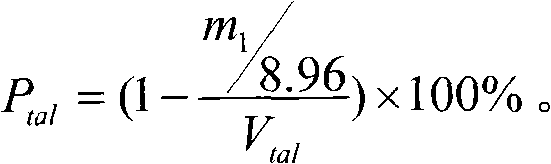
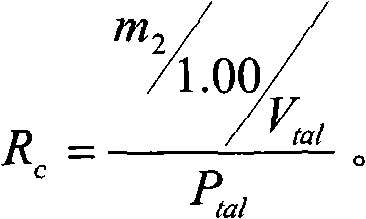
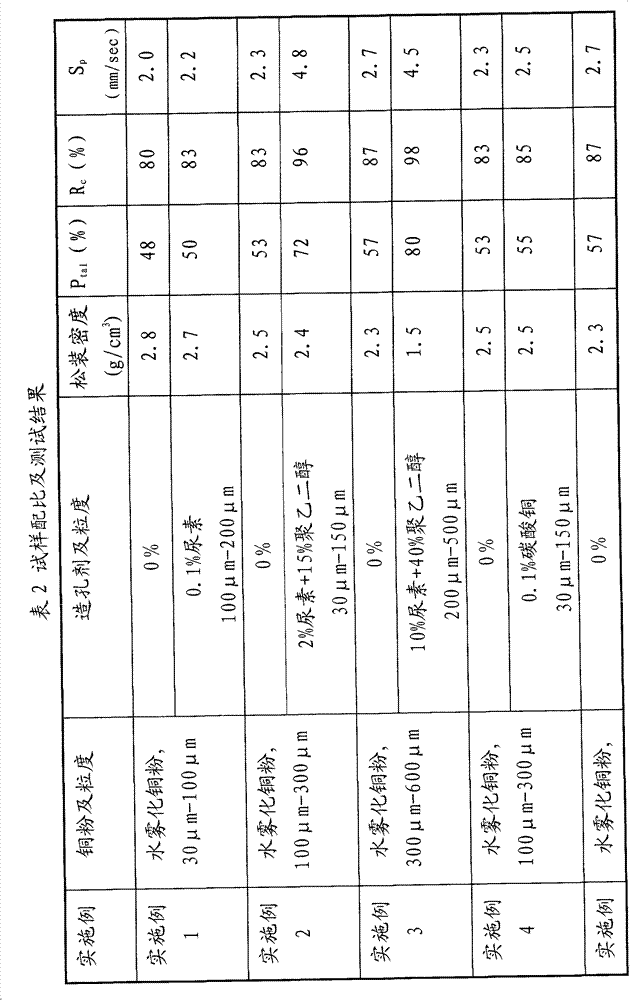
[0032] In Example 1, compared with the comparative experiment, the porosity and through-porosity did not change much, and the capillary water absorption rate increased slightly.
Embodiment 2
[0033] In Example 2, compared with the comparative experiment, the porosity and through-porosity are greatly improved, and the capillary water absorption rate is increased by 109%.
Embodiment 3
[0034] In Example 3, compared with the comparative experiment, the porosity and through-porosity are greatly improved, and the capillary water absorption rate is increased by 66.7%.
the structure of the environmentally friendly knitted fabric provided by the present invention; figure 2 Flow chart of the yarn wrapping machine for environmentally friendly knitted fabrics and storage devices; image 3 Is the parameter map of the yarn covering machine
Login to View More PUM
| Property | Measurement | Unit |
|---|---|---|
| particle size | aaaaa | aaaaa |
| particle size | aaaaa | aaaaa |
| decomposition temperature | aaaaa | aaaaa |
Login to View More
Abstract
The composite copper powder is a mixture of copper powder and pore-forming agent powder. The copper powder is selected from gas atomized copper powder, water atomized copper powder, oxide-reduced copper powder or electrolytic copper powder.The pore-forming agent powder may be ammonium carbonate, ammonium bicarbonate, copper sulfate, copper carbonate, copper hydroxide, ammonium nitrite, polyethylene glycol, polyvinyl alcohol, polyvinyl chloride, polystyrene, binary nitrogen-ammonia benzene, azobisisbutyromtple, azobisformamide, urea, paraffin or methylcellulose The composite copper powder can be used for manufacturing heat pipe with inner wall capillary structure. The heat pipe can be used for manufacturing high-efficiency radiator.
Description
technical field [0001] The invention relates to a composite copper powder, which is used for manufacturing the capillary structure of the inner wall of a heat pipe. The heat pipes include ordinary sintered heat pipes, composite heat pipes, loop heat pipes, flat heat pipes (Vapor chamber), etc., and can be used in aerospace, electrical, electronic and mechanical fields. Background technique [0002] In recent years, with the rapid development of aerospace, electrical and electronic fields, especially the rapid development of semiconductor manufacturing and electronic packaging technology, the work efficiency of electronic and electrical components has been greatly improved. However, while the components are working fast, the heat consumption is also greatly increasing, and the working life and stability of the devices are also severely restricted. According to statistics, when the operating temperature of the CPU rises by 10°C, its life It will be reduced by 50%; when the wo...
Claims
the structure of the environmentally friendly knitted fabric provided by the present invention; figure 2 Flow chart of the yarn wrapping machine for environmentally friendly knitted fabrics and storage devices; image 3 Is the parameter map of the yarn covering machine
Login to View More Application Information
Patent Timeline
 Login to View More
 Patent Type & AuthorityPatents(China)
IPC IPC(8): B22F1/00B22F3/11C22C1/08F28D15/02
CPCB22F3/1125B22F9/18F28D15/046B22F9/082
Inventor胡立荣莫文剑
OwnerSCM METAL PROD SUZHOU