
Method for detecting content of elements in oil with inductively coupled plasma (ICP) spectrometer
A technology of element content and spectrometer, which is applied in the field of detecting element content in oil, can solve the problems of rare organic standard samples, great differences in viscosity and physical properties, and inconvenient preparation and acquisition.
- Summary
- Abstract
- Description
- Claims
- Application Information
AI Technical Summary
Problems solved by technology
Method used
Image

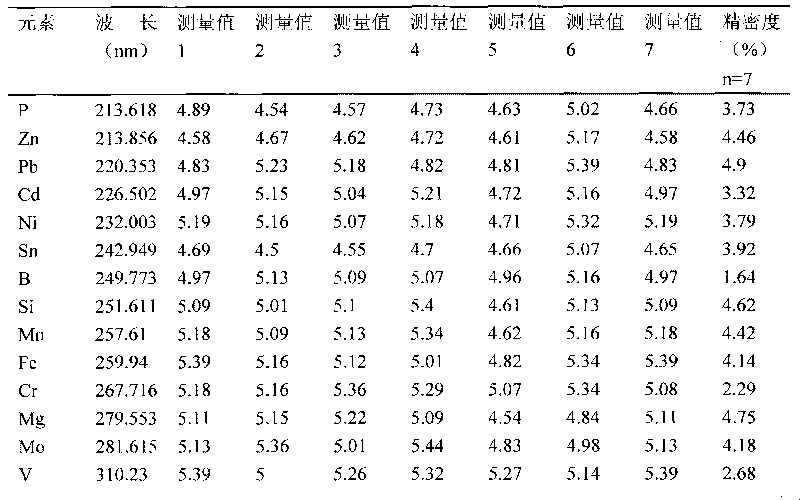
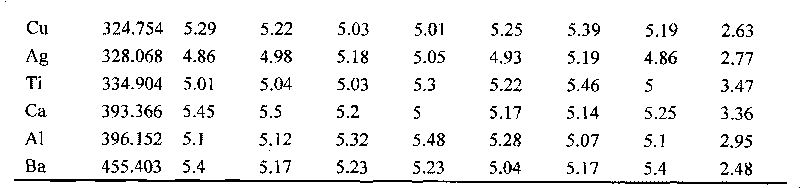
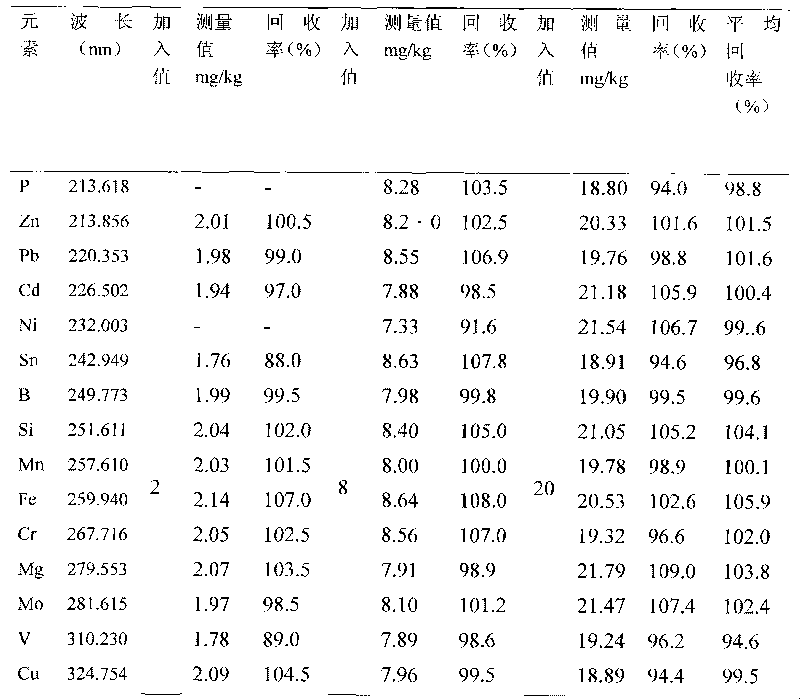
Examples
Embodiment Construction
[0019] The preferred embodiments of the present invention will be described in detail below.
[0020] The present invention will be described in detail below by using an ICP spectrometer to detect and analyze the content of elements in lubricating oil. First, dilute the lubricating oil with an organic solution. The organic solution can be light diesel oil, xylene or MIBK. These three organic solvents can dissolve the lubricating oil and have good storage stability. However, considering the safety of the diluent, We choose light diesel oil as diluent. After the lubricating oil has been diluted, inject the diluted lubricating oil into the inner quartz tube of the torch of the ICP spectrometer. At the same time, a cooling gas is passed through the outer quartz tube of the torch. Oxygen is passed through the quartz tube in the middle layer of the tube, and the flow rate of oxygen is 0.3L / min.
[0021] Using the above scheme, the cooling gas is introduced into the outer quartz tu...
PUM
 Login to View More
 Abstract
Description
Claims
Application Information
 Login to View More