

Method for preparing calcium magnesium phosphate fertilizer by utilizing phosphorite flotation tailing blast furnace method
A calcium-magnesium-phosphate fertilizer and blast furnace technology, applied in phosphate fertilizers, Thomas phosphate fertilizers, applications, etc., can solve problems such as hidden safety hazards, environmental pollution, occupation of land resources, etc., and achieve economic feasibility, reduce production costs, and save phosphorus resources.
Patent Information
- Authority / Receiving Office
- CN · China
- Current Assignee / Owner
- Publication Date
- 2010-06-23
- Estimated Expiration
- Not applicable · inactive patent
Smart Images
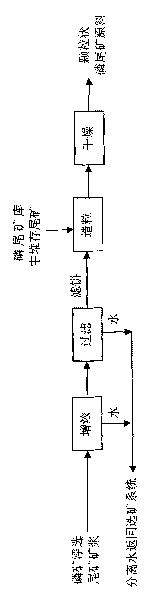
Figure 1 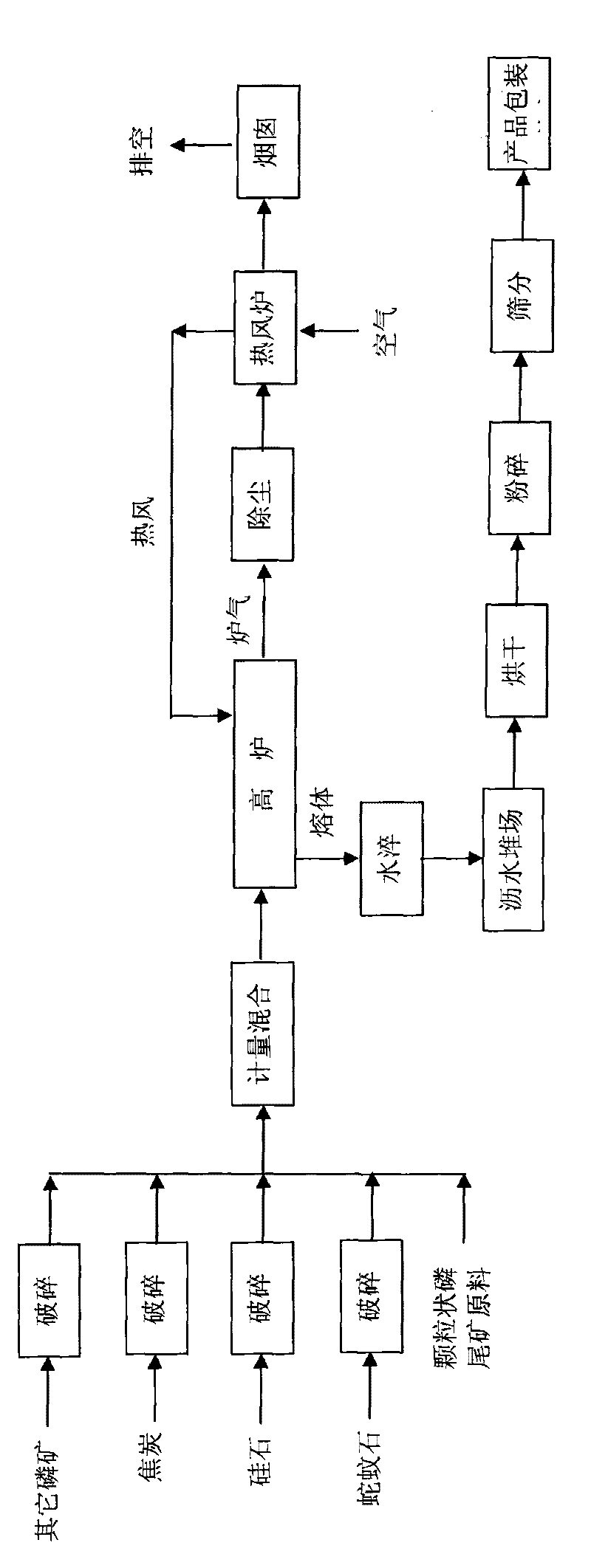
Figure 2 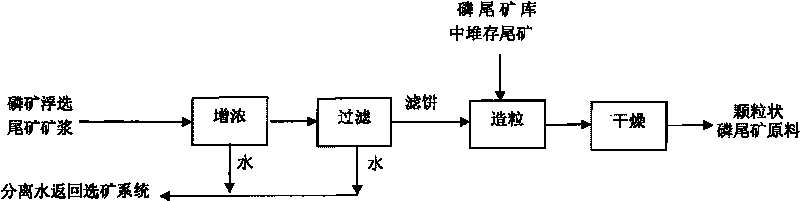
Figure 3
Abstract
Description
technical field
[0001] The invention belongs to the technical field of phosphate fertilizer chemical industry, and particularly relates to a method for preparing calcium-magnesium phosphate fertilizer by adopting a blast furnace method with phosphate ore flotation tailings as main raw materials. Background technique
[0002] In recent years, the rapid development of high-concentration phosphorus and compound fertilizer industries at home and abroad has caused a sharp decline in the reserves of phosphorus-rich ores that can be directly used for wet-process phosphoric acid processing, and the resources of phosphorus-rich ores in many areas are almost exhausted. In order to ensure the sustainable development of the high-concentration phosphorus compound fertilizer industry, many countries are using medium and low-grade phosphate rock or high-magnesium phosphate rock as raw materials to produce phosphate concentrate suitable for wet-process phosphoric acid processing. In the pro...
Examples
Embodiment 1
[0021] In this example, using phosphate rock flotation tailings as the main raw material, the production process and operation control steps of preparing calcium magnesium phosphate fertilizer by blast furnace are as follows:
[0022] (1) Preparation of phosphorous tailings raw materials
[0023] Use flotation phosphorus tailings slurry as raw material, dehydrate through thickener and filter to obtain flotation tailings filter cake with water content of 20-40%; use the filter cake or wet tailings stockpiled in tailings pond Granulator granulation (material particle size is 10 ~ 50mm); it is dried and dehydrated with a drier to obtain phosphorous tailings granules with a water content of 2 o 5 ) is 8 to 12%,). The production process is attached figure 1 .
[0024] (2) Preparation of raw materials for furnace melting
[0025] Primary phosphate rock W(P 2 o 5 ≥23%), coal, snakebite, and silica are crushed into lumps with a particle size of 30-60mm. The various minerals and...
Embodiment 2
[0036] (1) Chemical composition of flotation phosphorus tailings and phosphate rock raw materials
[0037] Typical chemical composition (mass %) of flotation phosphorus tailings and furnace phosphate rock raw materials used in this example
[0038] chemical composition
P 2 o 5
MgO
CaO
SiO 2
Flotation tailings
9.20
12.10
29.60
8.10
Phosphate Rock Raw Materials
15.50
10.80
32.80
12.35
[0039] (2) The production process and operation steps of calcium magnesium phosphate fertilizer prepared by cyclone furnace
[0040] Production flow and operation control step are identical with embodiment 1, and process flow chart is as figure 1 , figure 2 .
[0041] (3) Typical process conditions of this example
[0042] Typical process conditions for this example
[0043] Melting temperature (℃)
1370
Melting time (min)
38
Quenching temperature (℃)
30
...
Embodiment 3
[0048] (1) Chemical composition of flotation phosphorus tailings and phosphate rock raw materials
[0049]Typical chemical composition (mass %) of flotation phosphorus tailings and furnace phosphate rock raw materials used in this example
[0050] chemical composition
P 2 o 5
MgO
CaO
SiO 2
Flotation tailings
9.60
11.30
30.86
9.15
Phosphate Rock Raw Materials
15.90
10.76
32.26
12.85
[0051] (2) The production process and operation steps of calcium magnesium phosphate fertilizer prepared by cyclone furnace
[0052] Production flow and operation control step are identical with embodiment 1, and process flow chart is as figure 1 , figure 2 .
[0053] (3) Typical process conditions of this example
[0054] Typical process conditions for this example
[0055] Melting temperature (℃)
1380
Melting time (min)
40
Quenching temperature (℃)
35
...