
Ginkgolide derivative and application thereof to pharmacy
A technology of ginkgolides and derivatives, applied in the field of medicine
- Summary
- Abstract
- Description
- Claims
- Application Information
AI Technical Summary
Problems solved by technology
Method used
Image

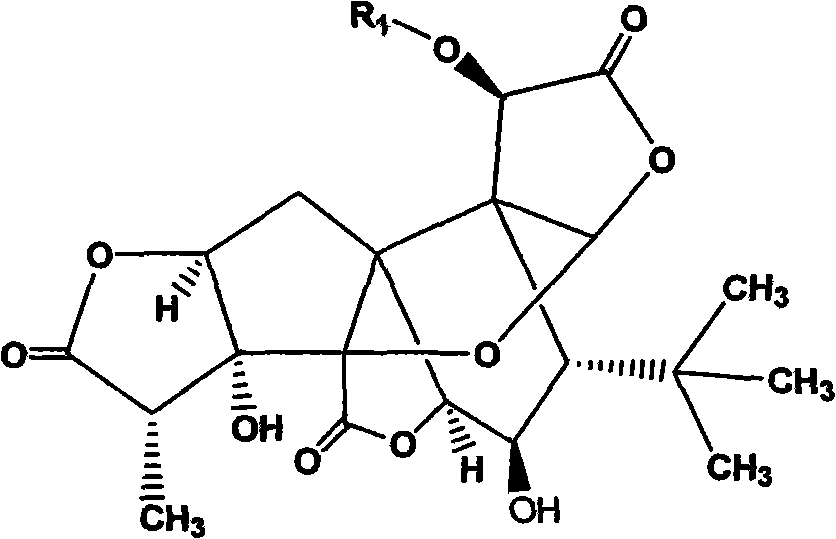
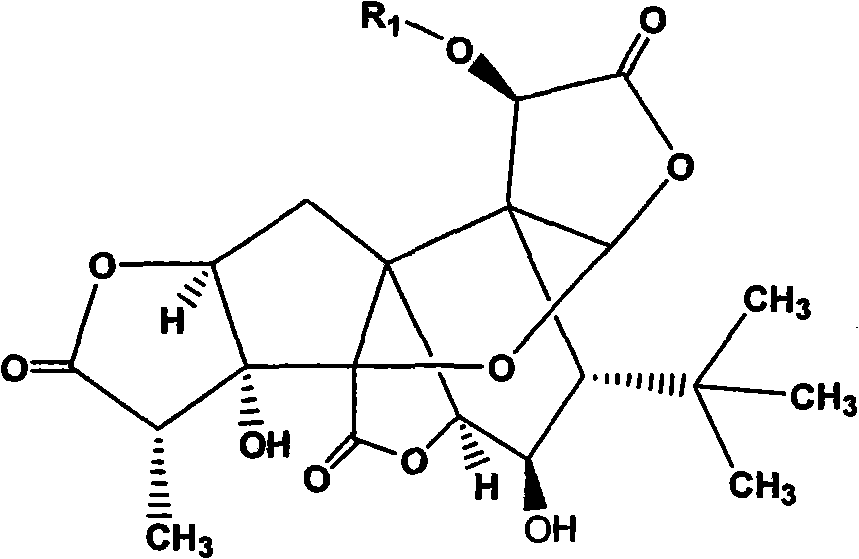
Examples
Embodiment 110
[0158] Example 1.10-(2'-Dimethylaminoethoxy)-Ginkgolide C Preparation and Structure Confirmation
[0159] Dissolve 600mg of ginkgolide C in 40mL of acetonitrile, add 300mg of N,N-dimethylchloroethylamine, 2.5g of potassium carbonate, and 300mg of potassium iodide in sequence, pass inert gas, heat and reflux for 2h, concentrate under reduced pressure, dissolve in chloroform, filter, The filtrate was concentrated. The obtained product was separated by column chromatography (eluent: ethyl acetate / petroleum ether=1 / 1) to obtain the desired product.
[0160] 1 H-NMR (DMSO-d 6 )δ7.26(s, 1H), 6.31(s, 1H), 6.05(s, 1H), 5.60(s, 1H), 5.31(d, 1H), 5.11(s, 1H), 4.55(d, 1H ), 4.30(t, 1H), 3.99(d, 1H), 3.50(t, 1H), 2.81(q, 1H), 2.60(d, 2H), 2.30(d, 2H), 2.15(s, 6H) , 1.60 (dd, 1H), 1.10 (d, 3H), 1.05 (s, 9H).
Embodiment 21
[0161] Example 2.10-(2'-Diethylaminoethoxy)-Ginkgolide C Preparation and Structure Confirmation
[0162] Dissolve 600mg of ginkgolide C in 40mL of acetonitrile, add 350mg of N,N-diethylchloroethylamine, 2.5g of potassium carbonate, 300mg of potassium iodide in sequence, pass inert gas, and heat to reflux for 2h. Concentrate under reduced pressure, dissolve in chloroform, filter, and concentrate the filtrate. The obtained product was separated by column chromatography (eluent: ethyl acetate / petroleum ether=1 / 1) to obtain the desired product.
[0163] 1 H-NMR (DMSO-d 6 )δ7.16(s, 1H), 6.20(s, 1H), 6.07(s, 1H), 5.26(d, 1H), 5.14(s, 1H), 4.65(d, 1H), 4.30(t, 1H ), 3.95(d, 1H), 3.52(t, 1H), 2.84(q, 1H), 2.60(d, 2H), 2.5(s, 4H), 2.30(d, 2H), 2.15(s, 6H) , 1.76 (dd, 1H), 1.21 (d, 3H), 1.10 (s, 9H).
Embodiment 310
[0164] Example 3.10-(4'-Chlorobenzyloxy)-Ginkgolide C Preparation and Structure Confirmation
[0165] Dissolve 600mg of ginkgolide C in 40mL of acetonitrile, add 1.0g of 4-chlorobenzyl iodide, 2.5g of potassium carbonate in sequence, pass inert gas, heat to reflux for 2h, concentrate under reduced pressure, dissolve in chloroform, filter, and concentrate the filtrate. The obtained product was separated by column chromatography (eluent: ethyl acetate / petroleum ether=1 / 1) to obtain the desired product.
[0166] 1 H-NMR (CDCl 3 )δ7.35~7.18(m, 2H), 7.25~7.089(m, 2H), 7.18(s, 1H), 6.15(s, 1H), 5.89(s, 1H), 5.22(brs, 1H), 5.03 (ABq, 2H), 4.85(s, 1H), 4.54(d, 1H), 3.85(d, 1H), 2.95(q, 1H), 2.28(s, 1H), 2.04(brs, 1H), 1.28( d, 3H), 1.65(dd, 1H), 1.14(s, 9H).
PUM
 Login to View More
 Abstract
Description
Claims
Application Information
 Login to View More