Unlock instant, AI-driven research and patent intelligence for your innovation.

Tail-biting convolutional code decoding method and device

A tail-biting convolutional code and decoding device technology, which is applied in the direction of using convolutional code error correction/error detection, data representation error detection/correction, etc., can solve the problems of large decoding delay, consumption, and multiple hardware resources , to achieve the effect of reducing the decoding complexity

Active Publication Date: 2012-08-15
LEADCORE TECH
View PDF3 Cites 4 Cited by
  • Summary
  • Abstract
  • Description
  • Claims
  • Application Information

AI Technical Summary

Problems solved by technology

If these backtracking processes are executed serially, the decoding delay will be very large, and if executed in parallel, more hardware resources will be consumed

Method used

the structure of the environmentally friendly knitted fabric provided by the present invention; figure 2 Flow chart of the yarn wrapping machine for environmentally friendly knitted fabrics and storage devices; image 3 Is the parameter map of the yarn covering machine
View more

Image

Smart Image Click on the blue labels to locate them in the text.
Viewing Examples
Smart Image
  • Tail-biting convolutional code decoding method and device
  • Tail-biting convolutional code decoding method and device
  • Tail-biting convolutional code decoding method and device

Examples

Experimental program
Comparison scheme
Effect test

Embodiment Construction

[0029] In order to make the purpose, technical solution and advantages of the present invention clearer, the following will further describe the implementation of the present invention in detail in conjunction with the accompanying drawings.

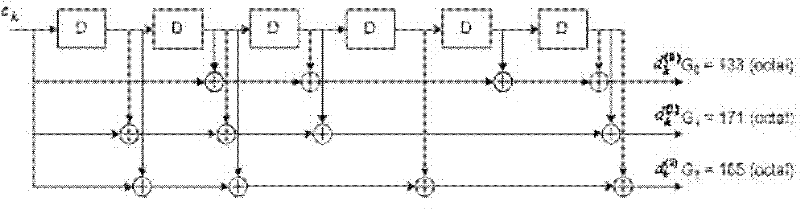
[0030] The first embodiment of the present invention relates to a tail-biting convolutional code decoding method. When the length of the data to be decoded is greater than a certain threshold, after the maximum number of iterations is reached, all terminal states are no longer traced, and only the one with the largest metric value is traced back. Then determine whether there is a tail-biting solution according to the initial state corresponding to the backtracking path. If there is a tail-biting solution, the decoding is successful. When the length of the decoded data is less than the above threshold, decode according to the existing method.

[0031] The inventors of the present invention have found that when the length of the data to be...

the structure of the environmentally friendly knitted fabric provided by the present invention; figure 2 Flow chart of the yarn wrapping machine for environmentally friendly knitted fabrics and storage devices; image 3 Is the parameter map of the yarn covering machine
Login to View More

PUM

No PUM Login to View More

Abstract

The invention discloses a tail-biting convolutional code decoding method and device. After the data length of a code to be decoded exceeds the constraint length of a decoder by about 4 to 5 times (wherein the constraint length is defined as tau), the backtracking preservation paths of all tail states are combined to one path with the probability being close to 1 before the length reaches tau, namely, the initial states of all the backtracked tail states equal to one another with the probability being close to 1. Therefore, when the data length of the code to be decoded is more than tau, the all tail states do not need to be backtracked when reaching maximum iterations, only the tail state with the largest metric needs to be backtracked, then the initial state corresponding to the backtracking path is directly utilized to define whether tail-biting solution exists or not, and if the tail-biting solution exists, the decoding is successful. Only when the data length of the code to be decoded is less than tau, the method is utilized for decoding. Therefore, the decoding complexity is reduced without influencing the decoding effect; and for the decoding data with longer length, time delay in the decoding is reduced, or hardware resources needed by the decoding are saved.

Description

technical field [0001] The invention relates to a decoding technology of convolutional codes, in particular to a decoding technology of tail-biting convolutional codes. Background technique [0002] The Long Term Evolution ("LTE" for short) project is an evolution of 3G, which started at the 3rd Generation Partnership Project (3rd Generation Partnership Project, "3GPP" for short) conference in Toronto in 2004. LTE is not the 4G technology that people generally misunderstand, but a transition between 3G and 4G technology. It is the global standard of 3.9G. It improves and enhances the air access technology of 3G. Division Multiplexing, referred to as "OFDM") and Multiple Input Multiple Output (Multiple Input Multiple Output, referred to as "MIMO") are the only standards for wireless network evolution. Under the 20MHz spectrum bandwidth, it can provide the peak rate of downlink 326Mbit / s and uplink 86Mbit / s. It improves the performance of cell edge users, increases cell capa...

Claims

the structure of the environmentally friendly knitted fabric provided by the present invention; figure 2 Flow chart of the yarn wrapping machine for environmentally friendly knitted fabrics and storage devices; image 3 Is the parameter map of the yarn covering machine
Login to View More

Application Information

Patent Timeline
no application Login to View More
IPC IPC(8): H03M13/23
Inventor 徐兵陈颖
Owner LEADCORE TECH