Extraction method and extraction device for direction of eye movement based on electro-oculogram signals

A technology of electrooculogram signal and extraction device, which is applied in the cross field of neuroengineering and informatics

CN103070682AActive Publication Date: 2013-05-01TSINGHUA UNIV
5 Cites 10 Cited by

Patent Information

Authority / Receiving Office
CN · China
Current Assignee / Owner
Publication Date
2013-05-01

Smart Images

  • Figure 1
    Figure 1
  • Figure 2
    Figure 2
  • Figure 3
    Figure 3
Patent Text Reader

Abstract

The invention provides an extraction method and an extraction device for the direction of eye movement based on electro-oculogram signals. The method sequentially comprises a training phase a and a testing phase b; the training phase a comprises the following steps of: (a1) arranging an electrode; (a2) beginning to collect electro-oculogram signals; (a3) pre-treating; (a4) carrying out smoothing treatment; (a5) extracting the characteristic vectors of the directions of eye movement; (a6) projecting the electro-oculogram signals in different directions to the characteristic vector in the same direction; (a7) carrying out differential treatment on a projecting result; and (a8) preserving the characteristic vectors; and the testing phase b comprises the following steps of: (b1) arranging an electrode; (b2) beginning to collect electro-oculogram signals; (b3) pre-treating; (b4) carrying out smoothing treatment; (b5) projecting the electro-oculogram signals to the characteristic vectors of the directions of the eye movement, which are obtained in the training phase a; (b6) carrying out differential treatment on a projecting result; and (b7) identifying the direction of the eye movement of a person to be tested in the testing phase b according to the positive-negative classification of the electro-oculogram signals corresponding to the maximum amplitude of a differential result .
Need to check novelty before this filing date? Find Prior Art

Description

technical field

[0001] The invention relates to the cross technical field of neural engineering and informatics, in particular to an eye movement direction extraction method and an extraction device based on electrooculogram signals. Background technique

[0002] Traditional computer systems use keyboards and mice as the main human-computer interaction devices, but these human-computer interaction devices cannot meet the needs of people with limb motor dysfunction. Scholars have conducted extensive research on the subject of barrier-free human-computer interaction, trying to design a human-computer interaction interface that does not depend on limb movement, and on this basis, design a set of human-computer interaction interfaces that are convenient for people with limb movement dysfunction. Barrier-free human-computer interaction system. Years of research have found that barrier-free human-computer interaction methods with relatively promising application prospects mainly ...

Examples

Embodiment Construction

[0067] The content of the invention of the present invention will be further described in detail below in conjunction with the accompanying drawings and embodiments.

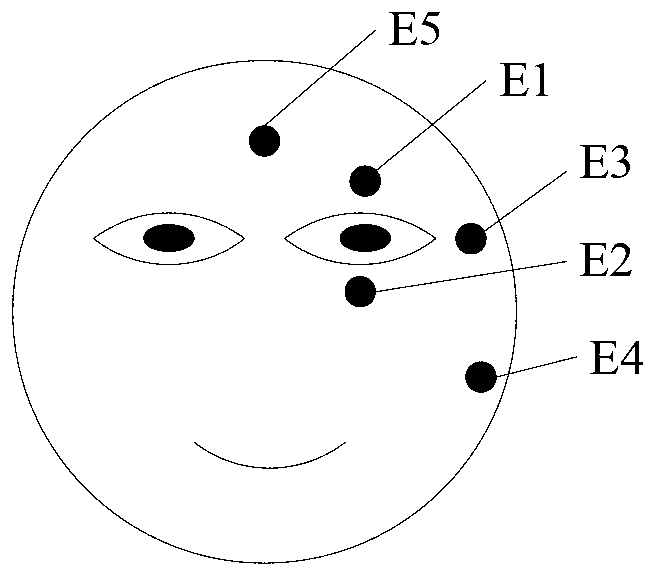
[0068] The eye movement direction extraction device based on the electrooculograph signal provided by this embodiment includes an acquisition module, an amplifier, an analog-to-digital conversion module, a processing module, a computer host and a display, such as figure 1 shown. The acquisition module is electrically connected with the amplifier, the analog-to-digital conversion module and the processing module in turn. The computer host is electrically connected to the display and the processing module respectively.

[0069] The acquisition module is used for collecting electrooculogram signals, and is used for recording the time of collecting electrooculogram signals. The amplifier is used to amplify the electro-oculogram signal from the acquisition module. The analog-to-digital conversion module is used fo...